

The $20,000 Mistake
a Home Inspection Can Prevent
The ultimate reality check to protect your investment from costly, hidden surprises.
Most buyers understand at least in theory that a home inspection is important. But understanding it in theory and feeling it in your gut are two different things. So before we get into what an inspection covers and why it matters, let me share two real stories from my experience that I think about every time a buyer considers skipping one.
✦ CAPTAIN’S LOG
The New Construction That Wasn’t As Perfect As It Looked
A client came through my office who had purchased a brand new construction home. She was thrilled — new build, modern finishes, everything shiny and untouched. And because it was new construction, she assumed an inspection wasn’t necessary. The builder had its own inspectors. The county had done its walk-throughs. What could possibly be wrong with a brand new home?
What nobody caught was that the roof panels were not properly connected. There was a six-inch gap running through the roof structure. The roofers had come in after and simply shingled right over it. From the outside, the roof looked perfect. From the inside, the problem was invisible — until it wasn’t.
When the issue was finally discovered, the repair cost her several thousand dollars on a home she had just bought brand new. Money she never should have had to spend. A thorough independent home inspection before closing would have caught that gap. The inspection would have cost a few hundred dollars. What followed cost significantly more — and that’s without getting into whether there should have been legal action against the builder.
✦ CAPTAIN’S LOG
The Attic Fire Nobody Saw Coming
I worked with a buyer on a home that showed well. Good neighborhood, solid price, nothing obviously wrong when you walked through it. We did the inspection — and the inspector found evidence of a fire in the attic that had been painted over. Someone had concealed it. Whether it was the seller, a previous owner, or a contractor, I can’t say for certain. But the damage was there, hidden under a fresh coat of paint.
That discovery changed everything about that transaction. Without the inspection, my buyer would have closed on a home with concealed fire damage in the attic — a safety issue, a potential structural concern, and a financial problem all at once. The inspection made it visible. And once it was visible, my buyer had options.
These two stories are not meant to alarm you. They are meant to make a straightforward point: problems exist in homes of all ages, in all conditions, at all price points — and some of them are not visible to the naked eye during a standard showing. An independent home inspection is the tool that brings them into the light before you close.
⚠ CAPTAIN’S WARNING
Never Skip the Inspection on New Construction
Builders make mistakes. County inspectors verify code compliance — they are not there to advocate for you. Only your independent inspector works exclusively in your interest. On a brand new home, that independent set of eyes is not a formality — it is the one thing standing between you and a defect nobody else was looking for.
What Does a Home Inspector Actually Do?
A licensed home inspector conducts a visual examination of the home’s accessible systems and components. They are not there to tell you whether to buy the home. They are there to give you an accurate, objective picture of the home’s condition so you can make an informed decision.
A standard home inspection in Virginia covers:
Roof — condition of shingles, flashing, gutters, fascia, and any visible structural issues
Foundation and structure — visible cracks, settling, signs of water intrusion or movement
Exterior — siding, windows, doors, grading and drainage
HVAC systems — heating and cooling equipment, ductwork, filters, age and condition
Plumbing — water heater, pipes, fixtures, water pressure, drainage
Electrical — panel, wiring, outlets, GFCI protection, visible safety issues
Attic — insulation, ventilation, visible roof structure from inside
Basement and crawl space — moisture, insulation, structural issues
Interior — walls, ceilings, floors, doors, windows, stairs
The inspection typically takes 2–4 hours depending on the size and age of the home. You should attend. Walking through with your inspector and asking questions gives you a far more complete understanding of the home than reading the written report alone.
The Big Ticket Items: What Can Really Cost You
Not every inspection finding carries the same weight. A sticky door is not the same as a failing HVAC system. A scuffed wall is not the same as a roof near the end of its useful life.
Here is a breakdown of the systems that matter most:
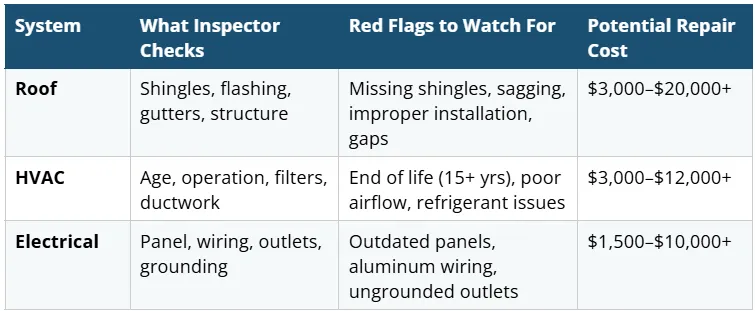
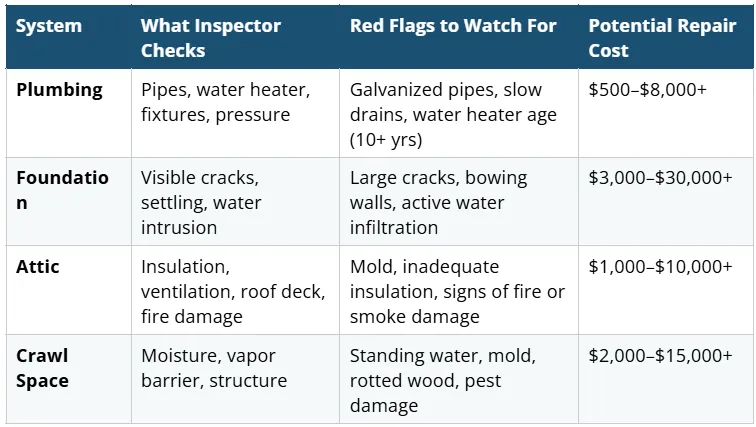
Note: Cost ranges are estimates and vary based on scope, severity, materials, and contractor. The point is not to alarm — it is to illustrate why knowing about issues before closing matters.
Termites, Moisture, and Wood Destroying Insects:
What Hampton Roads Buyers Need to Know
Hampton Roads has one of the more active termite environments on the East Coast. The combination of warm summers, high humidity, and older housing stock in many neighborhoods creates conditions where wood-destroying insects thrive — and where moisture damage quietly accumulates behind walls and under floors long before it becomes visible.
A standard home inspection does not include a termite or moisture inspection. That is a separate service, and in Hampton Roads, it is not optional.
The WDIR — Wood Destroying Insect Report
The formal name for what most people call a “termite inspection” is a Wood Destroying Insect Report, or WDIR. A licensed pest control professional conducts a visual inspection of the home’s accessible areas — foundation, crawl space, garage, and visible wood framing — and produces a report documenting any evidence of:
Active termite infestation
Previous termite damage
Other wood-destroying insects (carpenter ants, wood-boring beetles)
Conditions conducive to infestation (wood-to-soil contact, moisture accumulation)
The formal name for what most people call a “termite inspection” is a Wood Destroying Insect Report, or WDIR. A licensed pest control professional conducts a visual inspection of the home’s accessible areas — foundation, crawl space, garage, and visible wood framing — and produces a report documenting any evidence of:
The Moisture Piece
Termite inspectors in Virginia also look for moisture readings in wood framing and crawl spaces, because moisture and termites often go together — moisture-damaged wood is exactly what termites target. A crawl space with elevated moisture levels is both a termite risk and a structural risk in its own right.
If the WDIR or your general inspector flags elevated moisture readings, take it seriously. Crawl space moisture issues in Hampton Roads are common and correctable — but they need to be addressed, not ignored. Solutions range from improved ventilation and vapor barriers to full encapsulation, depending on severity. Costs vary widely, which is exactly why you want to know before you close.
One important distinction: a WDIR documents what the inspector observed visually. It is not a guarantee that no termites are present — it is a report of visible evidence at the time of inspection. If the report shows prior damage that has been treated, ask for documentation of the treatment and any warranties that transferred with the home.
In a Hampton Roads purchase, budget for the WDIR as a routine line item — not an optional add-on.
Home Warranties: Your Safety Net After Closing
An inspection tells you the condition of the home on the day you buy it. But what about three months later, when the air conditioner quits in the middle of a Hampton Roads July, or the water heater gives out, or the dishwasher floods the kitchen? That’s where a home warranty comes in.
A home warranty is a service contract separate from homeowner’s insurance that helps cover the repair or replacement of major systems and appliances when they break down from normal use. Insurance covers sudden disasters like fire or storm damage. A warranty covers the everyday breakdowns that come with owning a home: the things that simply wear out. When something covered fails, you pay a small service-call fee often $75 to $125 and the company sends a technician to repair or replace it. Let me show you what that looks like in real life.
✦ CAPTAIN’S LOG
The Year the AC Saved Us
When my family bought our home, we had three kids under the age of six. If you’ve been there, you know that is a particular kind of busy and a particular kind of broke. Money was tight, sleep was tighter, and there was zero room in the budget for a surprise. Not long after we moved in, the washer and dryer went out — not the end of the world, but not cheap with that many little ones in the house. And then the big one: the air conditioning failed.
If you’ve lived through a Hampton Roads summer, you know a dead AC isn’t an inconvenience — it’s an emergency. Now picture it with three kids under six in the house. Replacing that system out of pocket would have cost thousands of dollars we simply did not have, and it would have been a genuine disaster for us at that stage of our lives.
But we had a home warranty. And it took care of all of it — the washer, the dryer, and the AC — without us coming out of pocket for the major repairs. It wasn’t just money saved. It was a crisis avoided, for a young family that couldn’t have absorbed the hit. That’s the moment I understood, personally, what a home warranty is really for.
Here’s the lesson: not all home warranties are the same
Here’s something I didn’t fully appreciate until I got into real estate — home warranties vary enormously from one plan to the next. My plan happened to cover appliances, and that’s exactly why the washer and dryer were taken care of along with the AC. But not every home warranty covers appliances at all. Some are systems-only plans, meaning they’ll handle your HVAC and plumbing but leave you on your own when the refrigerator or dryer quits.
That difference is not a small detail. Two buyers can each say “I have a home warranty” and be holding two completely different levels of protection. What’s covered, what’s excluded, how much the company will pay per item — all of it changes from plan to plan. The single most important thing you can do is read what a plan actually covers before you sign, not after something breaks.
❖ FROM THE FIELD
The Sinking Foundation
A client in our office bought a home from a private developer. For whatever reason — and we may never know exactly what was or wasn’t done during construction — the foundation began to sink after they moved in. A sinking foundation is one of the most serious and expensive problems a home can have.
Here’s what made the difference: their warranty included a special provision — coverage that a lot of other home warranties simply do not carry. Most standard plans exclude foundation and structural issues entirely. Theirs didn’t, and that one provision is what helped them through a situation that would have financially flattened most buyers. It didn’t cover every dollar, but it kept a catastrophe from becoming a total loss.
That’s the same lesson from a different angle. The reason their warranty saved them is the same reason mine saved me — we each happened to have a plan that covered the thing that broke. Plenty of other plans wouldn’t have. A home warranty is one of the most practical protections a buyer can have, but its value lives entirely in the details of the specific plan you choose.
There’s genuinely a lot to explore here — which providers cover appliances, which offer structural provisions, how claims actually get paid, and where buyers most often get burned. I’ve put all of it into a full bonus training on home warranties. If this is on your mind, that’s the next thing to read.
⚓ CAPTAIN’S COURSE CORRECTION
The Myth of the Perfect Build
As the new construction story above illustrates, new construction homes can and do have defects. Multiple subcontractors work on a new home at different stages, often under time pressure, and mistakes get covered by subsequent work. By the time the house is finished, painted, and carpeted, some problems are impossible to see.
County inspectors who sign off on new construction are verifying code compliance — not conducting the buyer-focused examination an independent inspector provides. If you are buying new construction:
Get an independent inspection before closing — no exceptions
Consider a pre-drywall inspection if buying during construction — this is your one opportunity to see the framing, plumbing, and electrical before it is all covered up
Review the builder’s warranty carefully and understand exactly what it covers and for how long
Negotiating After the Inspection
Once you receive the inspection report, you have options. You are not obligated to accept the home as-is just because your offer was accepted. During the inspection contingency period in Virginia, you can:
Request repairs — ask the seller to fix specific items before closing, most appropriate for safety issues or major system defects
Request a credit — a dollar amount at closing you apply toward repairs yourself, giving you control over how and when work is done
Negotiate a price reduction — adjust the contract price to reflect the cost of necessary repairs
Accept as-is — if issues are minor, already priced in, or market conditions give you little leverage
Terminate the contract — if issues are serious enough, you can walk away within the contingency period and recover your earnest money deposit
What is worth negotiating depends on the severity of the issue, the purchase price, and the market conditions. One practical note: use the inspection to address genuine defects, not as an opportunity to renegotiate over cosmetic items. Submitting a long list of minor complaints after a seller has accepted your offer is a reliable way to damage goodwill — and sometimes the deal itself.
The PICRA: The Document That Makes Inspection Negotiations Official
When buyers in Virginia decide to request repairs or a credit after an inspection, there is a specific contract addendum used to make that request official — the Purchase Price Increase/Credit Request Addendum, commonly called the PICRA.
The PICRA is a written document submitted to the seller that formalizes exactly what you are asking for. It can request:
Specific repairs to be completed by a licensed contractor prior to closing
A seller credit at closing — a dollar amount applied toward your closing costs or repair costs
A combination of both
The PICRA has a response deadline. The seller can accept, reject, or counter your request and you have a set window to respond to their counter. If no agreement is reached within the contingency period, the buyer has the right to terminate the contract and recover their earnest money deposit.
A few things buyers often don’t know about the PICRA:
It is not the place for a wish list. Submitting a long list of cosmetic complaints alongside legitimate repair requests dilutes your position and signals to the seller that you are not negotiating in good faith. Focus on material defects — safety issues, failing systems, structural concerns.
Credits are often preferable to repairs. When you request a credit instead of a repair, you control the quality of the work and the timing. A seller-arranged repair before closing may be done quickly and cheaply. A credit puts the money in your hands.
The PICRA is time-sensitive. Virginia contracts have defined contingency windows, and the PICRA must be submitted and resolved within that window. Missing the deadline can affect your rights under the contract.
Your agent should walk you through the PICRA process before you ever receive an inspection report — so that when the report comes in, you already know how the tool works and how to use it strategically.
Choosing a Good Inspector
In Virginia, home inspectors are required to be licensed. Beyond licensing, look for experience, quality of written reports with photos, willingness to access attics and crawl spaces, and clear communication. Your agent should be able to refer you to inspectors they trust. And regardless of who you choose — attend the inspection in person.
The Bottom Line
A home inspection costs between $300 and $600 for most homes in Hampton Roads. For that investment you get an objective picture of exactly what you are buying. Skipping it to save a few hundred dollars or to make your offer look more competitive is rarely worth the risk.
Get the inspection. Show up for it. Ask questions. And let the findings inform your next move.
If you’d like help creating a personalized home buying plan for Hampton Roads, book a free consultation at coastalva.chat
About the Author: Marc Ian Griffin Sr., aka Captain Real Estate, is a licensed REALTOR and Wealth Advisor with Coastal VA Estates LLC, powered by Keller Williams Town Center. A retired U.S. Navy veteran, Marc has called the Hampton Roads area home since 1992. He entered real estate in 2006 because he saw what was happening to everyday families who were losing thousands and, in many cases, losing their homes simply because they didn’t have the right person guiding them through the potential real estate pitfalls — and he was determined to be that person. After a period away from the industry, he returned in 2025 with that same mission. Marc serves buyers and sellers across Virginia Beach, Norfolk, Chesapeake, Portsmouth, Suffolk, Hampton, and Newport News.

Expertise
Deep market knowledge.

Integrity
Honesty and transparency.

Excellence
Top-notch services.
Expertise
Deep market knowledge.
Integrity
Honesty and transparency.
Excellence
Top-notch services.
Coastal VA Estates LLC
Powered by Keller Williams Town Center
1 Columbus Center #301 Virginia Beach, VA 23462
Email: [email protected]
Phone: 757-774-7557
QUICK LINKS
FOLLOW US


© 2026 Coastal VA Estates LLC. All rights reserved. Marc Ian Griffin is a licensed REALTOR® in the Commonwealth of Virginia, powered by Keller Williams Town Center. Equal Housing Opportunity.