

BUYER EDUCATION SERIES | BONUS TRAINING
Home Warranties: The Buyer’s Complete Guide to
Protecting Yourself After Closing
Zero stress, maximum protection
You did everything right. You got the inspection. You handled the repairs. You closed on the home. And then, a few months in, the air conditioning quits on the hottest day of the year — or the water heater floods the garage, or the oven dies the week before the holidays.
This is the part of homeownership nobody warns first-time buyers about: the day-to-day systems and appliances you depend on will eventually wear out, and when they do, the bill lands entirely on you. A home warranty is one of the most practical tools for managing that risk — but only if you understand exactly what it is, what it does, and where its limits are.
This training is the deep dive. By the end, you’ll know how home warranties work, what they cover and don’t, how to read a contract before you sign it, how claims actually play out, and how to decide whether one is right for you.
First, the Most Important Distinction
⚓ CAPTAIN’S COURSE CORRECTION
A Home Warranty Is Not Home Insurance
This is the single most common misunderstanding buyers have, so let’s clear it up before anything else. Home insurance and a home warranty are two completely different products that solve two completely different problems.
Homeowner’s insurance covers sudden, accidental loss — fire, storm damage, theft, certain water damage, liability if someone is hurt on your property. It is required by your lender, and it protects the structure and your belongings against disasters.
A home warranty covers the breakdown of systems and appliances from normal use and age — the AC that finally gives out, the dishwasher that stops draining, the water heater that fails. It is optional, and it protects your budget against the ordinary wear-and-tear of owning a home.
Simple rule of thumb: insurance is for the disaster you hope never happens. A warranty is for the breakdown you know eventually will. You generally want both — they do not overlap.
What a Home Warranty Actually Covers
Coverage depends entirely on the plan you choose, and this is where reading the contract matters. Most companies sell tiered plans: a systems plan, an appliance plan, or a combined plan that covers both. Higher tiers and add-ons expand what’s included. Here’s the general landscape:
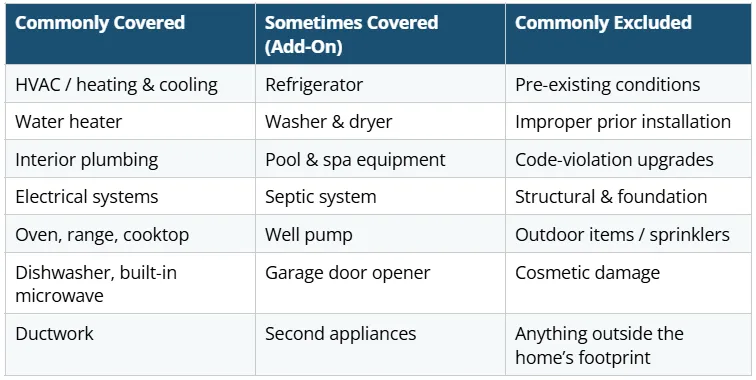
The key takeaway from that table is the third column. What a warranty excludes is just as important as what it covers — and exclusions are where most buyer disappointment comes from. We’ll come back to this.
Big point: appliance coverage is not universal
Here’s a distinction that surprises a lot of buyers — it surprised me before I got into real estate. Not every home warranty covers appliances. Plenty of plans are systems-only, meaning they’ll handle your HVAC, plumbing, and electrical, but if the refrigerator or the dryer quits, you’re on your own. My own plan happened to cover appliances, which is exactly why my washer and dryer were taken care of right alongside the AC. A different plan might have left me to replace those out of pocket.
So when you compare plans, don’t assume “home warranty” means the same thing from one company to the next. One buyer’s plan covers the kitchen and laundry; another buyer’s plan doesn’t touch them. Confirm in writing whether appliances are included, which appliances, and whether they’re part of the base plan or a paid add-on.
Add-Ons, Riders, and Special Provisions
Most providers let you expand a base plan with optional coverage, and this is where you tailor a warranty to the specific home you’re buying.
Common add-ons include:
Refrigerator, washer, and dryer (when not already in the base plan)
Pool and spa equipment
Septic system and well pump
Second refrigerators, ice makers, and additional appliances
Roof-leak coverage (limited, on some plans)
Beyond standard add-ons, some providers offer special provisions for items that the typical plan flatly excludes. This matters more than almost anything else in the fine print, because the items that are normally excluded — like structural and foundation issues — are exactly the ones that can financially flatten a buyer. A plan that carries a special provision for one of those excluded categories is rare, and it can be the difference between a manageable problem and a catastrophe, as you’ll see in the story below.
Two plans at the same price can offer wildly different protection. The add-ons and special provisions you select — not the brand name on the contract — determine what you’re actually covered for. Build the plan around your home, not around the cheapest premium.
How Much Does a Home Warranty Cost?
There are two numbers to understand, and buyers often only think about the first one:
The annual premium — what you pay for the plan itself, commonly a few hundred dollars a year, paid monthly or annually. Basic plans cost less; comprehensive plans with add-ons cost more.
The service-call fee — a flat fee you pay each time you file a claim and a technician comes out, typically in the $75 to $125 range. You pay this whether the item is repaired, replaced, or ultimately denied.
So the real question isn’t just “how much is the plan,” it’s “what’s my total exposure?” A plan that’s cheap up front but has a high service-call fee and a long exclusions list may cost you more in practice than a slightly pricier plan with better terms.
✦ CAPTAIN’S LOG
The Year the AC Saved Us
When my family bought our first home, we were young and money was tight — like it is for a lot of first-time buyers. Not long after we moved in, the washer and dryer went out. Then the air conditioning failed. If you’ve been through a Hampton Roads summer, you know a dead AC isn’t an inconvenience, it’s an emergency.
Replacing that system out of pocket would have been thousands of dollars we did not have. But we had a home warranty, and it covered all of it — the washer, the dryer, and the AC — without us coming out of pocket for the major repairs. For a young family, that wasn’t just convenient. It was the difference between a manageable month and a financial crisis. That experience is exactly why I make sure my buyers understand this option.
How a Home Warranty Claim Actually Works
Understanding the process before you need it is half the battle. Here’s the typical sequence:
Something breaks. You call the warranty company or file online — not your own repair person. Using an unauthorized technician first can void the claim.
They assign a contractor. The warranty company sends a technician from their approved network to diagnose the problem.
You pay the service-call fee. This is due at the visit, regardless of the outcome.
They make a coverage decision. The contractor reports back, and the company decides whether the failure is covered under your contract.
Repair or replace. If approved, they repair the item or replace it. Note that the company — not you — usually decides which, and replacements are often with a comparable builder-grade model, not an upgrade.
⚠ CAPTAIN’S WARNING
File the Claim Before You Call a Repair Tech
This trips up more homeowners than almost anything else. If your AC dies and you call your own HVAC company to fix it, then try to get reimbursed, the warranty company can deny the claim outright — because you didn’t follow their process. When something breaks, your first call is to the warranty company. Always. Build that habit the day your coverage starts.
The Fine Print: Where Buyers Get Burned
Home warranties are valuable, but they are contracts written by the company — and the details decide whether a claim is paid. Read these sections carefully before you buy:
Pre-existing conditions. Failures that existed before coverage began are typically excluded. This is why a good inspection matters — it documents the condition of systems at purchase.
Improper installation or prior repairs. If a previous owner installed something incorrectly or made a bad repair, the resulting failure may be denied.
Lack of maintenance. Companies can deny claims they attribute to neglect. Keep records of routine maintenance — HVAC servicing especially.
Coverage caps. Many plans cap what they’ll pay per item or per year. A high-dollar system failure may only be partially covered.
“Comparable” replacements. You may not get the same brand or efficiency level you had. Understand this going in.
Structural and foundation exclusions. Most standard warranties do not cover the home’s structure or foundation — which leads to the next story.
❖ FROM THE FIELD
The Sinking Foundation
A client in our office bought a home from a private developer. After they moved in, the foundation began to sink — one of the most serious and costly problems a home can have. We may never know exactly what was or wasn’t done during construction.
Here’s what made the difference: their warranty carried a special provision — coverage for something that most home warranties flatly exclude. Standard plans don’t touch foundation or structural problems. Theirs did, and that one provision is what carried them through a situation that would have financially flattened most buyers. It didn’t cover every dollar, but it kept a catastrophe from becoming a total loss. The lesson isn’t “warranties don’t work.” The lesson is that the specific provisions in your specific plan are everything — and most buyers never know to look for the one that ends up saving them.
Builder Warranties vs. Third-Party Warranties
Not all warranties are the same kind of protection. New-construction buyers in particular should understand the difference:
Builder’s warranty (new construction). When you buy new, the builder typically provides a limited warranty — often one year on workmanship, two years on systems, and up to ten years on major structural defects. This is separate from a service-contract home warranty, and the coverage and claims process are defined by the builder.
Third-party home warranty (any home). This is the service contract this guide focuses on — purchased from a warranty company, renewable yearly, covering systems and appliances against normal-use breakdowns on homes of any age.
New construction buyers: do not assume the builder’s warranty makes a third-party warranty pointless. They cover different things, for different lengths of time, with different claim processes. Know the boundaries of each.
Who Pays for It — and When to Get One
A home warranty can enter the picture at several points:
Seller-paid at closing. Sellers often offer to cover the first year as an incentive — sometimes it’s negotiated into the contract. This is a common and buyer-friendly arrangement.
Buyer-purchased at closing. You can add a plan as you close so coverage starts the day you take ownership.
Purchased anytime after. You can buy or switch plans at any point as a homeowner, though there’s often a short waiting period before coverage activates.
If you’re buying an older home, or a home with original systems and appliances nearing the end of their service life, a warranty tends to make the most sense — that’s where breakdowns are most likely. On a nearly new home with everything under builder warranty, the value is lower in the early years.
How to Choose a Home Warranty Company
Not all providers are equal. Before you commit, work through this checklist:
Read actual customer reviews — focus on how claims and denials are handled, not marketing.
Confirm the specific systems and appliances you care about are covered, in writing.
Compare service-call fees and annual caps across two or three providers.
Ask how they handle replacements — comparable model, cash payout option, or upgrade allowance.
Check the contractor network in Hampton Roads — a plan is only as good as the local techs behind it.
Understand the cancellation terms and any waiting period before coverage begins.
Ask me for current provider recommendations. I work in this market every day and can point you toward companies my clients have had real success with — and steer you away from the ones that fight every claim.
So — Is a Home Warranty Worth It?
Here’s the honest answer: it depends on the home, the age of its systems, and your own tolerance for financial surprise. A home warranty is not a guarantee that nothing will ever cost you money. It is a tool that converts unpredictable, occasionally devastating repair bills into a predictable annual cost plus a small service fee.
For a young family, a buyer with limited reserves, or anyone buying a home with aging systems, that trade can be enormously valuable — as it was for mine. For a buyer with a healthy emergency fund and a nearly new home, it may be less essential. The right answer is the one that fits your situation, made with eyes open to exactly what the contract does and doesn’t do.
That’s the whole point of this training: not to sell you on a warranty, but to make sure that if you get one, you get the right one — and you know how to use it.
If you have questions about home warranties or anything else in your Hampton Roads home purchase, book a free consultation at coastalva.chat
— there’s no obligation, just answers.
About the Author: Marc Ian Griffin, aka Captain Real Estate, is a licensed REALTOR and Wealth Advisor with Coastal VA Estates LLC, powered by Keller Williams Town Center. A retired U.S. Navy veteran, Marc has called the Hampton Roads area home since 1992. He entered real estate in 2006 because he saw what was happening to everyday families who were losing thousands and, in many cases, losing their homes simply because they didn't have the right person guiding them through the potential real estate pitfalls — and he was determined to be that person. After a period away from the industry, he returned in 2025 with that same mission. Marc serves buyers and sellers across Virginia Beach, Norfolk, Chesapeake, Portsmouth, Suffolk, Hampton, and Newport News.

Expertise
Deep market knowledge.

Integrity
Honesty and transparency.

Excellence
Top-notch services.
Expertise
Deep market knowledge.
Integrity
Honesty and transparency.
Excellence
Top-notch services.
Coastal VA Estates LLC
Powered by Keller Williams Town Center
1 Columbus Center #301 Virginia Beach, VA 23462
Email: [email protected]
Phone: 757-774-7557
QUICK LINKS
FOLLOW US


© 2026 Coastal VA Estates LLC. All rights reserved. Marc Ian Griffin is a licensed REALTOR® in the Commonwealth of Virginia, powered by Keller Williams Town Center. Equal Housing Opportunity.