

How to Make an Offer
Sellers Take Seriously
Pro strategies to gain the ultimate competitive edge and unlock your next front door.
Making an offer on a home feels like a big moment - and it is. But it's also a negotiation. And like any negotiation, the outcome depends less on luck and more on reading the situation correctly and responding with a strategy that fits.
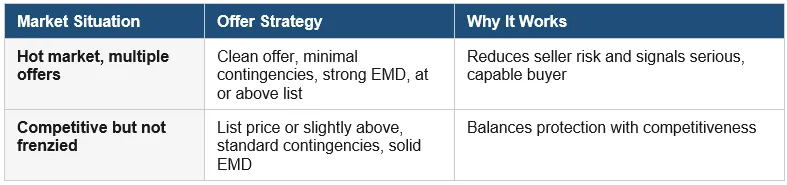
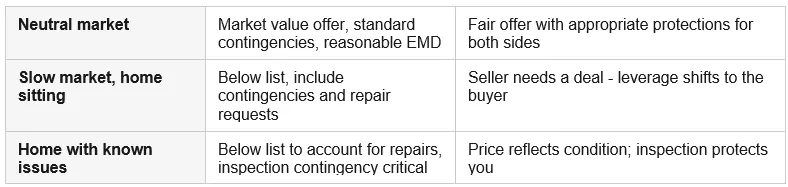
There is no universal formula for a winning offer. The right offer on a home that's been on the market for 90 days looks completely different from the right offer on a home that just hit the market this morning. The right offer in a competitive multiple-bid situation is not the same as the right offer when you're the only buyer at the table.
⚓ CAPTAIN’S COURSE CORRECTION
What Sellers Actually Care About
What's Actually in an Offer
A purchase offer is a legally binding contract that, once signed by both parties, kicks off a series of deadlines and obligations. Understanding what's in it helps you make better decisions about every element.
Purchase price - the amount you're offering to pay for the home
Earnest money deposit (EMD) - your good-faith deposit, typically submitted within 2 business days of ratification in Virginia
Financing contingency - confirms your offer is contingent on obtaining a mortgage loan
Inspection contingency - your right to inspect the property and negotiate repairs or terminate
Appraisal contingency - protects you if the home appraises below the purchase price
Closing date - the proposed settlement date
Possession date - when you actually get the keys (usually same as closing, but not always)
Personal property - what conveys with the home (appliances, fixtures, etc.)
Seller concessions (if requested) - contribution from the seller toward your closing costs
Home sale contingency (if applicable) - if your offer depends on selling your current home first
Each of these elements is a lever. Adjusting any one of them can make your offer more or less attractive to a seller depending on what that seller's priorities are.
What Sellers Actually Care About
Most buyers assume sellers care only about price. In reality, sellers care about three things: price, certainty, and timing.
Price:
Yes, price matters. But the highest price doesn't always win - especially if the seller has reason to doubt whether that buyer can actually close. A slightly lower offer from a well-qualified buyer with strong financing can beat a higher offer from a buyer whose deal looks shaky.
Certainty:
Sellers want to know the deal will close. Fewer contingencies, a strong pre-approval letter, a substantial earnest money deposit, and a clean offer with no unnecessary complications all signal to a seller that you're a serious buyer who can perform. Every contingency is a potential exit ramp - and sellers see them that way. Here is something most buyers never think about: the lender matters too. Experienced listing agents know which lenders are responsive, reliable, and easy to work with - and which ones are not. Some lenders are not available on weekends or after hours. In a real estate transaction, things can move fast and problems can surface at any time. If your loan officer is unreachable on a Saturday when an issue needs to be resolved, that creates real risk for the seller. Some sellers - especially in multiple-offer situations - will choose a lower offer backed by a lender they trust over a higher offer backed by one they've had problems with. Your agent should know the lending landscape in this market and be able to advise you on whether your lender choice could affect how your offer is received.
Timing:
Sometimes a seller has a very specific timeline - they need to close by a certain date, or they need to stay in the home for a few weeks after closing. An offer that accommodates their timing can be more attractive than a higher offer that doesn't. Knowing the seller's situation - and your agent should be working to find this out - can give you a significant edge.
Here's why strategy matters more than formula. Two of my clients, two very different situations, two very different approaches - and both got the home they wanted.
✦ CAPTAIN’S LOG
The Sight-Unseen Offer That Had to Win
Early in my real estate career, I worked with an Air Force client who was being stationed in the Hampton Roads area. She was a single mom who had done her research and locked onto a neighborhood in Williamsburg - great schools, low crime, exactly what she needed for her family. The problem was she couldn't be there in person. This was well before FaceTime and the virtual tour technology we have today, so I did it the old-fashioned way: I went to the house and took photographs and video of everything I could document and got them to her.
The home had been on the market for one day. She loved what she saw. She knew the neighborhood was right. She didn't want to risk losing it. So the offer was full price, clean, no games. We weren't going to try to negotiate on a home that just listed and that she knew was exactly what she was looking for. She got the home. She was thrilled. And the decision to come in strong on day one was exactly right for that situation.
✦ CAPTAIN’S LOG
When the Leverage Was Ours
A young family came to me looking for a starter home in Virginia Beach. They were just getting started - first home, young kids, budget-conscious. We found a home that was right for them, but it had been on the market for a while. That tells you something. When a home sits, it usually means one of a few things: the price is off, something about the home is turning buyers away, or the seller has been holding out for a number the market isn't supporting.
We went in below list price - somewhere in the range of five to ten thousand under, if I recall correctly - and we asked for some contingencies and some repairs. We knew the seller was in a position where any serious offer was going to be welcome. We were right. They accepted. The family got their home at a price that worked for their budget, with some of the repairs they needed addressed. That outcome was only possible because we understood the market position of that listing and structured the offer accordingly.
The lesson from both stories is the same: the offer that wins is the one that fits the situation. Your agent's job is to help you read that situation accurately and respond with a strategy that gives you the best possible outcome.
Offer Price Strategy
How do you decide what to offer? Start with data, not emotion.
Look at comparable sales - what have similar homes in that neighborhood sold for in the last 90 days? That's the most reliable indicator of market value.
Look at days on market - a home that listed yesterday in a desirable area and already has showings scheduled is a different conversation than a home that's been sitting for 60 days.
Look at price history - has the listing price been reduced? How many times? A home with repeated reductions signals seller motivation and potential negotiating room.
Consider the condition - a home that needs work may justify coming in below list. A turnkey home in a hot neighborhood may justify list price or above.
Your agent should walk you through a Comparative Market Analysis (CMA) before you make any offer. This is the data-driven foundation of your pricing strategy.
Contingencies: Protection vs. Competitiveness
Contingencies protect you - but they also give sellers pause. Every contingency is a condition that must be met for the sale to proceed, which means it's a potential way out of the deal. In a competitive market, sellers prefer fewer contingencies. In a slower market, you have more room to ask for them.
Earnest Money: Signaling Seriousness
We covered earnest money deposits in detail in Blog 4, but it's worth revisiting in the context of offer strategy. Your EMD is visible to the seller. It signals how serious you are.
In a competitive situation, a stronger EMD can differentiate your offer when the price and terms are similar to other buyers. In a relaxed market, a standard 1% deposit is usually fine. But in a multiple-offer situation on a home you really want, consider whether a larger deposit could tip the decision in your favor.
Remember: the EMD is not lost if you exit the contract during the contingency periods. It's only at risk if you breach the contract outside those protections. Your agent will explain exactly when your deposit is protected and when it isn't.
Escalation Clauses: When You're in a Bidding War
An escalation clause is a provision in your offer that says: 'I'm offering X, but if there are higher competing offers, I'll automatically beat the highest offer by Y dollars, up to a maximum of Z.'
For example: 'I offer $350,000, and I will beat any bona fide competing offer by $2,500, up to a maximum of $375,000.'
Escalation clauses can be effective in competitive situations, but they come with trade-offs:
• They reveal your ceiling to the seller - once you include an escalation clause, the seller knows your maximum
• Some sellers and agents prefer a clean highest-and-best offer and won't engage with escalation clauses
• They work best when you genuinely want the home, have a clear budget ceiling, and are in a verified multiple-offer situation
Your agent will advise you on whether an escalation clause is appropriate for a specific situation. It's a tool - not a default strategy.
Negotiation After Acceptance
Getting your offer accepted is not the end of the negotiation. The inspection period opens another round of discussions. If the inspector finds issues, you can:
• Request repairs - ask the seller to fix specific items before closing
• Request a credit - ask the seller to give you a dollar amount at closing that you apply toward repairs yourself
• Negotiate a price reduction - adjust the purchase price to reflect the condition
• Walk away - if the issues are serious enough and you're within your inspection contingency period, you can terminate and recover your deposit
The right response depends on the severity of the issues, the seller's motivation, and your own priorities. A good agent will help you figure out what's worth pushing for and what's better to let go.
When Something Feels Wrong - Walk Away
One of the most important things a good agent can do for you has nothing to do with finding the right home or writing a strong offer. It is telling you when a deal is wrong and you need to walk away. Not every accepted offer should become a closing. Sometimes the most valuable advice an agent gives is - this one is not right. Listen to that.
✦ CAPTAIN’S LOG
A Story I’ll Never Forget
One of my earlier deals, back in 2009, involved a family in Norfolk - I am not going to use their names out of respect for their privacy - husband, wife, and a small child. I had been working with them for over a year. We finally found a home in Norfolk that was nearly finished being built. The offer was accepted. Then the delays started. The closing kept getting pushed back, week after week, with no clear explanation. The seller could not obtain a certificate of occupancy from the City of Norfolk.
I kept telling my clients something was wrong. I could not prove it, but everything about this deal felt off. I advised them to walk away. They did not want to. What we did not know at the time was that the person selling the property was not who he claimed to be. He had purchased the home from a legitimate contractor who wanted out of the market, then forged the contractor's documents to make himself appear to be a licensed general contractor. The certificate of occupancy delays were because his paperwork was fraudulent and the City of Norfolk would not approve it.
What I did not know at the time - and did not find out until much later - was that the seller had completely circumvented me and gone directly to my clients. He contacted them without my knowledge and told them he just needed $3,000 more to fix the water and pass the final inspection. They gave it to him without calling me first. And I understand the impulse - they were excited, they wanted the house, and this guy was convincing. But that is exactly why the agent is there. What this seller did is no different from a prosecuting attorney trying to negotiate directly with the defendant instead of going through their counsel. You do not do that. There are rules and processes in place for a reason, and the reason is to protect the buyer. I had worked with this family for over a year - helping them with their credit, looking at properties together, building a real relationship. They trusted me. The wife honored that trust and wanted to follow my advice to walk away. the husband trusted me too - but his pride got in the way. This man had already taken $3,000 from him, and the husband was not going to let him win. He was determined to make the deal work no matter what. So instead of walking away and cutting his losses at $3,000, he pushed forward. And the cost to his family ended up being far greater than three thousand dollars. He took it and the delays continued. The family eventually ran out of time on their apartment lease and had nowhere to go. The seller told them they could move in - into a home with no certificate of occupancy, no electricity, and no heat. In November. With a small child.
The situation unraveled from there. The deal never closed. The family lost the $3,000. The marriage did not survive the ordeal. It broke my heart - I had worked with this family for over a year and genuinely cared about them. And the painful truth is that every step of the way, I was telling them something was wrong. They both trusted me. But the husband let his pride override his judgment - he refused to walk away from a bad deal because he did not want the swindler to win. Instead of losing $3,000, he lost far more. I tell this story not to assign blame but because it illustrates something important: trust your agent, follow the process, and never let pride or emotion drive a financial decision of this magnitude.
The lesson is not complicated: when your agent tells you something is wrong with a deal, take it seriously. A good agent is not trying to kill your excitement. They are trying to protect you. And never - under any circumstances - hand money directly to a seller, a contractor, or anyone outside the proper escrow and title process. All funds should go through your title company. That is what it is there for.
The Bottom Line
A winning offer isn't always the highest one. It's the one that best matches what the seller needs - in price, certainty, and timing - while protecting your interests as a buyer. Reading the situation correctly, structuring your offer thoughtfully, and negotiating strategically after acceptance is how you get the home you want at terms you can live with.
When you're ready to start making offers in the Hampton Roads market, let's talk strategy. Book a free consultation and we'll look at exactly what it takes to compete effectively in the cities and neighborhoods you're targeting.
If you'd like help creating a personalized home buying plan for Hampton Roads, book a free consultation at coastalva.chat
About the Author: Marc Ian Griffin, aka Captain Real Estate, is a licensed REALTOR and Wealth Advisor with Coastal VA Estates LLC, powered by Keller Williams Town Center. A retired U.S. Navy veteran, Marc has called the Hampton Roads area home since 1992. He entered real estate in 2006 because he saw what was happening to everyday families who were losing thousands and, in many cases, losing their homes simply because they didn't have the right person guiding them through the potential real estate pitfalls - and he was determined to be that person. After a period away from the industry, he returned in 2025 with that same mission. Marc serves buyers and sellers across Virginia Beach, Norfolk, Chesapeake, Portsmouth, Suffolk, Hampton, and Newport News.

Expertise
Deep market knowledge.

Integrity
Honesty and transparency.

Excellence
Top-notch services.
Expertise
Deep market knowledge.
Integrity
Honesty and transparency.
Excellence
Top-notch services.
Coastal VA Estates LLC
Powered by Keller Williams Town Center
1 Columbus Center #301 Virginia Beach, VA 23462
Email: [email protected]
Phone: 757-774-7557
QUICK LINKS
FOLLOW US


© 2026 Coastal VA Estates LLC. All rights reserved. Marc Ian Griffin is a licensed REALTOR® in the Commonwealth of Virginia, powered by Keller Williams Town Center. Equal Housing Opportunity.