

SELLER EDUCATION SERIES | BONUS TRAINING
After the Inspection
Understanding the PICRA and Protecting Your Net Proceeds
The home inspection report just landed. It's several pages long, it has photos, and it lists everything the inspector found — from the minor to the potentially significant. And now the buyer's agent has submitted a PICRA: the Post-Inspection Contingency Removal Addendum.
This is the moment most sellers are least prepared for. Not because the inspection found something shocking — most inspection reports do — but because now there's a negotiation to navigate, a deadline to meet, and real money on the line depending on how you respond.
This Bonus Training is the deep dive we promised in Blogs 6 and 7. By the time you finish it, you'll understand exactly what the PICRA is, how the REIN contract repair cap works in practice, what your response options are in every scenario, and how to protect your net proceeds through one of the most consequential negotiations in the entire transaction.
What the PICRA Actually Is
PICRA stands for Post-Inspection Contingency Removal Addendum. It is the formal document a buyer submits after the home inspection to communicate what they are requesting as a condition of moving forward with the purchase.
The PICRA is not a demand letter. It is a negotiating document. The buyer is not entitled to every item they request — and you, as the seller, are not obligated to agree to everything. What you are obligated to do is respond within the timeframe specified in the contract.
A PICRA typically requests one or more of the following:
Repairs: The buyer wants specific items fixed by a licensed contractor before closing.
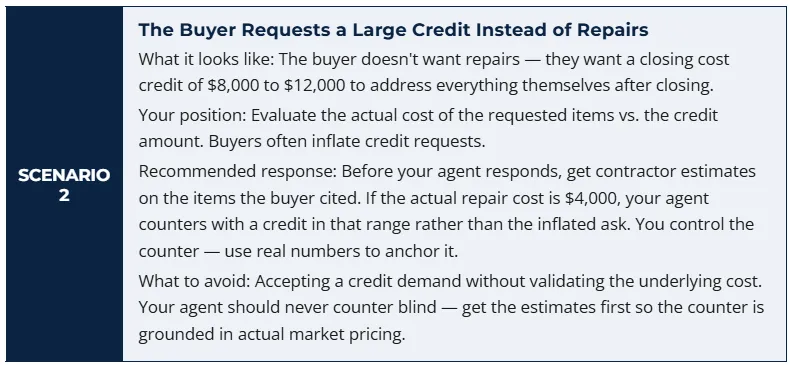
Credits: Instead of repairs, the buyer asks for a dollar credit at closing — allowing them to address the items themselves after they take ownership.
Price reduction: The buyer requests a reduction in the purchase price to account for the cost of addressing the findings.
A combination: Some repairs plus a credit, or a credit plus a price reduction. Buyers can get creative, and so can sellers in their counter-response.
The PICRA Timeline Is a Hard Deadline
Under the REIN contract, the seller has a specified window to respond to the PICRA — typically five to seven days from receipt, though the exact timeline is set in your contract. If the seller does not respond within that window, the buyer may have the right to exit the contract and recover their earnest money deposit.
Your agent tracks this deadline. Do not let it slip.
Reading the Inspection Report Like a Seller
Before you can respond to a PICRA, you need to understand what the inspection actually found — and what it means.
Inspection reports are written to be thorough. Inspectors flag everything, from significant structural issues to the fact that a light switch cover is slightly crooked. The volume of findings can be alarming to sellers who haven't seen one before. The key is learning to read the report through the right lens.
Triage the Findings Into Three Categories
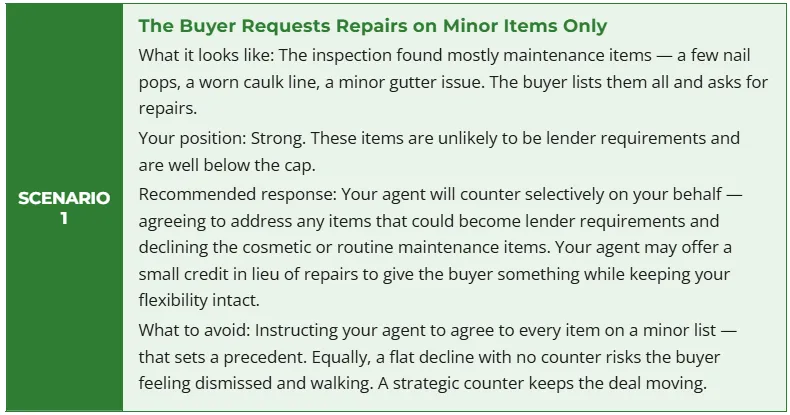
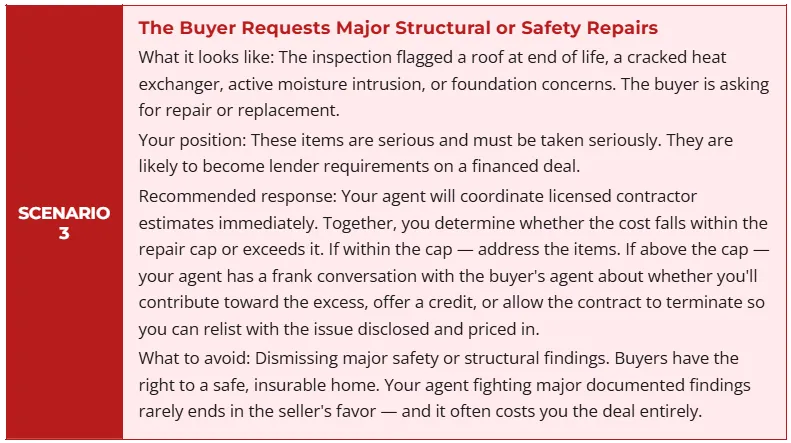
Category 1 — Safety and structural issues: These are the findings that matter most — foundation problems, roof failures, electrical hazards, active water intrusion, HVAC failures, and anything that poses a genuine risk to the occupants or the structural integrity of the home. These are the items most likely to trigger lender requirements and the ones buyers will push hardest on.
Category 2 — Maintenance and deferred items: Older caulk, dirty gutters, minor wood rot, worn weatherstripping, aging systems that still function. These are real findings but not emergencies. Buyers often include them in a PICRA even when they're not deal-critical.
Category 3 — Cosmetic and informational notes: Inspectors flag scratched surfaces, minor cosmetic defects, and general maintenance recommendations. These are the line items sellers can almost always decline without threatening the deal.
Your Agent Should Attend the Inspection — Or At Least Review
the Report With You
A good listing agent reviews the inspection report with the seller before any PICRA response is drafted. They know which findings are likely to become lender requirements, which ones are negotiating chips, and which ones can be safely declined. That triage conversation is where your response strategy is built.
The REIN Paragraph 13 Repair Cap — In Full Detail
We introduced the repair cap in Blog 6 and referenced it in Blog 7. Here is the full picture, because this is the Bonus Training and you deserve the complete version.
What Paragraph 13 Says
Under Paragraph 13 of the REIN Regional Sales Contract, the seller is obligated to pay for repairs in three specific categories up to a defined cap:
Section 13a — Appraisal and Required Repairs: Repairs required by the buyer's lender appraiser as a condition of loan approval.
Section 13b — Wood-Destroying Insect / Moisture Inspection Repairs: Repairs identified by a WDI or moisture inspection — termite damage, active infestation, moisture-related wood damage.
Section 13c — Drinking Water and Septic: Issues identified with the water supply or septic system where applicable.
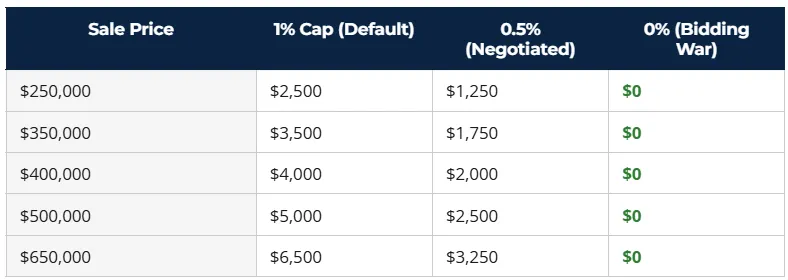
The cap is the maximum dollar amount the seller is obligated to spend across all three categories combined. If the contract does not specify a dollar amount in the blank line of Paragraph 13, the cap defaults to 1% of the purchase price.
The Cap Is Not a Floor — It's a Ceiling
The repair cap does not mean the seller must spend up to the cap on every transaction. It means the seller's maximum obligation is the cap amount. If actual qualifying repair costs come in under the cap, the seller only pays for the actual costs.
And critically — the cap is negotiable. It can be set at any dollar amount both parties agree to. In competitive bidding situations, it has been negotiated all the way to zero, meaning the buyer agrees in advance to waive all Paragraph 13 repair obligations from the seller.
The Cap Applies Even If the Buyer Waives Items in the PICRA
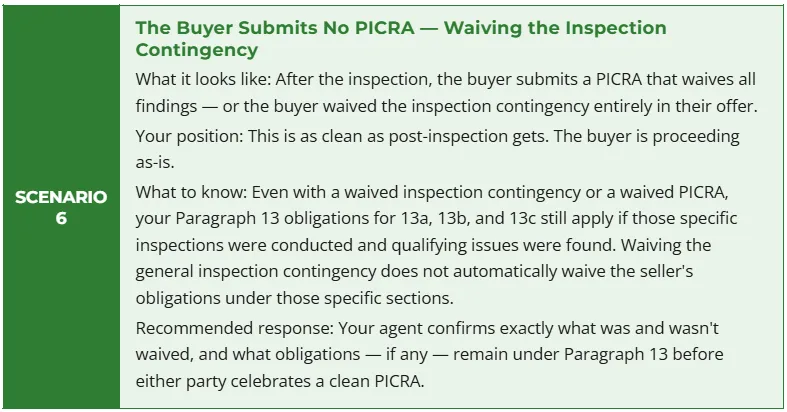
This is the provision that surprises sellers most. Even if the buyer agrees to waive certain inspection items in the PICRA response, the seller's obligation under Paragraph 13 for qualifying items under 13a, 13b, and 13c does not disappear. The contract requires the seller to address those categories up to the cap regardless of what is negotiated in the PICRA.
The practical implication: a buyer might waive a termite treatment in the PICRA, but if the WDI inspection identified active infestation, the 13b obligation still exists. Your agent needs to understand this distinction to protect you from inadvertently agreeing to terms that conflict with your contract obligations.
What Happens When Costs Exceed the Cap
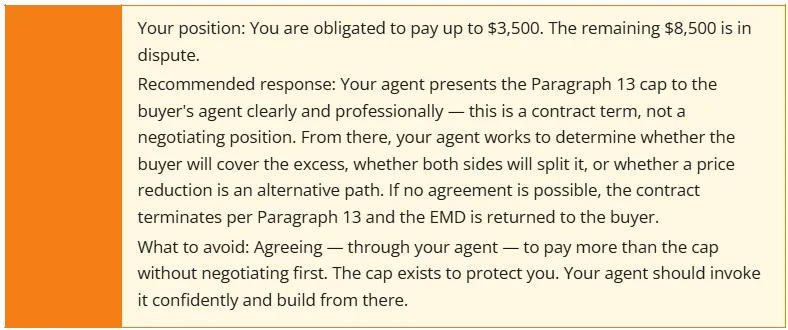
If the total estimated cost of qualifying repairs under 13a, 13b, and 13c exceeds the cap, three outcomes are possible:
The buyer agrees to pay the excess above the cap.
The seller agrees to pay the excess above the cap.
Both parties agree to split the excess.
If none of those agreements can be reached, the contract terminates. The seller executes a release agreement and the buyer's earnest money deposit is fully refunded. The seller is back to square one — with a disclosed inspection history.
The Repair Cap at Different Price Points
Here is what the 1% default cap looks like at common Hampton Roads sale prices, compared to a negotiated lower cap and a zero cap from a competitive offer:
Why This Is 'Deal Insurance' — Not a Penalty
The 1% default exists because real estate attorneys and regional boards needed a legal fallback for contracts where the blank line in Paragraph 13 was left unfilled. Without a default, a blank line creates an unenforceable term — and unenforceable terms can void contracts.
The 1% was designed as a compromise: high enough to cover most routine lender-required and inspection-related repairs, low enough to protect sellers from unlimited exposure. It keeps deals together when qualifying repair costs are moderate, and it gives both parties a defined exit if costs spiral beyond what either party can reasonably absorb.
Understanding why it exists makes it far easier to negotiate around it with confidence.
Every PICRA Response Scenario — and How to Handle Each
When a PICRA arrives, you have several response options. The right choice depends on what was requested, how significant the findings are, where you are relative to the repair cap, and how motivated you are to keep this particular buyer.

Negotiation Principles That Protect Your Net
Beyond the specific scenarios, there are principles that apply to every PICRA negotiation. Sellers who internalize these walk away with better outcomes than sellers who react emotionally or accept the first number offered.
Credits Are Often Better Than Repairs
When you make a repair, you control the quality and the cost — but you also take on the liability of the work. If the repair is done poorly or the problem recurs after closing, it can come back on you. A credit shifts that responsibility to the buyer. They take the money, they choose the contractor, they own the outcome. In many cases, a credit is the cleaner solution for both parties.
Get Estimates Before You Counter
Never counter a repair request without knowing what the repair actually costs. Call licensed contractors. Get written estimates. Then counter based on real numbers, not assumptions. Buyers who ask for $5,000 for a repair that costs $2,200 are testing you — and you should know the difference before you respond.
Protect the Deal, Not the Dollar
There is a version of PICRA negotiation where sellers fight for every dollar and lose the deal. And there is a version where sellers make strategic concessions on smaller items to protect the transaction on the larger ones. Know which items are worth the fight and which ones aren't. Losing a qualified buyer over a $400 repair credit is an expensive way to win an argument.
Know Your Market Position Before You Respond
If you have a backup offer waiting, your negotiating position is completely different than if this is your only buyer after 60 days on market. Your agent should brief you on your current market position before any PICRA response goes out. That context shapes every decision.
Respond Strategically — Not Emotionally
The inspection report is not a personal attack on your home. The PICRA is not an insult. Buyers who submit long PICRA lists are doing exactly what the contract allows them to do — and sometimes they're testing to see what you'll agree to. A calm, measured, strategic counter-response is almost always more effective than an emotional rejection.
The Mistake That Costs Sellers the Most
The single most expensive PICRA mistake sellers make is refusing to engage. A flat rejection with no counter — especially on a buyer who has a legitimate concern about a real issue — frequently results in the buyer exercising their right to exit the contract.
Even if you disagree with what the buyer is asking for, respond with a counter. Keep the conversation alive. The deal that stays together is almost always worth more than the principle you were defending.
The Best PICRA Strategy Starts Before You List
Everything in this training becomes easier — and less expensive — when sellers take proactive steps before the home hits the market.
Order a pre-listing WDI inspection. Know what's there before the buyer's inspector finds it. Address any termite or moisture issues on your timeline, with your contractors, at your cost — not under contract pressure with a closing date looming.
Address obvious deferred maintenance. Walk through your home with your agent before listing and fix the items that are certain to show up on an inspection report. A $200 repair before listing is worth more than a $500 credit after.
Service your HVAC and keep the records. A serviced system with documentation is a selling point. An unknown system is an inspection concern. The cost difference between those two outcomes is minimal.
Negotiate the repair cap upfront. When reviewing offers, your agent should flag the Paragraph 13 cap on every offer. In a competitive situation, asking buyers to reduce or eliminate the cap is a legitimate negotiating point — and one that can meaningfully affect your net proceeds.
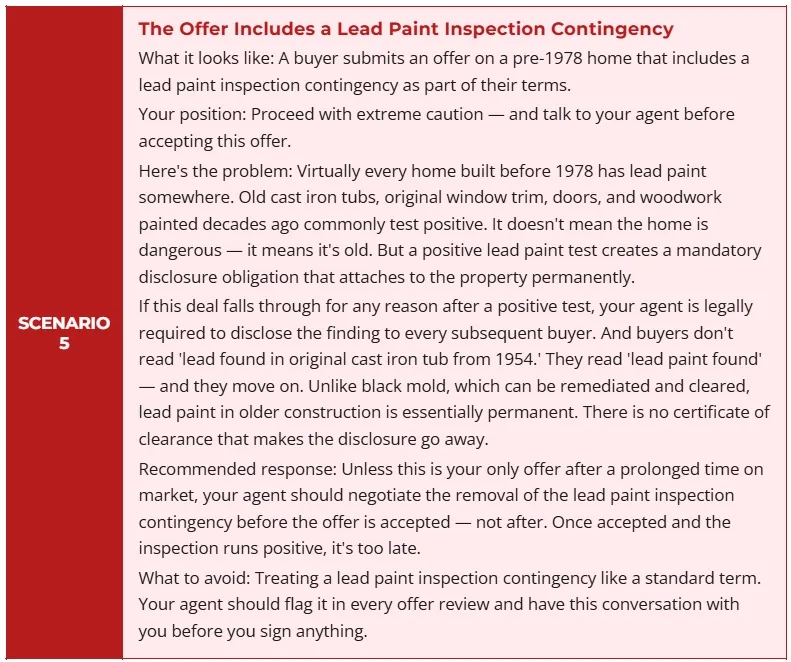
Understand the lead paint risk before you accept an offer. If your home was built before 1978, have a conversation with your agent about lead paint inspection contingencies before you accept any offer that includes one. A positive result — which is likely in any home of that age — creates a permanent disclosure obligation that follows the property to every future buyer. That conversation is far easier to have before you're under contract than after a test has already run positive.
Preparation Is the Best Negotiation
The sellers who navigate the PICRA with the least stress and the best outcomes are almost always the ones who prepared thoroughly before listing. A home that was properly prepared, properly disclosed, and properly priced walks into the post-inspection period from a position of strength.
A home that was rushed to market with deferred maintenance and undisclosed issues walks in hoping the inspector doesn't look too closely. Hope is not a strategy.
The Bottom Line
The PICRA is not the enemy. It's a negotiating document — and like all negotiations, the party that is better prepared, better informed, and less emotional almost always gets the better outcome.
Know your repair cap. Know what's in the three qualifying categories. Know the difference between items that are lender requirements and items that are buyer preferences. Know what repairs actually cost before you counter. And know that your goal is not to win every line item — it's to get to the closing table with the best possible net proceeds.
Your agent is your partner in this negotiation. Their job is to translate what the inspector found into what it actually means for your transaction, help you build a response strategy that protects your interests, and keep the deal alive when both sides are feeling the pressure.
If you've read this training alongside the full Seller Education Series, you now know more about the post-inspection process than most sellers ever learn. Use that knowledge. It's worth real money at the closing table.
Have Questions About Your Inspection or PICRA Response?
Post-inspection negotiations are one of the most consequential moments in your transaction. Don't navigate them alone.
Book a free consultation at coastalva.chat
About the Author: Marc Ian Griffin, aka Captain Real Estate, is a licensed REALTOR and Wealth Advisor with Coastal VA Estates LLC, powered by Keller Williams Town Center. A retired U.S. Navy veteran, Marc has called the Hampton Roads area home since 1992. He entered real estate in 2006 because he saw what was happening to everyday families who were losing thousands and, in many cases, losing their homes simply because they didn't have the right person guiding them through the potential real estate pitfalls — and he was determined to be that person. After a period away from the industry, he returned in 2025 with that same mission. Marc serves buyers and sellers across Virginia Beach, Norfolk, Chesapeake, Portsmouth, Suffolk, Hampton, and Newport News.

Expertise
Deep market knowledge.

Integrity
Honesty and transparency.

Excellence
Top-notch services.
Expertise
Deep market knowledge.
Integrity
Honesty and transparency.
Excellence
Top-notch services.
Coastal VA Estates LLC
Powered by Keller Williams Town Center
1 Columbus Center #301 Virginia Beach, VA 23462
Email: [email protected]
Phone: 757-774-7557
QUICK LINKS
FOLLOW US


© 2026 Coastal VA Estates LLC. All rights reserved. Marc Ian Griffin is a licensed REALTOR® in the Commonwealth of Virginia, powered by Keller Williams Town Center. Equal Housing Opportunity.