

Understanding Offers
and Negotiations
Navigate the negotiation table with total confidence and close on your own terms.
Choosing the Winning Offer
Why the Highest Price Isn't Always the Best Deal
The moment offers start coming in is one of the most exciting moments in the home selling process. After all the preparation, the photography, the marketing, and the showings — buyers are raising their hands and saying they want your home. That energy is real and it deserves to be celebrated.
But this is also one of the moments where sellers make costly mistakes. Because the instinct — perfectly understandable — is to look straight at the price and choose the highest number. And sometimes that's the right call. But often it isn't.
An offer is not just a price. It's a package of terms, conditions, timelines, contingencies, and financing details that together determine whether that transaction actually makes it to the closing table — and what you actually walk away with when it does. This blog breaks down every piece of that package so you know exactly what you're evaluating when the offers come in.
The Anatomy of an Offer
Every offer on your home contains several components beyond the purchase price. Understanding each one is critical to evaluating what the offer is actually worth.
1. Purchase Price
Yes, price matters — but it's the starting point, not the whole picture. A higher price with weak financing, heavy concessions, and a long timeline may net you less at closing than a slightly lower offer with clean terms and a fast close.
2. Financing Type and Strength
How a buyer is paying for your home has a direct impact on the likelihood that the deal closes — and how smoothly it gets there.
Cash offers eliminate the financing contingency entirely. No lender, no appraisal requirement, no risk of loan denial. Cash is king — but only if the funds are verified. An unverified cash offer is not a cash offer. Always request proof of funds.
Conventional financing with a strong down payment (10–20% or more) signals a qualified buyer and a lender with appetite for the deal. These close reliably when the buyer is truly preapproved.
FHA and VA loans are perfectly legitimate financing vehicles — and VA loans in particular are common in Hampton Roads. However, they come with appraisal requirements and property condition standards that can create complications depending on the state of your home.
Prequalified vs. preapproved is a distinction that matters enormously. Prequalified means a lender ran some numbers based on what the buyer told them. Preapproved means the lender has actually verified income, assets, credit, and employment. A prequalified buyer may not close. A preapproved buyer almost always does.
Lender Quality Is Not Optional to Evaluate
Not all lenders are created equal. A buyer using an online discount lender or an out-of-state institution with no track record in Virginia can introduce delays, communication breakdowns, and last-minute complications that push your closing back weeks — or kill the deal entirely.
Ask your agent to research the lender on every financed offer. A local, reputable lender who closes on time is worth more than a slightly higher price from a buyer whose financing is a question mark.
3. Earnest Money Deposit
The earnest money deposit (EMD) is the buyer's good-faith deposit — the amount they put up to demonstrate they're serious about the transaction. In Virginia, the EMD is typically due within two business days of contract ratification.
A larger EMD signals a more committed buyer. A minimal EMD — especially on a high-priced offer — can be a yellow flag. If a buyer walks away from the deal without cause, the EMD is typically forfeited to the seller. The larger that deposit, the more skin the buyer has in the game.
4. Closing Timeline
When does the buyer need to close? Does that timeline work for you? A buyer who needs 60 days may cost you a month of carrying expenses compared to a buyer who can close in 30. If you're buying another home simultaneously, the closing timeline on your sale may need to align with your purchase — and that coordination matters.
5. Contingencies
Contingencies are conditions that must be met for the sale to proceed. Each one represents a potential exit ramp for the buyer — and a potential delay or complication for you.
Inspection contingency: The buyer has the right to have the home professionally inspected and to request repairs or credits based on the findings. This is standard and expected — but how it's handled post-inspection is where things get interesting. More on this below.
Financing contingency: The buyer's obligation to purchase is contingent on obtaining loan approval. If their financing falls through, they can exit the contract and typically recover their EMD. The stronger the buyer's preapproval, the lower this risk.
Appraisal contingency: If the home appraises below the contract price, the buyer can renegotiate or exit. Sellers in competitive markets sometimes request appraisal gap coverage — a buyer's commitment to cover the difference between the appraised value and the contract price up to a specified amount.
Home sale contingency: The buyer's purchase is contingent on selling their current home first. This introduces significant timeline uncertainty and is generally the weakest offer structure a seller can accept.
6. Seller Concessions
Concessions are costs the buyer is asking you to cover — most commonly a contribution toward their closing costs. A buyer asking for $8,000 in seller-paid closing costs on a $400,000 offer is effectively making a $392,000 offer. Always evaluate offers on their net-to-seller value, not just the headline price.
Two Offers Side by Side: Which One Would You Take?
Here is a scenario that plays out regularly in Hampton Roads. Two offers arrive on the same day. On the surface, Offer A looks like the winner.
But look closer:
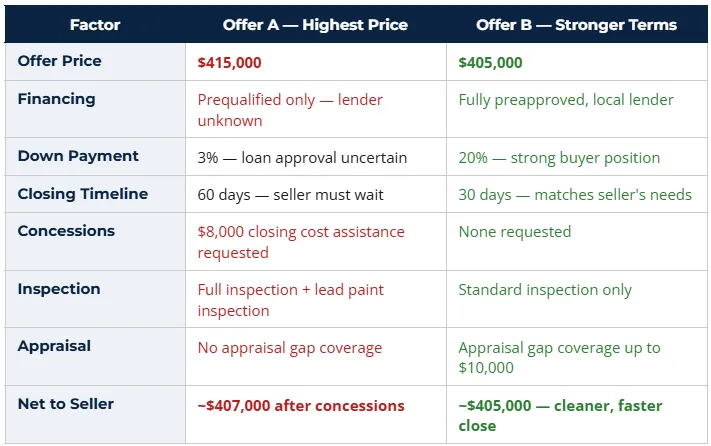
Offer B nets the seller nearly the same amount — with a faster closing, no concessions, a stronger buyer, appraisal gap protection, and significantly less risk. For most sellers, Offer B is the winning offer. But a seller who only looks at the price line will sign Offer A and wonder later why the transaction was so difficult.
The Inspection Contingency: What Sellers Need to Know
The home inspection is one of the most misunderstood parts of the transaction for sellers. Many sellers think accepting an offer means the hard part is over. In reality, the inspection period is where deals are renegotiated — and sometimes lost.
The Standard Home Inspection
A licensed home inspector will examine the structure, systems, and components of your home and produce a report detailing any deficiencies. The buyer then has the right to submit a PICRA — Post-Inspection Contingency Removal Addendum — requesting repairs, credits, or a price reduction based on those findings.
How you respond to the PICRA is a negotiation. You are not obligated to agree to every request. But you are in a position where the buyer can exit the contract if you don't reach an agreement — which means your response strategy matters.
Lead Paint Inspections — A Seller's Red Flag
If a buyer requests a lead paint inspection as part of their offer or inspection contingency, sellers need to understand what they're agreeing to — and the potential consequences.
Lead paint inspections test surfaces throughout the home for the presence of lead-based paint. In homes built before 1978, lead can turn up in unexpected places — old window trim, doors, and yes, even cast iron bathtubs that were enameled with lead-based coatings decades ago.
Why Lead Paint Inspections Can Be Deal Killers
If a lead paint inspection comes back positive — even for a minor, contained source like an old tub or painted window — the seller is now legally obligated to disclose that finding to every subsequent buyer if this deal falls through. What was once a manageable negotiation point becomes a permanent disclosure item attached to the property.
A finding that a reasonable buyer would have accepted as a non-issue can become a stigma that follows the home. This is not a reason to refuse all inspections — it's a reason to understand exactly what you're agreeing to before you sign an offer that includes a lead paint inspection contingency.
The Virginia Repair Limit — What Every Seller Must Know
In Virginia, the sales contract includes a provision that establishes the seller's maximum repair obligation following a home inspection. This repair limit caps what you are required to spend on inspection-related repairs as a percentage of the purchase price.
The REIN Contract Repair Cap — What Sellers Must Understand
Under Paragraph 13 of the Real Estate Information Network (REIN) contract used in Hampton Roads, sellers are obligated to pay for repairs up to a defined cap. If no dollar amount is specified in the contract, that cap defaults to 1% of the purchase price.
On a $400,000 home, that's $4,000 in repair obligations — minimum — that the seller should plan for before closing.
The cap applies to repairs arising from three specific categories: appraisal-required repairs (13a), wood-destroying insect and moisture inspections (13b), and drinking water and septic issues (13c).
Here's the part that surprises most sellers: the obligation to pay up to the cap exists even if the buyer waives those items in the PICRA. The contract requires it regardless. If total repair costs exceed the cap and neither party agrees to cover the excess, the contract can terminate — and the buyer's earnest money deposit is fully refunded. That means the seller is back to square one, with a disclosed inspection history and no deal.
Why does this provision exist? Real estate attorneys and regional boards built it into the contract as 'deal insurance.' If an agent or seller forgot to fill in a specific dollar amount on that blank line, the deal needed a legal default to stand on. The 1% figure was designed as a deliberate compromise: it prevents sellers from canceling a contract over minor lender-required repairs, while simultaneously protecting them from being forced into unlimited, catastrophic repair bills. It keeps deals together without exposing either party to an unreasonable outcome.
Important: The 1% is a default, not a fixed requirement. In competitive situations — particularly bidding wars — the repair cap can be negotiated, and in some cases buyers have agreed to reduce it all the way to zero as part of their offer terms. This is another reason why offer evaluation is about more than just price.
Sellers who understand this going in are never blindsided by it. Sellers who don't find out at the worst possible moment — when they're already under contract and the clock is running.
A Smart Move: Get Your Inspections Done Before You List
Two of the three repair cap categories — wood-destroying insect/moisture (13b) and drinking water/septic (13c) — are inspections sellers can proactively order before the home ever hits the market.
Getting a wood-destroying insect and moisture inspection done pre-listing gives you a significant advantage. You'll know exactly what's there, you can address any findings on your own terms and timeline, and you eliminate one of the biggest sources of post-contract surprises. Buyers will likely order their own inspection regardless — but you'll walk into that process with confidence instead of uncertainty.
The one category sellers cannot address preemptively is appraisal-required repairs (13a). Those don't exist until a lender sends an appraiser — which only happens after a financed offer is accepted. If the appraiser identifies required repairs, they must be completed before the loan will fund. On a cash deal, there is no lender appraisal and this category doesn't apply.
On septic systems: an estimated 30,000 to 50,000+ homes across the Hampton Roads region rely on septic systems, though prevalence varies heavily by location. If your home is on septic, the 13c inspection requirement applies and sellers should be prepared for that as part of the transaction.
The bottom line: the more you know before you list, the fewer surprises you face after you're under contract.
What makes this important is the cumulative effect. When sellers add up the repair limit obligation, plus any credits negotiated in the PICRA, plus closing cost concessions already built into the offer, the gap between the headline price and what actually hits their bank account at closing can be significant — and surprising if they weren't prepared for it.
This is why we cover the full cost picture in Blog 8 of this series. But it starts here, in the offer evaluation stage, before you ever sign on the dotted line.
Coming Soon: The PICRA Bonus Training
The Post-Inspection Contingency Removal Addendum deserves its own deep dive — and it's getting one. The PICRA Bonus Training covers exactly how to read and respond to a buyer's inspection requests, what you're legally obligated to address, how the repair limit works in practice, and the negotiation strategies that protect your net proceeds.
Watch for the PICRA Bonus Training in the Coastal VA Estates Seller Education Center.
When Multiple Offers Arrive: How to Run the Process
A well-priced, well-marketed home in Hampton Roads can generate multiple offers — especially in a low-inventory market. When that happens, the process of evaluating and responding matters as much as the offers themselves.
Set an offer deadline. Rather than responding to offers one at a time as they arrive, establish a deadline — typically 24 to 48 hours after listing — by which all offers must be submitted. This creates a level playing field and prevents you from accepting a good offer before a great one arrives.
Request highest and best. In a multiple-offer situation, you can ask all buyers to submit their highest and best offer by the deadline. This surfaces the true top of the market for your home.
Evaluate net-to-seller on each offer. Build a side-by-side comparison of every offer that accounts for price, concessions, financing strength, timeline, and contingencies. The number at the bottom — what you actually net — is what you're choosing between.
Don't ignore the terms for the price. A $10,000 higher offer with a shaky buyer, a home sale contingency, and $8,000 in concessions is not a $10,000 better offer. Do the math before you sign.
Respond strategically. You can accept, reject, or counter any offer. You can also accept one offer while issuing backup offer status to a second — a smart move when the top offer has contingencies and a strong backup exists.
The Goal Is a Smooth Path to Closing
Sellers sometimes focus so heavily on maximizing the accepted price that they overlook the likelihood of actually getting to closing. The best offer is the one that gets you to the closing table — on your timeline, at a strong net price, without the drama of a deal falling apart halfway through.
A clean offer from a qualified buyer with reasonable terms and a local lender is worth more than a high-priced offer full of risk. Choose the path to closing, not just the headline number.
The Bottom Line
Choosing the right offer is one of the most consequential decisions you'll make in the entire selling process — and it's one that most sellers are underprepared for because nobody explained the full picture to them before the offers arrived.
Price is important. But financing strength, lender quality, contingency structure, concessions, timeline, and the buyer's overall commitment to closing are just as important — sometimes more so. The seller who understands all of it walks away with the best outcome. The seller who only looks at the price sometimes doesn't make it to closing at all.
Your agent's job is to lay every offer out in full, explain what each term means for your bottom line, and help you choose the path that gets you to the closing table with the most money in your pocket and the least stress along the way.
Got Offers? Let's Make Sure You Choose the Right One.
Evaluating offers is one of the most consequential decisions in the selling process. Don't do it alone. Book a free consultation at coastalva.chat
About the Author: Marc Ian Griffin, aka Captain Real Estate, is a licensed REALTOR and Wealth Advisor with Coastal VA Estates LLC, powered by Keller Williams Town Center. A retired U.S. Navy veteran, Marc has called the Hampton Roads area home since 1992. He entered real estate in 2006 because he saw what was happening to everyday families who were losing thousands and, in many cases, losing their homes simply because they didn't have the right person guiding them through the potential real estate pitfalls — and he was determined to be that person. After a period away from the industry, he returned in 2025 with that same mission. Marc serves buyers and sellers across Virginia Beach, Norfolk, Chesapeake, Portsmouth, Suffolk, Hampton, and Newport News.

Expertise
Deep market knowledge.

Integrity
Honesty and transparency.

Excellence
Top-notch services.
Expertise
Deep market knowledge.
Integrity
Honesty and transparency.
Excellence
Top-notch services.
Coastal VA Estates LLC
Powered by Keller Williams Town Center
1 Columbus Center #301 Virginia Beach, VA 23462
Email: [email protected]
Phone: 757-774-7557
QUICK LINKS
FOLLOW US


© 2026 Coastal VA Estates LLC. All rights reserved. Marc Ian Griffin is a licensed REALTOR® in the Commonwealth of Virginia, powered by Keller Williams Town Center. Equal Housing Opportunity.