

What Happens After You
Accept an Offer?
Your step-by-step roadmap through inspection, appraisal, and the final walk-through.
What Happens After You Accept an Offer?
Inspections, Appraisals, and the Path to Closing
Accepting an offer feels like the finish line. After all the preparation, the pricing decisions, the marketing, the showings, and the negotiations — someone wants your home. You've signed the contract. You're done, right?
Not quite. Accepting an offer is not the end of the transaction. It's the beginning of the most consequential stretch of it. What happens between contract ratification and the closing table determines whether this deal actually closes — and on what terms.
Most sellers are not prepared for this phase because nobody walked them through it before they got there. This blog changes that. By the time you finish reading, you'll know every milestone between contract and closing, what each one means for you, and how to navigate the ones that have a tendency to derail deals.
The Contract-to-Closing Timeline
Here is an overview of the key milestones from contract ratification to settlement. Exact timelines vary based on the terms of your specific contract, but this gives you a clear picture of what to expect and when:

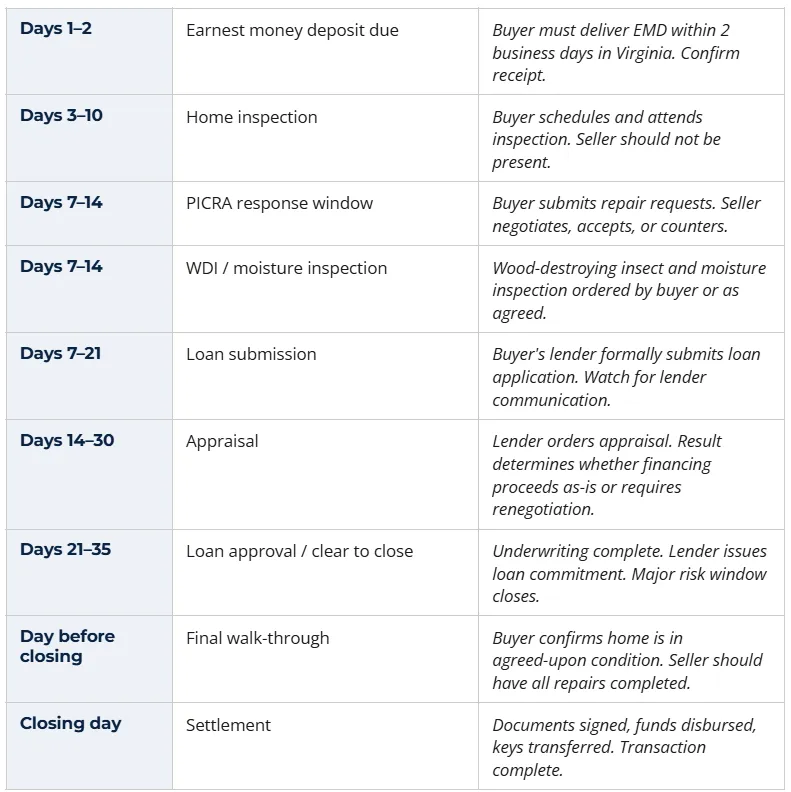
Every one of those milestones has a deadline attached to it. Missing deadlines — on either side — has real legal and financial consequences. Your agent's job is to track every one of them and make sure nothing falls through the cracks.
The Home Inspection: What Sellers Need to Know
The home inspection is typically one of the first major milestones after contract ratification. The buyer hires a licensed inspector to examine the structure, systems, and components of the home and produce a written report.
As a seller, here's what you need to know going in:
You should not be present. Buyers need space to ask questions freely and inspectors need to do their job without the seller in the room. Plan to be out of the home during the inspection.
The home should be in showing condition. Every light should work, every system should be accessible, and the home should be clean. An inspector who can't access a panel or a crawl space will flag it — and buyers will wonder why.
No home is perfect. Every inspection report finds something. Don't panic when the report comes back with a list of items. What matters is the severity of the findings and how you respond to them.
Prepare your records. If you've had recent repairs, replacements, or service done — HVAC service, roof repairs, pest treatments — have the documentation ready. It gives buyers confidence and reduces negotiating leverage on items you've already addressed.
The PICRA: Post-Inspection Contingency Removal Addendum
After the inspection, the buyer submits a PICRA — the Post-Inspection Contingency Removal Addendum — which outlines what they're requesting: repairs, credits, a price reduction, or some combination of all three.
As we covered in Blog 6, the REIN contract establishes a repair cap — defaulting to 1% of the purchase price if left blank in Paragraph 13 — that defines the seller's maximum repair obligation for qualifying items under sections 13a, 13b, and 13c. Understanding that cap before you respond to a PICRA is essential.
Your response options:
Agree to all requests. Cleanest resolution. Deal moves forward without further negotiation.
Counter the requests. Agree to some items, decline others, or offer a credit in lieu of repairs. This is the most common outcome.
Decline all requests. The buyer then decides whether to proceed as-is, continue negotiating, or exit the contract.
Coming Soon: The PICRA Bonus Training
The PICRA deserves a deep dive of its own — and it's getting one. The PICRA Bonus Training covers how to read inspection requests strategically, what the repair cap means in practice, how to structure counter-responses that protect your net proceeds, and the negotiation dynamics that most sellers never see coming. Watch for it in the Coastal VA Estates Seller Education Center.
Wood-Destroying Insect and Moisture Inspection
The wood-destroying insect and moisture inspection — commonly called a WDI or termite inspection — is a separate inspection from the general home inspection. It specifically looks for evidence of termites, other wood-destroying insects, and moisture damage that could compromise the structural integrity of the home.
In Virginia, this inspection is particularly important. The combination of humidity, older housing stock, and crawl space construction common in Hampton Roads creates conditions where termite activity and moisture issues are more prevalent than in many other markets.
The Case for a Pre-Listing WDI Inspection
As we discussed in Blog 6, sellers can order a WDI inspection before listing — and doing so is a smart move. You'll know what's there before a buyer's inspector finds it. You can address any issues on your own terms, at your own timeline, with contractors you choose. And you walk into the post-contract inspection period with confidence instead of anxiety.
A buyer will likely order their own WDI inspection regardless. But sellers who have already done one and addressed any findings are in a much stronger negotiating position when the buyer's report comes back.
The Appraisal: What It Is and Why It Matters
On financed transactions, the buyer's lender will order an independent appraisal of your home. The appraiser's job is to determine the market value of the property — and the lender will not fund the loan for more than the appraised value.
This is the moment where market pricing and contract price either align — or don't.
The Appraisal: What It Is and Why It Matters
The best-case scenario. Financing proceeds as planned. No renegotiation needed. The transaction moves forward toward closing.
If the Home Appraises Below Contract Price
This is the appraisal gap — and it's one of the most stressful moments in a real estate transaction. When the appraised value comes in below the agreed purchase price, there are several possible paths:
The buyer covers the gap. If the buyer included appraisal gap coverage in their offer — a commitment to pay the difference between appraised value and contract price up to a specified amount — the deal proceeds. This is why we evaluated that term carefully in Blog 6.
The seller reduces the price. The seller agrees to lower the contract price to match the appraised value. The buyer proceeds with their original financing. Seller nets less.
Both parties meet in the middle. A negotiated split of the appraisal gap. Both sides give something to keep the deal alive.
The deal terminates. If no agreement can be reached and the buyer has an appraisal contingency, they can exit the contract and recover their earnest money deposit.
Appraisal-Required Repairs
Appraisers don't just determine value — they also flag property conditions that fail to meet lender standards. Health and safety items, structural concerns, and code violations can all trigger required repairs as a condition of loan approval.
Unlike inspection repairs, appraisal-required repairs are not optional. If the lender requires them, they must be completed before the loan will fund. On a cash deal, there is no lender and therefore no appraisal requirement — one of the key advantages of a cash offer that we covered in Blog 6.
Title Search and Title Insurance
While inspections and appraisals are underway, the title company is doing its own work: searching the public record to confirm that the seller has clear, marketable title to the property — and that there are no liens, judgments, unpaid taxes, easement disputes, or encumbrances that would prevent a clean transfer of ownership.
For most sellers, the title search is uneventful. But when title issues surface, they can range from minor and easily resolved to serious and transaction-halting.
Unpaid liens: Contractor liens, HOA liens, and tax liens must be satisfied before closing. If discovered at title, they become the seller's responsibility to resolve — often on a compressed timeline.
Boundary and survey issues: Fences, structures, or improvements that cross property lines can create title complications that require legal resolution before the property can transfer cleanly.
Estate and ownership issues: Inherited properties or homes with multiple owners on title can surface complications if all parties haven't properly authorized the sale.
📖 From the Field
I had a listing in Chesapeake where everything was moving smoothly right up until the title company completed their search. It turned out that the previous owners had installed a fence that crossed the property line — by about a foot — onto the neighbor's lot. Nobody had ever surveyed the property, so no one had caught it.
It wasn't catastrophic, but it wasn't nothing either. The fence had to be remedied before we could close. That meant working with the neighbor, adjusting the fence line, and getting the paperwork right — all while the buyers were waiting and the clock was ticking on the contract.
We got it done. The deal closed. But it took coordination, patience, and a seller who was willing to do what needed to be done instead of digging in and making it somebody else's problem. That's what getting to the closing table actually looks like sometimes — not a straight line, but a path that requires everyone to keep moving forward together.
The neighbors across the street watched that whole process play out. When they decided to list their home shortly after, they came to me — and they came prepared. They fixed everything that needed fixing before we listed. They priced it right. They trusted the process. That home sold in under a week, slightly above list price, with no drama and no surprises.
That contrast — same street, same market, completely different experience — comes down to one thing: sellers who work with their agent instead of against them get a different outcome. We are not the enemy. We are in your corner. Every decision we recommend is because we want this transaction to close, and we want you to walk away with the best possible result.
The Final Walk-Through
The final walk-through typically occurs on the day of — or the day before — settlement. It is the buyer's opportunity to confirm that the home is in the same condition as when they made the offer, that all agreed-upon repairs have been completed, and that nothing has changed since the last time they were in the home.
For sellers, this means:
All negotiated repairs must be complete and documentation should be available at closing. If you agreed to fix something in the PICRA response, it needs to be done — not in progress, not scheduled. Done.
The home should be clean and empty (or in the agreed-upon condition). If you're doing a rent-back or taking specific items, those terms should be clearly documented in the contract.
Systems should be operational. Buyers will run the HVAC, test appliances, run faucets, and check everything they checked during the inspection. Everything should work.
Nothing should have changed. If a tree fell on the fence, a pipe burst, or an appliance died between contract and closing — disclose it immediately. Surprises at the final walk-through can delay or derail settlement.
Closing Day: What to Expect
Settlement is the final step. Both parties (or their representatives) meet at the title company, sign the necessary documents, and transfer ownership. Here's what sellers experience on closing day:
Bring your ID. Government-issued photo identification is required at settlement.
Review your closing disclosure in advance. You'll receive a closing disclosure — typically 24 to 48 hours before settlement — that outlines all the final numbers: sale price, agent commissions, closing costs, payoff amounts, and your net proceeds. Review it carefully before you sit down at the table.
Sign the documents. The seller's closing paperwork is typically less voluminous than the buyer's, but there are still documents to sign transferring title and confirming the terms of the sale.
Receive your proceeds. Your net proceeds — after commissions, closing costs, any repair credits, and payoff of your existing mortgage — will be wired to your account or issued as a check, depending on your arrangement with the title company.
Hand over the keys. Once everything is signed and funds are confirmed, ownership transfers. The home is no longer yours.
What Sellers Are Often Surprised By at Closing
The most common closing day surprise for sellers is the gap between the sale price and the net proceeds. Commissions, transfer taxes, title fees, prorated property taxes, any repair credits, and the payoff of the existing mortgage all come out before the seller sees a dollar.
We cover the full cost picture in Blog 8 of this series — The Hidden Costs of Selling a Home.
Read it before you get to the closing table so there are no surprises.
The Bottom Line
The period between accepting an offer and sitting down at the closing table is where real estate transactions live or die. Inspections find issues. Appraisals produce gaps. Title searches surface surprises. Deadlines come and go. Every one of these moments requires a clear head, good communication, and a seller who understands what's happening and why.
The sellers who get to closing with the least stress and the best outcome are the ones who went in prepared — who knew what was coming, trusted their agent's guidance, and stayed focused on the goal rather than getting derailed by the inevitable bumps along the way.
There will be bumps. There almost always are. What matters is that you keep moving forward.
Ready to Navigate the Path to Closing With Confidence?
Let's build a selling plan that prepares you for every step — from listing to closing table. Book a free consultation at coastalva.chat
About the Author: Marc Ian Griffin, aka Captain Real Estate, is a licensed REALTOR and Wealth Advisor with Coastal VA Estates LLC, powered by Keller Williams Town Center. A retired U.S. Navy veteran, Marc has called the Hampton Roads area home since 1992. He entered real estate in 2006 because he saw what was happening to everyday families who were losing thousands and, in many cases, losing their homes simply because they didn't have the right person guiding them through the potential real estate pitfalls — and he was determined to be that person. After a period away from the industry, he returned in 2025 with that same mission. Marc serves buyers and sellers across Virginia Beach, Norfolk, Chesapeake, Portsmouth, Suffolk, Hampton, and Newport News.

Expertise
Deep market knowledge.

Integrity
Honesty and transparency.

Excellence
Top-notch services.
Expertise
Deep market knowledge.
Integrity
Honesty and transparency.
Excellence
Top-notch services.
Coastal VA Estates LLC
Powered by Keller Williams Town Center
1 Columbus Center #301 Virginia Beach, VA 23462
Email: [email protected]
Phone: 757-774-7557
QUICK LINKS
FOLLOW US


© 2026 Coastal VA Estates LLC. All rights reserved. Marc Ian Griffin is a licensed REALTOR® in the Commonwealth of Virginia, powered by Keller Williams Town Center. Equal Housing Opportunity.