How Much Money
Do You Really Need to Buy a Home?
Go beyond the down payment and uncover the true upfront costs of buying.
Ask most people how much they need to buy a home and they'll say twenty percent. It's one of the most persistent myths in real estate - and it stops a lot of people from buying who are actually ready.
The truth is more nuanced, more hopeful, and more dependent on your specific situation than most people realize. This blog breaks down every dollar you need to account for when buying a home in Coastal Virginia - down payments, closing costs, earnest money, and the costs that catch buyers off guard - so you can walk into this process with a clear, accurate picture of what it actually takes.
⚓ CAPTAIN’S COURSE CORRECTION
Down Payment Myths, Busted
MYTH: You need 20% down to buy a home.
FACT: Twenty percent is not a requirement for most loan programs. It's the threshold at which you avoid Private Mortgage Insurance (PMI) on a conventional loan - but many buyers purchase homes with significantly less down, or nothing at all. The right down payment depends entirely on the loan program you qualify for and your financial goals.
MYTH: If you don't have 20% down, you shouldn't buy yet.
FACT: This advice costs buyers years of equity building and home appreciation while they wait. In many cases, buying with a lower down payment today makes more financial sense than renting for another 3-5 years saving toward 20%. Run the numbers with your loan officer before assuming you need to wait.
MYTH: VA loans are too complicated and not worth the trouble.
FACT: VA loans are one of the best mortgage products available anywhere - zero down payment, no PMI, competitive interest rates, and no prepayment penalty. In Hampton Roads, where we have one of the highest concentrations of military and veterans in the country, a huge portion of home purchases use VA financing. Any lender worth working with knows this program well.
Down Payment Requirements by Loan Type
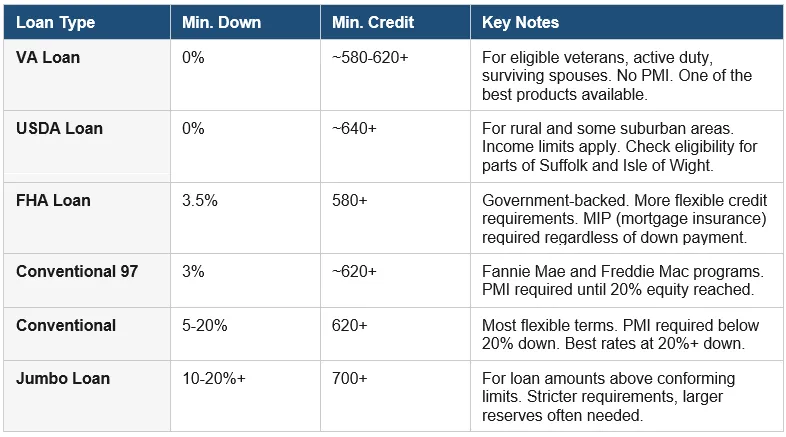
In Hampton Roads, VA loans are extremely common. If you are a veteran, active duty service member, or surviving spouse, your very first question to a lender should be about your VA loan eligibility. Don't assume you don't qualify until you've actually checked.
What Are Closing Costs - And How Much Are They?
Closing costs are fees and expenses you pay at settlement to complete the purchase of your home. They're separate from your down payment and they add up to more than most buyers expect. In Virginia, buyers can typically expect to pay between 2% and 3% of the loan amount in closing costs, though this varies based on the loan type, lender, and specific transaction.
Here's what closing costs generally include:
• Loan origination fees - what the lender charges to process your loan
• Appraisal fee - typically $400-$700, ordered by the lender to verify the home's value
• Title search and title insurance - protects you and the lender from ownership disputes
• Settlement/closing fee - paid to the title company or attorney handling the closing
• Prepaid interest - interest on your loan from the closing date to the end of the month
• Homeowner's insurance premium - first year often paid at closing
• Property tax escrow - lender collects 2-3 months upfront to establish your escrow account
• Recording fees - county charges to record the deed and mortgage
• VA Funding Fee (VA loans only) - can be rolled into the loan amount
On a $350,000 purchase with a VA loan, closing costs might run between $5,000 and $8,000. On a conventional loan with a down payment, add that amount to your down payment when calculating what you need to bring to the table.
Seller Concessions: How the Seller Can Help Pay Your Costs
Here's something that changes the math significantly for a lot of buyers: sellers can contribute toward your closing costs. This is called a seller concession or seller-paid closing costs, and it's a completely legitimate and common part of the negotiation process.
Instead of taking a lower sale price, a seller might agree to contribute a dollar amount toward your closing costs at settlement. The result: you need less cash at closing, and the seller still gets their price. Depending on market conditions and negotiating leverage, this can dramatically reduce the upfront cash required to buy a home.
Limits on seller concessions vary by loan type:
• VA loans: seller can contribute up to 4% of the purchase price in concessions
• FHA loans: up to 6% of the purchase price
• Conventional loans: 3-9% depending on down payment amount
In a market where a home has been sitting for a while or the seller is motivated, negotiating seller concessions is absolutely worth exploring. Your agent should always be looking for opportunities to reduce your out-of-pocket costs at closing.
Earnest Money Deposits: What You Need to Know
When you make an offer on a home in Virginia, you'll include an Earnest Money Deposit (EMD) - a good-faith payment that shows the seller you're serious about the purchase. Once the contract is ratified, you have 2 business days to deliver your EMD to the escrow agent.
How much should your EMD be?
When you make an offer on a home in Virginia, you'll include an Earnest Money Deposit (EMD) - a good-faith payment that shows the seller you're serious about the purchase. Once the contract is ratified, you have 2 business days to deliver your EMD to the escrow agent.
There's no fixed rule, and that's actually an important point. The right EMD depends on several factors:
• The purchase price - a $500 EMD on a $500,000 home sends a message, and not a good one. Your deposit should be proportional to the price you're offering.
• Market conditions - in a competitive market with multiple offers, a stronger EMD signals serious intent and can differentiate your offer. In a slow market where a home has been sitting for months without offers, you have more flexibility.
• How motivated you are - the more you want the house, the more your deposit should reflect that.
• Whether there are competing offers - if you know or suspect there are other buyers at the table, your EMD is one of the levers you can pull to make your offer more attractive.
A common starting point is 1% of the purchase price, but in competitive situations buyers often go higher. Talk to your agent about what's appropriate for the specific home and market conditions.
How to deliver your EMD - three options:
Digital payment app - most title companies now offer a secure digital payment platform, and this has become the most common delivery method, especially for tech-comfortable buyers. It is fast, trackable, and eliminates the risk of a physical check getting lost.
Personal check - still accepted by most escrow agents, though some title companies prefer certified funds.
Cashier's or certified check - traditional and widely accepted. If you go this route, get it to your agent immediately so it can be delivered to the escrow office without delay.
✦ CAPTAIN’S LOG
The Earnest Money Check
I always treated a client's earnest money check like it was the most important thing I was carrying that day - because it was. The moment a buyer handed me that check, my first stop was the office to get it into escrow. I never lost an EMD in all my years in this business, but I also never gave chance the opportunity. Whether you use an app or a check, the goal is the same: get it delivered quickly, get confirmation it was received, and don't let it sit.
⚓ CAPTAIN’S COURSE CORRECTION
The Most Important EMD Myth to Bust
Your earnest money deposit is NOT part of your down payment. This is one of the most common misconceptions buyers have, and it affects how they plan their finances going into a purchase.
The EMD goes into escrow when you submit it. At closing, it gets applied toward your closing costs or returned to you in certain circumstances - but it does not reduce your down payment requirement. You still need your full down payment available separately. Plan your cash accordingly.
Gift Funds: Can Family Help With Your Down Payment?
Yes - with documentation. Many loan programs allow buyers to use gift funds from family members toward their down payment and closing costs. However, lenders have specific requirements around gift funds that you need to follow:
• The funds must be a gift - not a loan. A gift letter signed by the donor stating no repayment is expected is typically required.
• The transfer must be documented - bank statements showing the gift leaving the donor's account and entering yours are standard requirements.
• The donor must typically be a family member - spouse, parent, sibling, grandparent, or domestic partner, depending on the loan program.
• Some loan programs limit how much of the down payment can come from gift funds vs. your own savings.
If you're planning to use gift funds, tell your lender upfront and early. How the funds are sourced, transferred, and documented matters - and doing it wrong can create problems during underwriting.
HOA and Condo Fees: What You Need to Know
If you are buying in a community with a Homeowners Association (HOA), or purchasing a condo or townhome, you will pay monthly or quarterly fees on top of your mortgage. These fees can range from $50 a month in a basic neighborhood to $500 or more per month in a high-amenity community or luxury condo building.
One thing many buyers don't realize until it's too late: some properties carry dual fees. A condo inside a planned neighborhood may have both a condo association fee AND a master HOA fee. A townhome in a community with shared amenities might have a sub-association fee on top of a master community fee. Before you fall in love with a property, ask your agent specifically: are there any additional association fees beyond the one listed? The answer can significantly change your true monthly housing cost.
Also important: if the property has an HOA or condo association, Virginia law requires the seller to deliver the association documents to you within 14 days of contract ratification. Once you receive them, you have only 3 calendar days to review them and, if the terms are unacceptable, notify the seller in writing to terminate the contract and recover your deposit. Three days goes by fast. Read those documents immediately when they arrive. We cover this in more detail in Blog 8.
Down Payment Assistance Programs
Many first-time buyers in Virginia don't know that assistance programs exist that can help cover down payments and closing costs.
Here are some worth exploring:
• Virginia Housing (formerly VHDA) - offers down payment assistance grants and loans to qualifying buyers in Virginia. Income and purchase price limits apply.
• NeighborhoodLift and similar bank-sponsored programs - periodically offered in specific markets, including Hampton Roads, to help buyers in targeted neighborhoods.
• Local city programs - Virginia Beach, Norfolk, Chesapeake, Portsmouth, and other Hampton Roads cities occasionally offer assistance programs for buyers purchasing within city limits.
• Employer-assisted housing - some large employers in the area offer housing assistance benefits. Worth asking HR.
These programs change over time, and availability depends on funding. Ask your lender or your agent about current programs when you're ready to move forward.
Putting It All Together: Your Real Cash-to-Close Number
Here's a realistic picture of what you need to have available when you buy a home in Coastal Virginia.
Let's use a $325,000 purchase as an example:
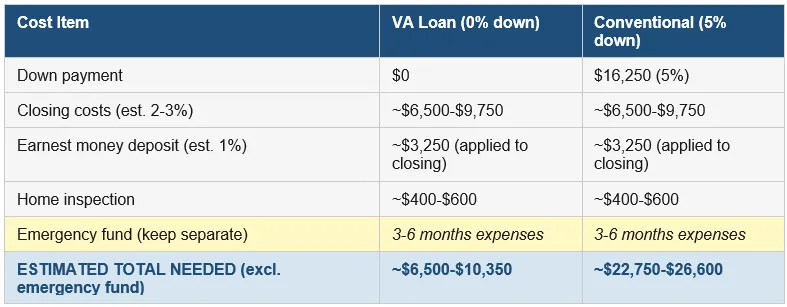
Note: These are estimates for illustration. Actual figures will vary. If the seller agrees to concessions, your cash-to-close can be significantly reduced. Your lender will provide an official Loan Estimate with exact figures.
The Bottom Line
Buying a home in Hampton Roads doesn't require twenty percent down, a perfect credit score, or a bank account that looks like a hedge fund. It requires understanding your options, knowing what numbers actually matter, and working with people who will give you straight answers.
Download the free Budget Worksheet from Blog 2 to map out your specific numbers, or book a free consultation and let's look at your situation together. There may be more options available to you than you realize.
If you'd like help creating a personalized home buying plan for Hampton Roads, book a free consultation at coastalva.chat
You can also download the free Home Buyer Budget Worksheet to map out your numbers before you start.
About the Author: Marc Ian Griffin, aka Captain Real Estate, is a licensed REALTOR and Wealth Advisor with Coastal VA Estates LLC, powered by Keller Williams Town Center. A retired U.S. Navy veteran, Marc has called the Hampton Roads area home since 1992. He entered real estate in 2006 because he saw what was happening to everyday families who were losing thousands and, in many cases, losing their homes simply because they didn't have the right person guiding them through the potential real estate pitfalls - and he was determined to be that person. After a period away from the industry, he returned in 2025 with that same mission. Marc serves buyers and sellers across Virginia Beach, Norfolk, Chesapeake, Portsmouth, Suffolk, Hampton, and Newport News.

Expertise
Deep market knowledge.

Integrity
Honesty and transparency.

Excellence
Top-notch services.
Expertise
Deep market knowledge.
Integrity
Honesty and transparency.
Excellence
Top-notch services.
Coastal VA Estates LLC
Powered by Keller Williams Town Center
1 Columbus Center #301 Virginia Beach, VA 23462
Email: [email protected]
Phone: 757-774-7557
QUICK LINKS
FOLLOW US


© 2026 Coastal VA Estates LLC. All rights reserved. Marc Ian Griffin is a licensed REALTOR® in the Commonwealth of Virginia, powered by Keller Williams Town Center. Equal Housing Opportunity.