

The Hidden Costs of
Selling a Home
Before you count your cash, uncover the closing costs, taxes, and agent fees most sellers miss.
What Sellers Should Budget for Before They List
Most sellers go into the listing process with a number in their head. They look at what homes in their neighborhood have sold for, they subtract what they still owe on the mortgage, and they do the mental math on what they'll walk away with.
That math is almost always wrong — not because sellers are bad at numbers, but because nobody told them all the numbers that need to be in the equation.
The gap between your sale price and what actually hits your bank account at closing can be significant. In some cases it surprises sellers in a good way — they had more equity than they realized. In others, it catches them completely off guard, especially if they were counting on a specific number to fund their next purchase or cover a move.
This blog lays out every cost a seller should account for before they list — so there are no surprises at the closing table.
Agent Commissions
Real estate commissions are typically the largest single cost of selling a home. Traditionally, the seller paid a total commission — split between the listing agent and the buyer's agent — that generally ranged from 5% to 6% of the sale price.
It's worth noting that the real estate industry has seen changes in how commissions are structured and disclosed following recent legal settlements. Today, buyer's agent compensation is increasingly negotiated separately rather than assumed to be seller-paid. Your listing agent will walk you through the current commission structure and what you can expect based on your specific situation and market conditions.
What hasn't changed: agent commissions remain one of the most significant line items in your closing cost calculation. On a $400,000 home, a 5% total commission is $20,000. That comes directly off the top before you see a dollar.
What Commission Pays For
It's easy to look at a commission figure and feel the sticker shock. What's harder to see is what that commission funds: professional photography, paid marketing campaigns, MLS access, negotiation expertise, transaction management, liability coverage, and the network of relationships that get buyers to your door.
The agents who charge less and do less tend to produce results that reflect that. The commission is
not a fee for showing up — it's an investment in the outcome.
Seller-Paid Closing Costs
Beyond commissions, sellers in Virginia are responsible for several closing costs that come due at settlement. These vary based on the sale price, the terms of the contract, and local requirements.
Virginia Grantor's Tax
Virginia imposes a grantor's tax on the seller at the time of property transfer. The standard rate is $1 per $1,000 of the sale price (or $0.50 per $500). On a $400,000 sale, that's $400. In some jurisdictions, additional recordation taxes may apply — your settlement agent will confirm the exact amounts for your locality.
Title and Settlement Fees
The seller typically pays a portion of the title and settlement fees — the costs associated with the title company's work to confirm clear ownership and facilitate the closing. These generally run $400 to $800 on the seller's side, though the exact split is negotiable and sometimes covered entirely by the buyer depending on contract terms.
Attorney and Document Preparation Fees
If an attorney is involved in the transaction for document preparation or legal review, those fees typically run $200 to $500. Not all transactions require attorney involvement, but it's a line item worth being aware of.
Prorated Property Taxes
Property taxes in Virginia are paid in arrears, which means at closing the seller will credit the buyer for the portion of the tax year the seller occupied the home. Depending on when in the tax year you close, this can range from a few hundred to several thousand dollars.
HOA Transfer and Resale Fees
If your home is in a homeowners association, the HOA will typically charge transfer fees, resale certificate fees, and sometimes capital contribution fees when ownership changes hands. These vary widely by association — from $200 to $600 or more — and should be confirmed with your HOA before listing.
Pre-Listing Repairs and Preparation Costs
As we covered in Blog 4, preparing your home for sale is one of the highest-return investments a seller can make. But it is still an investment — and it needs to be budgeted for before you list.
Cosmetic repairs and touch-ups: Paint, patching, fixture replacements, and cleaning can run $500 to $2,000 depending on the condition of the home.
Landscaping and curb appeal: Power washing, mulching, lawn care, and exterior touch-ups typically run $300 to $1,500.
Deferred maintenance: Items you've been putting off — HVAC service, roof repairs, plumbing fixes — should be addressed before listing. The cost varies enormously based on what's been deferred, but budgeting $1,000 to $5,000 for a home with any meaningful age is prudent.
Staging: Professional staging for a vacant home can run $1,500 to $4,000 or more. Partial staging or a consultation is less expensive but still a real cost.
The False Economy of Skipping Prep
Sellers who skip pre-listing preparation to save money almost always spend more in post-inspection repair negotiations than they saved. A buyer's inspector will find what you didn't fix — and the buyer will ask you to pay for it under contract pressure, often at a higher cost than if you'd addressed it on your own terms before listing.
Post-Contract Costs: What Can Come Up After You Accept an Offer
As we covered in Blog 4, preparing your home for sale is one of the highest-return investments a seller can make. But it is still an investment — and it needs to be budgeted for before you list.
The REIN Paragraph 13 Repair Cap
As we covered in Blog 6, the REIN contract defaults to a 1% repair cap under Paragraph 13 if no specific dollar amount is filled in. On a $400,000 home, that's up to $4,000 in repair obligations for qualifying items — appraisal-required repairs (13a), wood-destroying insect and moisture issues (13b), and drinking water and septic (13c) — that the seller is contractually obligated to address even if the buyer waives those items in the PICRA.
Plan for it. Budget for it. Don't be surprised by it.
Buyer Concessions
If you agreed to pay any of the buyer's closing costs as part of the offer negotiation, those concessions come directly off your net at closing. A $6,000 concession on a $400,000 sale is effectively a $394,000 sale. Always evaluate offers on their net-to-seller value — not just the headline price.
Appraisal Gap Negotiations
If the home appraises below the contract price and you agreed to reduce the price to meet the appraised value, that reduction comes directly out of your proceeds. Budget for the possibility — especially in a market where values are shifting.
Title Issues and Hidden Liens
Most sellers never think about this category until it surfaces — and when it does, it can stop a transaction cold.
📖 From the Field
I had a client — a successful business owner and a friend — who was selling a home in Norfolk with beautiful water views. Everything looked good on the surface. The home showed well, we had interest, and we were moving toward a contract.
When the title company completed their search, they found a tax lien against the property for over a million dollars. She had been through an extraordinarily difficult time — she had lost her son, and in the fog of grief that follows something that devastating, the business taxes had gone unfiled for a couple of years. She didn't even realize the full extent of what had accumulated.
That lien didn't go away on its own. It took over a year to untangle the tax situation before the property could sell. A year of carrying costs, a year of stress, a year of a transaction in limbo — all because of something that was invisible until the title search surfaced it.
I share this story not to alarm sellers, but to illustrate why it matters to know what's attached to your property before you list it. If you have any open judgments, unpaid contractor invoices, delinquent HOA assessments, or tax obligations that could have attached to the property — find out now, not at the closing table.
Talk to your agent. Talk to a title company. Know what you're working with before a buyer is waiting on the other end.
Common title issues sellers should be aware of before listing:
Unpaid federal or state tax liens: Tax obligations that go unresolved can attach to real property and must be satisfied before a clean title transfer can occur.
Contractor or mechanic's liens: If work was done on the home and the contractor was not paid in full, they may have filed a lien against the property.
HOA assessment liens: Unpaid HOA dues or special assessments can result in liens that surface at title.
Judgment liens: Court judgments against the owner can attach to real property as a lien.
Survey and boundary issues: As we covered in Blog 7, structures that cross property lines can create title complications that require resolution before closing.
Consider a Pre-Listing Title Search
A pre-listing title search is an inexpensive way to surface any issues attached to your property before a buyer is waiting on the other end. It gives you time to resolve problems on your own terms — not under contract pressure with a closing deadline looming.
Ask your agent or a local title company about ordering one before you list. The peace of mind alone is worth it.
Your Existing Mortgage Payoff
If you have an existing mortgage on the property, the full payoff balance — not just what you think you owe — must be satisfied at closing before you receive any proceeds.
Request a payoff statement from your lender before closing. The payoff amount includes the principal balance, any accrued interest through the payoff date, and potentially prepayment penalties depending on your loan terms. It will be slightly higher than your current statement balance — and it changes daily as interest accrues.
Your closing disclosure will reflect the exact payoff amount. Review it carefully and confirm it against the payoff statement from your lender.
Moving Expenses
Moving expenses are the cost sellers most commonly forget to include in their pre-sale financial planning — because they happen after closing, not at the closing table. But they're a real cost that comes directly out of your proceeds.
Local moves: A local move within Hampton Roads using professional movers typically runs $1,000 to $3,000 depending on the size of the home and the distance.
Long-distance moves: If you're relocating out of the area — common for military sellers receiving PCS orders — moving costs can range from $3,000 to $10,000 or more depending on the distance and volume.
Temporary housing: If there's a gap between your closing and your next home being available, short-term housing costs need to be factored in.
Storage: If you're staging the home and need to store furniture and belongings during the listing period, storage costs add up over weeks or months.
Your Seller Net Sheet: Putting It All Together
Here is a sample seller net sheet based on a $400,000 sale price. These are estimates — your actual numbers will vary based on your mortgage balance, your specific contract terms, and local fee schedules. Your agent should provide you with a personalized net sheet before you list
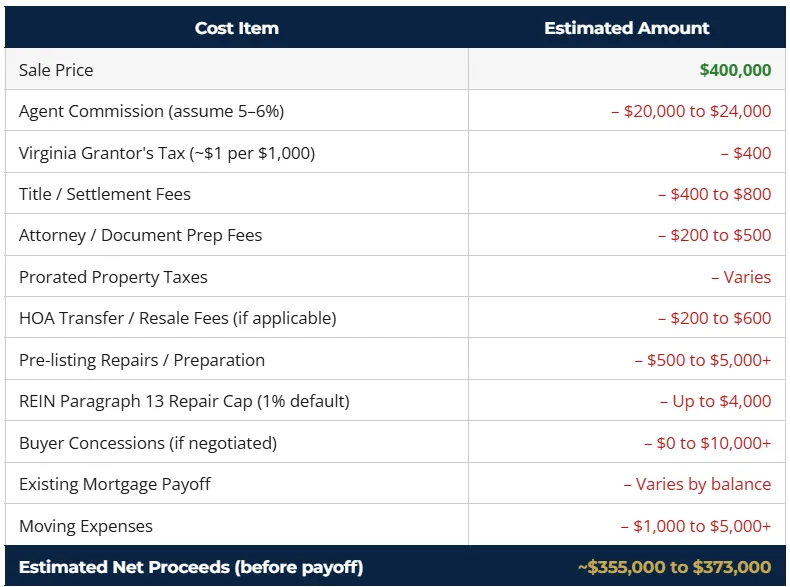
Note: The estimated net proceeds above do not include your mortgage payoff, which varies by remaining balance. Subtract your payoff amount from the net proceeds figure to determine your true cash-in-hand after closing.
Important: These figures are estimates designed to give you a realistic picture of what to expect — not fixed amounts carved in stone. Many of these line items are negotiable. The repair cap defaults to 1% but can be negotiated down, including to zero in competitive situations. Concessions are deal-specific. Commission structures vary. A skilled agent is working to minimize every deduction on that list where possible — and knowing what's negotiable versus what's fixed is part of what that agent brings to the table.
The Number That Actually Matters
The sale price is what goes on the sign. The net proceeds — after every deduction — is what goes in your pocket. Know both numbers before you list, not after you close.
A seller who lists expecting to net $350,000 and walks away with $310,000 didn't lose money — they just didn't have complete information going in. This blog exists so that doesn't happen to you.
The Bottom Line
Selling a home is a significant financial transaction, and the costs involved are real, varied, and easy to underestimate if nobody walks you through them in advance. Commissions, closing costs, repairs, the REIN repair cap, concessions, title issues, your mortgage payoff, and moving expenses all factor into what you actually walk away with.
The sellers who are best prepared are the ones who did this math before they listed — not after they signed. They knew their numbers, they priced strategically, and they made decisions with a clear picture of their bottom line.
Ask your agent for a seller net sheet before you commit to anything. It's one of the most valuable documents in the entire selling process — and it costs you nothing to
get it.
Want to Know Your Real Net Before You List?
I'll run a full seller net sheet for your home so you know exactly what you're working with before you make any decisions.
Book a free consultation at coastalva.chat
About the Author: Marc Ian Griffin, aka Captain Real Estate, is a licensed REALTOR and Wealth Advisor with Coastal VA Estates LLC, powered by Keller Williams Town Center. A retired U.S. Navy veteran, Marc has called the Hampton Roads area home since 1992. He entered real estate in 2006 because he saw what was happening to everyday families who were losing thousands and, in many cases, losing their homes simply because they didn't have the right person guiding them through the potential real estate pitfalls — and he was determined to be that person. After a period away from the industry, he returned in 2025 with that same mission. Marc serves buyers and sellers across Virginia Beach, Norfolk, Chesapeake, Portsmouth, Suffolk, Hampton, and Newport News.

Expertise
Deep market knowledge.

Integrity
Honesty and transparency.

Excellence
Top-notch services.
Expertise
Deep market knowledge.
Integrity
Honesty and transparency.
Excellence
Top-notch services.
Coastal VA Estates LLC
Powered by Keller Williams Town Center
1 Columbus Center #301 Virginia Beach, VA 23462
Email: [email protected]
Phone: 757-774-7557
QUICK LINKS
FOLLOW US


© 2026 Coastal VA Estates LLC. All rights reserved. Marc Ian Griffin is a licensed REALTOR® in the Commonwealth of Virginia, powered by Keller Williams Town Center. Equal Housing Opportunity.