

Building Your First
Real Estate Portfolio
Scale your wealth. Learn how to acquire multiple properties and leverage equity for long-term growth.
Going from One Property to Multiple Properties
Getting your first rental property is a big deal, and if that's as far as you ever go, you've still done more than most people ever will. But here's where it gets exciting:
that first property doesn't have to be the finish line. It can be the first domino.
The difference between owning a rental and building a portfolio is mostly a shift in how you think. One is a thing you own. The other is a system you run. And once you understand how investors actually go from one property to five to ten and beyond, you'll see that it's not magic and it's not luck. It's a repeatable process — one that anybody willing to learn it and stay disciplined can follow.
Remember the Man With 40 Properties?
Way back in Blog 2, I told you about a client of mine — the investor who bought distressed properties out in Suffolk, Carrollton, and Smithfield, lifted the houses, fixed the floor joists, and put tenants in them. By the time he and I were working together, he had close to 40 properties, and that number kept climbing.
I promised we'd come back to him, because his story isn't really about 40 houses. It's about the system that produced them. He didn't get to 40 by saving up and buying one property at a time with fresh cash out of his pocket. Nobody does it that way — the math doesn't work. He got there because he had a repeatable machine: find the property everyone else was scared of, buy it right, fix what needed fixing with his crew, get it rented, and then use that property to help fund the next one. Over and over and over.
That's the secret nobody tells you when you're starting out. Portfolios aren't built by buying houses. They're built by building a system and running it again and again. Let me show you how the engine actually works.
The Engine: Recycling Your Capital
Here's the problem every new investor bumps into. You save up your down payment, you buy a property, and now your money is gone — it's locked up in that house. If you need $40,000 or $50,000 for every deal, and it takes you two years to save that up, you'll own maybe five properties by the time you retire. That's not a portfolio. That's a slow crawl.
The investors who actually scale figured out something powerful: you don't need fresh cash for every deal. You can use the same money over and over by pulling it back out of each property and reusing it. Remember those tools I mentioned back in Blog 5 — the HELOC and the cash-out refinance? This is where they earn their keep.
As a property gains value — through the work you put in and through appreciation — it builds equity. A cash-out refinance or a home equity line lets you pull that equity back out as cash, which you then carry to your next purchase. The property stays yours, it stays rented, it keeps cash flowing. But the capital you had trapped inside it is now free to go to work again on the next deal. That's the whole trick. You're not spending money on real estate. You're recycling it.
The BRRRR Method: The Repeatable Loop
There's a name for the strategy that puts all of this together, and it's become one of the most popular ways to build a portfolio. It's called BRRRR, and it stands for Buy, Rehab, Rent, Refinance, Repeat. If that sounds familiar, it should — it's almost exactly what my 40-property client was doing, years before anybody gave it a catchy name.
Here's how the loop works:
Buy a distressed or undervalued property, below market — the kind most people walk away from.
Rehab it — fix it up, forcing the value up in the process. This is where you create equity instead of waiting years for it.
Rent it out to a good tenant, turning it into a cash-flowing asset.
Refinance it based on the new, higher value — pulling most or all of your invested cash back out.
Repeat — take that recycled cash and do it all over again on the next property.
Let me put some rough numbers on it so you can see the money move. (Idealized round numbers to show the concept — real deals are messier, and often you'll leave a little cash in.)
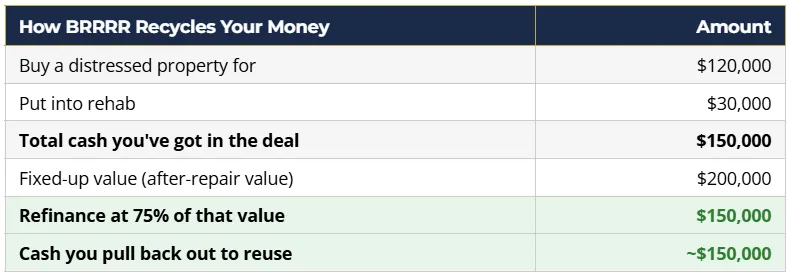
Look at what just happened. You put $150,000 into that deal, forced the value up to $200,000 by fixing it, then refinanced and pulled roughly your whole investment back out — while keeping the property, rented and cash-flowing. Now you've got a rental in your portfolio AND your capital back in your pocket, ready for the next one. That's how one chunk of money turns into a portfolio over time.
Worth Knowing
Real talk: BRRRR rarely works out this perfectly. Sometimes you leave $10,000 or $20,000 in the deal, the appraisal comes in lower than you hoped, or the rehab runs over. That's normal. Even a 'partial BRRRR' where you get most of your money back is a huge win, because you're still scaling far faster than saving up fresh cash for every purchase. Just don't count on the perfect-case numbers when you're planning.
Financing a Growing Portfolio
As you add properties, you'll run into the wall we talked about in Blog 5: conventional loans get harder to qualify for once you've got a handful of mortgages, because they lean on your personal income. This is exactly where the DSCR loan becomes your best friend.
Remember, a DSCR loan qualifies based on the property's rental income instead of yours. So it doesn't care that you already have six mortgages — it only cares whether this property pays for itself. That's the door that lets serious investors keep growing long after conventional financing taps out. Portfolio loans and commercial financing open up more room as you get bigger still. The point is simple: there's always a next financing door, and knowing they exist keeps you from thinking you've hit your ceiling when you haven't.
The Snowball Effect
Here's the part that gets fun. Every property you add doesn't just add its own cash flow — it adds another source of equity you can borrow against, and another stream of income you can reinvest. The whole thing starts to compound.
Say each property throws off a few hundred dollars a month. One property, that's nice pocket money. Five properties, now you've got real income. Ten properties, and the cash flow alone can start funding your next down payments without touching your day job. The rents rise over time. The loans get paid down by your tenants. The equity keeps building. And each new property makes the next one easier to reach. That's the snowball — slow at the top of the hill, then faster and faster as it rolls.
You Can't Scale Without Systems and a Team
Here's something that trips up growing investors. Managing one rental in your spare time is easy. Managing eight is a part-time job you didn't sign up for. At some point, doing everything yourself becomes the very thing that stops you from growing.
My 40-property client didn't answer every maintenance call himself — he had a crew, a process, a way of doing things that didn't depend on him being everywhere at once. That's what let him scale. As your portfolio grows, you'll lean more on systems and on people: a good contractor, a lender who knows you, a solid REALTOR, and very likely a property manager to handle the day-to-day. We're going to dig into that property management decision — do it yourself or hire it out — in the very next blog, because it's one of the most important calls a growing investor makes.
Grow Smart, Not Just Fast
I'd be doing you a disservice if I made this all sound like easy money. Remember the flipper from Blog 6 — the one who lost his house and his sister's house because he overextended and bet on everything going perfectly? That's the shadow side of scaling. The same leverage that builds a portfolio can bury you if you get reckless with it.
So grow with discipline. Keep your reserves strong — every property needs its own cushion for vacancies and repairs. Don't stretch so thin that one bad month topples the whole stack. The investors who last aren't the ones who grew the fastest. They're the ones who grew steady, kept cash on hand, and never bet the farm. Slow and solid beats fast and fragile every single time.
Building a portfolio is one of the most reliable paths to lasting wealth I know of. But it's a marathon, not a sprint — and having someone who's watched investors do it right (and watched others do it wrong) can make all the difference in which group you end up in.
If you have questions about real estate investing in Hampton Roads, book a free consultation at coastalva.chat — there's no obligation, just answers.
Let's Talk
If you have questions about real estate investing in Hampton Roads, book a free consultation at coastalva.chat — there's no obligation, just answers.
Book Your Free Consultation → coastalva.chat
About the Author: Marc Ian Griffin, aka Captain Real Estate, is a licensed REALTOR and Wealth Advisor with Coastal VA Estates LLC, powered by Keller Williams Town Center. A retired U.S. Navy veteran, Marc has called the Hampton Roads area home since 1992. He entered real estate in 2006 because he saw what was happening to everyday families who were losing thousands and, in many cases, losing their homes simply because they didn't have the right person guiding them through the potential real estate pitfalls — and he was determined to be that person. After a period away from the industry, he returned in 2025 with that same mission. Marc serves buyers and sellers across Virginia Beach, Norfolk, Chesapeake, Portsmouth, Suffolk, Hampton, and Newport News.

Expertise
Deep market knowledge.

Integrity
Honesty and transparency.

Excellence
Top-notch services.
Expertise
Deep market knowledge.
Integrity
Honesty and transparency.
Excellence
Top-notch services.
Coastal VA Estates LLC
Powered by Keller Williams Town Center
1 Columbus Center #301 Virginia Beach, VA 23462
Email: [email protected]
Phone: 757-774-7557
QUICK LINKS
FOLLOW US


© 2026 Coastal VA Estates LLC. All rights reserved. Marc Ian Griffin is a licensed REALTOR® in the Commonwealth of Virginia, powered by Keller Williams Town Center. Equal Housing Opportunity.