

Property
Management
Keep cash flow steady and tenants happy. Efficiently handle maintenance, collections, and vacancies.
Self-Manage or Hire a Pro: What to Know Before Becoming a Landlord
Here's a question that trips up more new investors than almost any other, and it has nothing to do with buying the property. It's this: once you own the rental, who's actually going to run it? Because a rental property isn't a painting you hang on the wall and admire. It's a living, breathing little business with a tenant, a building, and a hundred small things that need tending.
You've got two choices. Roll up your sleeves and manage it yourself, or hire a professional property manager to handle it for you. Both are legitimate. Both have real trade-offs. And picking the right one for your situation can be the difference between real estate feeling like freedom or feeling like a second job you can't quit.
So before you become a landlord, let's talk honestly about what you're signing up for either way.
What Managing a Property Actually Involves
A lot of people picture being a landlord as collecting rent checks and not much else. If only. Whether you do it yourself or pay someone, here's the actual job that has to get done month in and month out:
Marketing and filling vacancies. Advertising the unit, showing it, and getting a qualified tenant in fast — because every empty week is money lost, just like we covered with carrying costs back in Blog 3.
Tenant screening. Credit checks, background checks, income verification, rental history. This is the single most important step there is — remember, back in Blog 1 I told you most landlord horror stories start with skipping this. Get it right and half your problems never happen.
Leases and paperwork. Drafting a solid, legally compliant lease and handling renewals, notices, and documentation the right way.
Rent collection. Getting paid on time, every time — and handling it professionally when someone doesn't.
Maintenance and repairs. Fielding the call when the water heater dies at 11 p.m., coordinating the fix, and making sure the work actually gets done right.
Legal compliance. Staying on the right side of Virginia's landlord-tenant laws — and there are more of them than you'd think. More on that in a minute.
The hard stuff. Late payments, lease violations, and in the worst case, evictions — which in Virginia follow a strict legal process you cannot shortcut.
That's the job. Now the only question is whether you do it, or you pay a pro to do it. Let's weigh both.
Option 1: Self-Manage
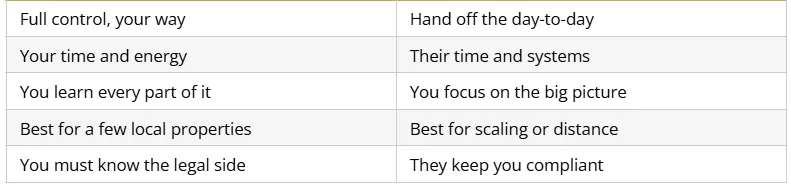
Managing it yourself means you keep the money a property manager would charge — and you keep full control. For a lot of investors starting out with one or two local properties, this is the natural choice, and there's nothing wrong with it. You learn the business from the ground up, you know your tenants, and you pocket that management fee as extra cash flow.
But self-managing is real work, and it's on your schedule whether you like it or not. The 11 p.m. maintenance call is your call. The awkward conversation about late rent is your conversation. And if you don't know Virginia's landlord laws cold, a well-meaning mistake can cost you.
Self-managing works best when:
You own just a few properties, and they're close to where you live.
You've got the time and the temperament to deal with tenants directly.
You want to maximize cash flow and don't mind earning it with your own hours.
You're willing to learn the legal side, or lean on professionals when you need to.
Option 2: Hire a Professional
A property manager takes that entire job off your plate. They market the unit, screen the tenants, sign the leases, collect the rent, coordinate repairs, keep you legal, and handle the ugly stuff when it comes up. You go from running a business to owning an investment that runs itself. For that, they typically charge somewhere around 8% to 12% of the monthly rent, plus a leasing fee when they place a new tenant.
Let me show you what that actually costs on a property renting for $2,000 a month, so it's not abstract:
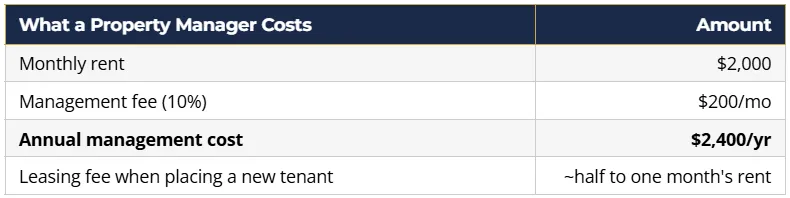
Now, that's real money — it comes straight out of your cash flow, and you have to make sure your numbers still work with it baked in (which is exactly why I had you include property management as a line item back in the Blog 3 analysis). But here's the flip side: a good manager fills vacancies faster, screens out the tenants who'd have cost you thousands, keeps you out of legal trouble, and hands you your life back. For a lot of investors, that's worth every penny.
Self-managing works best when:
You own several properties, or you're actively growing a portfolio.
Your properties are far from where you live — including our military folks who get stationed elsewhere but keep their Hampton Roads rentals.
Your time is worth more spent finding the next deal than fixing the last one's plumbing.
You simply don't want to deal with tenants directly, and that's a perfectly valid choice.
Side by Side

A Word on Virginia's Landlord Laws
This part matters no matter which route you choose, so don't skim it. Virginia has a specific set of rules governing the landlord-tenant relationship — most of it lives under what's called the Virginia Residential Landlord and Tenant Act. It covers things like how much you can collect for a security deposit, how quickly you have to return it, how and when you're allowed to enter the property, the notice you must give, and the exact legal steps you have to follow if you ever need to evict.
These aren't suggestions. Get them wrong — even by accident — and you can lose in court, forfeit money, or get stuck with a tenant you can't remove. This is a big part of why some investors happily pay a property manager: a good one knows these rules cold and keeps you out of trouble. If you self-manage, you'll want to learn them, and it's smart to have a real estate attorney you can call when something tricky comes up. I'm a REALTOR, not a lawyer, so on the legal specifics I'll always point you to someone qualified — but I can absolutely help you find that someone.
How to Choose a Good Property Manager
If you decide to hire out, understand this: not all property managers are created equal. A bad one is worse than no manager at all — they'll cost you money and headaches while charging you for the privilege. Here's what to look for when you're vetting one:
How they screen tenants. Ask them to walk you through their exact process. This is where they earn their fee — or fail you.
How fast they fill vacancies, and their track record. Ask about their average days-on-market and their occupancy rate across the properties they manage.
Their fee structure — all of it. Management fee, leasing fee, renewal fees, maintenance markups, and any charges for vacant months. Get it all in writing.
How they handle maintenance. Do they mark up repairs? What's their network of contractors? How quickly do they respond?
Communication and reporting. How and how often will they update you? Can you see statements and inspections online?
Reviews and references. Talk to other investors who use them. A good local reputation is hard to fake.
There's No Wrong Answer — Just the Right One for You
Here's the honest truth: plenty of wealthy investors self-manage, and plenty hand everything off. Remember my client with close to 40 properties from Blog 2 and Blog 7? He self-managed — but notice he didn't do it with his bare hands and good intentions. He had a crew and a system. That's what made self-managing at that scale even possible.
And you're allowed to change your mind. A ton of investors start out self-managing their first property to learn the ropes and save money, then bring in a pro once they've got a few doors and their time gets stretched thin. There's real wisdom in that path — you understand the job well enough to hold a manager accountable, precisely because you did it yourself first.
The right answer comes down to your time, your temperament, how many properties you've got, and how close they are. There's no shame in either choice — only in going in blind and getting blindsided. And figuring out which path fits your situation is exactly the kind of thing worth talking through together.
Let's Talk
If you have questions about real estate investing in Hampton Roads, book a free consultation at coastalva.chat — there's no obligation, just answers.
Book Your Free Consultation → coastalva.chat
About the Author: Marc Ian Griffin, aka Captain Real Estate, is a licensed REALTOR and Wealth Advisor with Coastal VA Estates LLC, powered by Keller Williams Town Center. A retired U.S. Navy veteran, Marc has called the Hampton Roads area home since 1992. He entered real estate in 2006 because he saw what was happening to everyday families who were losing thousands and, in many cases, losing their homes simply because they didn't have the right person guiding them through the potential real estate pitfalls — and he was determined to be that person. After a period away from the industry, he returned in 2025 with that same mission. Marc serves buyers and sellers across Virginia Beach, Norfolk, Chesapeake, Portsmouth, Suffolk, Hampton, and Newport News.

Expertise
Deep market knowledge.

Integrity
Honesty and transparency.

Excellence
Top-notch services.
Expertise
Deep market knowledge.
Integrity
Honesty and transparency.
Excellence
Top-notch services.
Coastal VA Estates LLC
Powered by Keller Williams Town Center
1 Columbus Center #301 Virginia Beach, VA 23462
Email: [email protected]
Phone: 757-774-7557
QUICK LINKS
FOLLOW US


© 2026 Coastal VA Estates LLC. All rights reserved. Marc Ian Griffin is a licensed REALTOR® in the Commonwealth of Virginia, powered by Keller Williams Town Center. Equal Housing Opportunity.