

Fix and Flip vs.
Buy and Hold
Choose the investment strategy that fits your goals. Evaluate the timelines, capital requirements,
and profitability of both models.
What Strategy Is Right for Your Goals?
There are two big roads in real estate investing, and most new investors eventually have to decide which one they're driving down. One is fix and flip — buy it, fix it, sell it, take your profit, move on. The other is buy and hold — buy it, rent it, keep it, and let it build wealth for years. Both can make you money. They just make it in completely different ways, and they ask completely different things of you.
There's no universally right answer here. The right strategy is the one that fits your goals, your timeline, your stomach for risk, and honestly, your temperament. So let's break both of them down, and then I'm going to tell you a story that'll stick with you — about a flip that went about as wrong as a flip can go.
Fix and Flip: The Fast Money Play
Flipping is what most people picture when they think about real estate investing, probably because it's what all the TV shows are built on. You buy a distressed or dated property below market, put money and work into fixing it up, and sell it for more than you've got into it. The profit comes fast — a good flip might wrap up in a few months — and then you're on to the next one.
When it works, it works well. But flipping is a lot more like running a business than owning an investment. You're managing a renovation, a budget, a crew, a timeline, and a sale, all at once. And the whole thing runs on a clock.
What flipping demands of you
A real handle on renovation costs — because every dollar over budget comes straight out of your profit.
A reliable contractor and crew, or the skills to do the work yourself.
Enough capital — or the right financing — to buy AND renovate AND carry the property until it sells.
A sharp read on the after-repair value: what the finished house will actually sell for, not what you hope it sells for.
Nerves. Because the market can move under you while you're mid-project.
And here's the piece that sinks more flippers than any other — the one we started talking about back in Blog 3. Carrying costs. Every single day you own that property before it sells, you're bleeding money. The loan, the taxes, the insurance, the utilities — all ticking away while you renovate, while you list, while you wait for a buyer. On a flip, time isn't just money. Time is the enemy.
A Flip That Went About as Wrong as It Gets
Let me tell you about an investor I crossed paths with years back. I was on the other side of a deal from him — I represented the buyer, he was on the selling end — so I had a front-row seat to how the whole thing unraveled. I'll keep him anonymous, but the lesson is worth every bit of the discomfort.
This fella had bought a house to flip, and he'd financed it with a hard money loan. Now, remember what we said about hard money back in Blog 5 — it's fast, it's expensive, and the clock is always ticking. That clock is the whole point. Hard money is short-term money, and it expects to get paid back quickly.
Well, the market started to shift on him. And he couldn't get the house sold in time. The hard money loan came due, he didn't have the money to pay it back, and he couldn't sell fast enough to cover it. So the lender took the house. That's how hard money works — you don't pay, they take the asset. That's the deal you signed.
But here's the part that still gets me. He'd been so confident, so overextended, that he'd talked his own sister into putting up her house to help him with his investing. When it all came crashing down, he didn't just lose the flip. He lost her house too. One bad flip, financed with money he couldn't pay back on a timeline he couldn't meet, and it took down two homes — his and his sister's.
The lesson isn't 'never use hard money.'
Hard money is a legitimate tool, and plenty of successful flippers use it well. The lesson is respect it. That short clock is real. If you're going to flip with hard money, you'd better have a firm grip on your timeline, a realistic sale price, a cushion for when things run long, and a backup plan if the market moves. This man had none of that. He bet everything on it all going perfectly — and real estate almost never goes perfectly. Never risk what you can't afford to lose, and for heaven's sake, don't drag family down with you.
Buy and Hold: The Slow, Steady Wealth Play
Now let's talk about the other road — the one I lean toward for most everyday investors. Buy and hold is exactly what it sounds like. You buy a property, you rent it out, and you hold onto it for the long haul. Instead of one payday from a sale, you get years of monthly cash flow, appreciation, loan paydown, and tax benefits — those four wealth-builders we talked about all the way back in Blog 1, all working together, year after year.
Remember the investor from Blog 2? The one with close to 40 properties out in Suffolk, Carrollton, and Smithfield? That's buy and hold done right. He wasn't chasing quick sales. He was building something that paid him month after month and grew into a small empire over time. That's the quiet power of this strategy — it's not flashy, but it compounds.
What buy and hold demands of you
Patience — this is a long game measured in years, not months.
The willingness to be a landlord, or to hire one (we'll cover that in Blog 8).
Properties that actually cash flow, analyzed the right way like we did in Blog 3.
Reserves to handle vacancies, repairs, and the occasional bad month.
The beauty of buy and hold is that time works FOR you instead of against you. On a flip, every extra month is a threat. On a buy and hold, every extra month is another mortgage payment your tenant made for you, another month of appreciation, another step toward owning that property free and clear.
Side by Side
Here's the honest comparison, laid out plain:
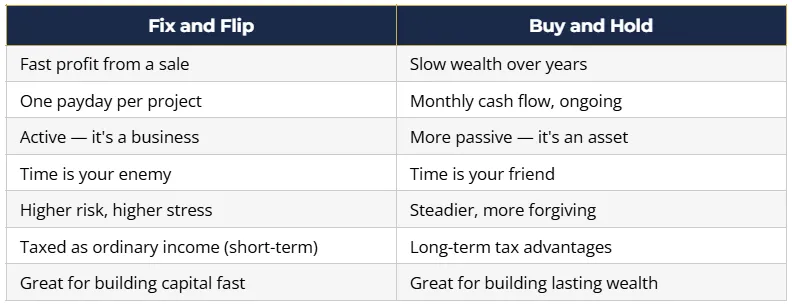
So Which One Is Right for You?
Ask yourself a few honest questions. Do you need money now, or are you building for the future? Do you have the time and stomach to run renovations, or would you rather buy something and let it work quietly in the background? How much risk can you actually live with — not in theory, but at 2 a.m. when a deal is going sideways?
For most everyday investors, especially those just starting out, buy and hold is the steadier path to real wealth, and it's the one I most often point people toward. Flipping can be a fantastic way to build up capital fast — but it's less forgiving, and as our story showed, the downside can be brutal when it's financed on a short clock and a lot of hope.
And plenty of investors do both. They flip a couple properties to build up cash, then use that cash to buy and hold for the long term. The two strategies can feed each other. There's no rule that says you have to pick one and marry it.
The right answer is the one that fits your life and your goals — and that's exactly the kind of thing worth talking through with someone who's watched both strategies play out, the good and the bad.
Let's Talk
If you have questions about real estate investing in Hampton Roads, book a free consultation at coastalva.chat — there's no obligation, just answers.
Book Your Free Consultation → coastalva.chat
About the Author: Marc Ian Griffin, aka Captain Real Estate, is a licensed REALTOR and Wealth Advisor with Coastal VA Estates LLC, powered by Keller Williams Town Center. A retired U.S. Navy veteran, Marc has called the Hampton Roads area home since 1992. He entered real estate in 2006 because he saw what was happening to everyday families who were losing thousands and, in many cases, losing their homes simply because they didn't have the right person guiding them through the potential real estate pitfalls — and he was determined to be that person. After a period away from the industry, he returned in 2025 with that same mission. Marc serves buyers and sellers across Virginia Beach, Norfolk, Chesapeake, Portsmouth, Suffolk, Hampton, and Newport News.

Expertise
Deep market knowledge.

Integrity
Honesty and transparency.

Excellence
Top-notch services.
Expertise
Deep market knowledge.
Integrity
Honesty and transparency.
Excellence
Top-notch services.
Coastal VA Estates LLC
Powered by Keller Williams Town Center
1 Columbus Center #301 Virginia Beach, VA 23462
Email: [email protected]
Phone: 757-774-7557
QUICK LINKS
FOLLOW US


© 2026 Coastal VA Estates LLC. All rights reserved. Marc Ian Griffin is a licensed REALTOR® in the Commonwealth of Virginia, powered by Keller Williams Town Center. Equal Housing Opportunity.