

Professional Photos,
Marketing, and Exposure
The blueprint to turning casual online scrollers into motivated, serious buyers.
Show Up or Get Passed Up
Why Marketing Exposure Wins or Loses the Sale
There was a time when selling a home meant putting a sign in the yard, listing it in the MLS, and waiting for buyers to show up. That time is gone.
Today's buyers start their search online — often weeks or months before they ever contact an agent. They scroll through photos, watch video walkthroughs, compare listings side by side, and form strong opinions about homes before they've set foot inside a single one. By the time a buyer schedules a showing, they've already narrowed their list. If your home wasn't on that list, the sign in your yard doesn't matter.
This blog is about what it actually takes to show up in front of the right buyers — and what happens to the homes that don't.
Where Buyers Are Actually Looking
Understanding where buyers spend their time is the foundation of any effective marketing strategy. The data is consistent: the overwhelming majority of home searches begin online, and buyers use multiple platforms before they ever pick up the phone.
Understanding where buyers spend their time is the foundation of any effective marketing strategy. The data is consistent: the overwhelming majority of home searches begin online, and buyers use multiple platforms before they ever pick up the phone.
Zillow, Realtor.com, and Homes.com are the primary search portals. Buyers filter by price, location, bedroom count, and photos. If your listing photos don't stop the scroll in the first two or three images, they move on.
Social media — Facebook, Instagram, and YouTube in particular — is where buyers discover homes they weren't actively searching for. A well-executed paid campaign can put your home in front of buyers who didn't know they were looking until they saw it.
YouTube and video platforms are increasingly where buyers research neighborhoods, do virtual walkthroughs, and evaluate markets they're relocating to. Military buyers transferring to Hampton Roads are especially active here.
Agent networks still matter enormously. A listing agent with strong relationships in the local agent community can generate showing activity through direct outreach before a home even hits the public market.
Email campaigns to curated buyer databases can surface your home to active, qualified buyers who have already expressed interest in homes in your area and price range.
The Hampton Roads Relocation Factor
Hampton Roads is one of the largest military communities in the world. At any given time, there are servicemembers and their families relocating to this area from bases across the country — and they are doing almost all of their home research online before they arrive. A home that isn't visible on video platforms, social media, and the major portals is invisible to a massive and highly motivated buyer segment.
Professional Photography: The Non-Negotiable
If there is one thing in this blog you take away above everything else, let it be this: professional photography is not optional. It is the single most impactful marketing investment a seller can make, and no amount of pricing strategy or description copy will overcome a bad photo lineup.
Buyers make split-second judgments based on listing photos. In a competitive market, a home with dark, blurry, or poorly composed photos will be skipped in favor of the next listing — regardless of what the home actually looks like in person.
What Professional Photography Delivers
Proper lighting: Professional photographers use equipment and technique to capture the natural light in your home accurately — making rooms feel bright, open, and inviting.
Volume: Most MLS platforms allow a significant number of photos. A professional shoot gives you the inventory to tell the full visual story of your home — not just the highlight reel.
Correct angles and composition: A wide-angle lens and thoughtful framing make rooms appear larger and more functional. A smartphone shot from the doorway does the opposite.
Editing and post-processing: Color correction, exposure balancing, and sky replacement for exterior shots — the details that separate a listing photo from a marketing photo.
Volume: Most MLS platforms allow a significant number of photos. A professional shoot gives you the inventory to tell the full visual story of your home — not just the highlight reel.
Smartphone Photos Are Costing Sellers Money
Homes listed with professional photography sell faster and for more money than homes listed with amateur photos consistently, across markets. The cost of a professional real estate photographer in Hampton Roads is a fraction of what poor photos cost you in reduced buyer interest, fewer showings, and lower offers. This is not a place to cut corners.
Video, Drone, and the Digital Walkthrough
Photos get buyers to the door. Video gets them invested before they arrive.
A well-produced video walkthrough lets buyers experience the flow of your home in a way that photos simply can't replicate. They see how the spaces connect, how the light moves through the home, how the layout actually feels. For buyers who are relocating from out of state — a significant portion of the Hampton Roads market — video may be the closest thing to an in-person showing they get before making an offer.
Walkthrough video: A professionally shot and edited video tour narrated or set to music that guides buyers through every key area of the home.
Drone footage: Aerial photography and video are particularly powerful for homes with acreage, water views, waterfront access, or proximity to key landmarks. They also provide neighborhood context that ground-level photos can't capture.
Digital tours: Interactive 3D tours allow buyers to virtually navigate your home at their own pace — an increasingly expected feature in today's market.
Video and the Military Buyer
A servicemember receiving PCS orders to Hampton Roads often has 30 days or less to find a home — sometimes from thousands of miles away. A listing with a professional video walkthrough and drone footage is not just a nice feature to that buyer. It may be the deciding factor in whether they schedule an in-person showing or make an offer sight-unseen. Sellers who provide this level of visibility tap into one of the most motivated buyer segments in the entire Hampton Roads market.
Beyond the MLS: What a Real Marketing Campaign Looks Like
Submitting your home to the MLS is the starting line — not the finish line. The MLS syndicates your listing to the major portals automatically, but syndication is passive. A real marketing campaign is active. It finds buyers instead of waiting for them.
Paid Social Media Advertising
Most agents post a listing on their personal Facebook page and call it social media marketing. That is not a campaign — that is an announcement to people who already know the agent.
A genuine paid social campaign targets buyers based on geography, demographics, income, life events (like recent job changes or military assignments), and browsing behavior. It puts your home in front of people who are actively in the market but may not yet be searching on Zillow. It creates discovery — and discovery creates demand.
Email Marketing to Active Buyer Databases
A well-maintained buyer database is one of the most underutilized assets in real estate marketing. When a new listing matches the criteria of buyers who have already expressed interest in a specific area and price range, a direct email campaign can generate showing requests within hours of going live — before the MLS traffic even picks up.
Agent-to-Agent Outreach
In Hampton Roads, the agent community is active and well-connected. A listing agent who proactively reaches out to buyer's agents with qualified clients in your price range — before and immediately after listing — can generate early showing momentum that shapes the entire trajectory of your sale.
Open Houses — Done Right
Open houses are not just about the buyers who walk through. They're a marketing event that creates visible activity around your home. A well-promoted open house — advertised on social media, the portals, and through the agent network — signals to the market that your home is active, available, and worth seeing.
What to Demand From the Agent You Hire
Here is a question most sellers never think to ask: Does my agent actually know how to market a home — or do they know how to list one?
There is a meaningful difference. Listing a home means entering it into the MLS and waiting. Marketing a home means building a strategy, executing a campaign, and actively driving buyer attention to your property across multiple channels. Most real estate agents are not trained marketers. They're trained in contracts, negotiations, and transactions — all critically important skills. But when it comes to digital advertising, paid social campaigns, SEO, video production, and audience targeting, the average agent is working with limited tools and limited experience.
Before you sign a listing agreement, ask your agent these questions:
Will you use professional photography — and is it included?
Do you run paid advertising campaigns for your listings — on which platforms and with what budget?
How do you market to buyers who aren't actively searching the MLS right now?
Do you have a buyer database you'll email when my home lists?
What does your social media marketing strategy look like specifically for my home?
Can you show me examples of how you've marketed similar listings?
A Different Kind of REALTOR
Before returning to real estate, I spent over ten years in professional marketing — running my own marketing company for six years and working as a marketing coach. I held Google Ads and Google Search certifications for years and have managed hundreds of thousands of dollars in digital ad spend across campaigns for clients in multiple industries.
I bring that background to every listing I take. When your home goes on the market with Coastal VA Estates, it gets a real marketing campaign — not a personal Facebook post and a prayer. Paid social ads targeted to active buyers. Video content built for platforms where buyers are actually spending time. Email outreach to a curated database. Professional photography as a standard, not an upgrade.
Most sellers never think to ask whether their agent knows how to run a digital ad campaign. You should. Because in today's market, the agent you hire is also the marketer you hire — and that choice directly affects how many buyers see your home and what they're willing to pay for it.
Minimum Effort vs. Full Marketing: Side by Side
Here is what the gap looks like between an agent who lists your home and an agent who markets it:
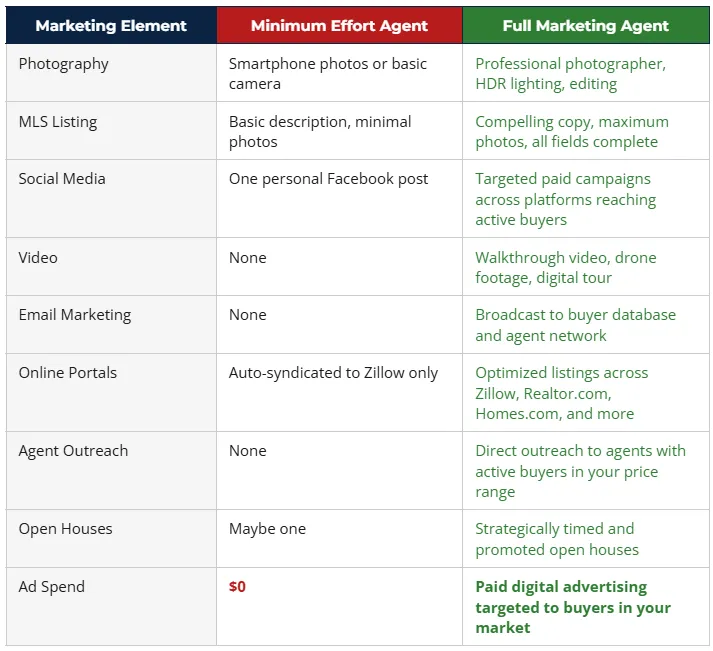
The column on the right is not a luxury tier. It is what effective home marketing looks like in today's market. Sellers who receive the minimum often don't realize what they're missing — until they compare their results to a neighbor who listed with someone who showed up differently.
Staging and Marketing Work Together
Everything we covered in Blog 4 about preparation and staging feeds directly into this blog. Marketing exposure gets buyers to look at your home. Staging and preparation determine what they see when they look.
A beautifully staged home photographed by a professional, promoted through paid campaigns, featured in a video walkthrough, and distributed across every major platform creates a compounding effect: more buyers see it, more buyers want to see it in person, and more buyers competing for it drives up your final sale price.
The reverse is also true. The best marketing in the world can't save a cluttered, poorly lit home from bad listing photos. Preparation and marketing are not separate strategies — they are two halves of the same campaign.
The Bottom Line
Your home will only sell if buyers can find it — and in today's market, finding it means showing up on the platforms where buyers are looking, in a way that stops the scroll and earns the showing.
A sign in the yard and an MLS listing are the minimum. They are not a strategy. The sellers who get the most showings, the strongest offers, and the best final sale prices are the ones whose homes were marketed — not just listed.
Show up, or get passed up. It really is that simple.
Ready to Show Up and Stand Out?
Let's build a marketing plan for your Hampton Roads home that puts it in front of the right buyers — not just on the MLS.
Book a free consultation at coastalva.chat
About the Author: Marc Ian Griffin, aka Captain Real Estate, is a licensed REALTOR and Wealth Advisor with Coastal VA Estates LLC, powered by Keller Williams Town Center. A retired U.S. Navy veteran, Marc has called the Hampton Roads area home since 1992. He entered real estate in 2006 because he saw what was happening to everyday families who were losing thousands and, in many cases, losing their homes simply because they didn't have the right person guiding them through the potential real estate pitfalls — and he was determined to be that person. After a period away from the industry, he returned in 2025 with that same mission. Marc serves buyers and sellers across Virginia Beach, Norfolk, Chesapeake, Portsmouth, Suffolk, Hampton, and Newport News.

Expertise
Deep market knowledge.

Integrity
Honesty and transparency.

Excellence
Top-notch services.
Expertise
Deep market knowledge.
Integrity
Honesty and transparency.
Excellence
Top-notch services.
Coastal VA Estates LLC
Powered by Keller Williams Town Center
1 Columbus Center #301 Virginia Beach, VA 23462
Email: [email protected]
Phone: 757-774-7557
QUICK LINKS
FOLLOW US


© 2026 Coastal VA Estates LLC. All rights reserved. Marc Ian Griffin is a licensed REALTOR® in the Commonwealth of Virginia, powered by Keller Williams Town Center. Equal Housing Opportunity.