Investment Property
Financing
Maximize your buying power. Learn how to leverage creative financing, optimize loan terms,
and structure debt to scale faster.
Conventional, DSCR, Portfolio Loans, and Other Options
Let me tell you what makes real estate different from just about every other way to build wealth. It's this: you can buy it with mostly other people's money. Try walking into a bank and asking to borrow $200,000 to buy stocks. They'll laugh you out of the building. But buy a rental property? They'll hand you the money all day long, because there's a real asset behind it. That borrowed money — that leverage — is the engine that makes real estate so powerful.
And here's the thing most new investors don't realize: how you finance a property matters just as much as which property you buy. The right loan can turn a so-so deal into a good one. The wrong loan can sink a great property. So in this blog, we're going to open up the whole financing toolbox and go through your options one by one.
Now, back in Blog 4 we spent real time on the owner-occupant loans — the VA and the FHA — the ones you use when you're going to live in the property. Those are your best terms, hands down, and if you can house hack your way in, do it. But most of the time, as an investor, you're buying a property you won't live in. That's a different world with different rules, and that's what we're focused on here.
First, Understand How Lenders See You as an Investor
When you buy a home to live in, the lender is betting on you — your job, your income, your credit. When you buy an investment property, they're betting on you AND the property. And because a landlord is statistically more likely to walk away from a rental than from the roof over their own family's head, they treat investor loans as riskier.
That shows up in three ways:
Bigger down payments. Forget 3.5% down. On investment property you're typically looking at 20% to 25% down, sometimes more on multi-unit.
Higher interest rates. Investor loans usually carry a rate a bit above what an owner-occupant gets. It's the price of the lender's added risk.
Cash reserves. Lenders often want to see months of payments sitting in the bank — proof you can carry the property if a tenant stops paying. Remember our carrying-costs talk from Blog 3? Lenders think about that too.
None of this should scare you off. It just means you plan for it. Now let's walk through the actual loan types, because you've got more options than most people ever realize.
Your Financing Options, One by One
1. Conventional Investment Loans
This is the workhorse — the loan most investors use for their first few properties. It's a standard mortgage through the same system (Fannie Mae and Freddie Mac) that backs most home loans, just written for a non-owner-occupied property. You'll put down 20% to 25%, and you'll qualify based on your personal finances: your income, your credit score, and your debt-to-income ratio.
Conventional loans give you the best rates and terms on the investor side, so they're where most people start. The catch is they lean entirely on your personal income and debt picture — and there's a limit. The system allows up to 10 financed properties, but somewhere around the fourth or fifth, the requirements tighten up and it gets harder to keep qualifying on your income alone. That's exactly where the next option becomes a game-changer.
2. DSCR Loans — the Investor's Secret Weapon
DSCR stands for Debt Service Coverage Ratio, and this loan type has quietly become one of the most important tools for serious investors. Here's why it's special: a DSCR loan qualifies based on the property's income, not yours. No tax returns. No W-2s. No debt-to-income ratio. The lender looks at one question — does this property earn enough rent to cover its own loan payment?
The ratio itself is simple. You take the property's monthly rent and divide it by its total monthly payment (principal, interest, taxes, insurance, and any association dues). Watch:
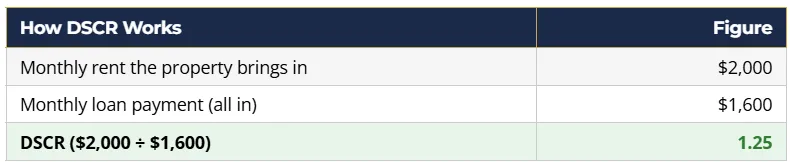
A DSCR of 1.25 means the property earns 25% more than its loan costs. Lenders love to see that. Anything at 1.0 or above means the rent covers the payment; most DSCR lenders want to see somewhere around 1.0 to 1.25 or better. If the property pencils out, you can qualify — even if you're self-employed, even if your tax returns are complicated, even if you've already got a stack of other mortgages.
That's the magic of DSCR: it lets the property stand on its own two feet. It's how investors blow past the conventional loan limits and keep growing. The trade-off is a somewhat higher interest rate and usually 20% to 25% down. But for the right investor, that's a price well worth paying for the freedom to keep buying.
A DSCR of 1.25 means the property earns 25% more than its loan costs. Lenders love to see that. Anything at 1.0 or above means the rent covers the payment; most DSCR lenders want to see somewhere around 1.0 to 1.25 or better. If the property pencils out, you can qualify — even if you're self-employed, even if your tax returns are complicated, even if you've already got a stack of other mortgages.
That's the magic of DSCR: it lets the property stand on its own two feet. It's how investors blow past the conventional loan limits and keep growing. The trade-off is a somewhat higher interest rate and usually 20% to 25% down. But for the right investor, that's a price well worth paying for the freedom to keep buying.
3. Portfolio Loans
A portfolio loan is one the lender keeps in-house instead of selling off to Fannie or Freddie. Because they're keeping it on their own books, they get to make their own rules. That means flexibility — they can work with situations a conventional loan won't touch, and some will even bundle several properties under one loan to simplify your life. Local banks and credit unions are often where you'll find these. Rates run a little higher, but when you've got a situation that doesn't fit the standard box, a portfolio lender can be your best friend.
4. Commercial Loans
Once you step up to a property with five or more units, you've crossed into commercial territory, and the financing changes. Commercial loans lean heavily on how the property performs rather than on you personally. The terms look different too — often shorter, sometimes with a balloon payment down the road. This isn't where most folks start, but it's good to know it's there when your ambitions grow into bigger buildings.
5. Hard Money and Private Money
These are short-term, fast-moving loans built for speed, not for holding. Hard money comes from companies that lend against the deal itself — they care more about the property and the numbers than about your credit. It's expensive money, with high rates and upfront points, but it closes fast, which is exactly what you need when you're grabbing a flip or a distressed property before someone else does. Private money is similar, just coming from an individual instead of a company. We'll talk more about when this makes sense in Blog 6, because it's a natural fit for the fix-and-flip game.
6. Tapping Your Equity: HELOCs and Cash-Out Refinances
Here's one that becomes powerful once you own a property or two. As your real estate builds equity — through appreciation and loan paydown — you can borrow against that equity to fund your next purchase. A HELOC (home equity line of credit) or a cash-out refinance lets you pull that trapped money out and put it to work on the next deal. This is one of the main engines of how investors scale from one property to many, and we'll get into that strategy in Blog 7.
The Toolbox at a Glance
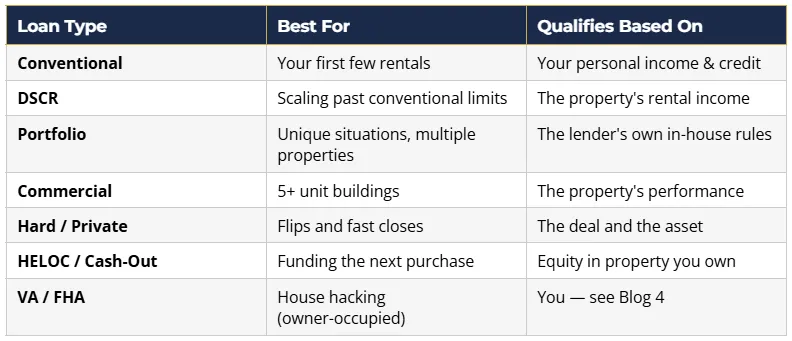
Here's the whole lineup side by side, so you can see which tool fits which job:
A Word on Leverage — Handle With Care
I told you at the top that leverage is the engine of real estate. Let me be straight with you about the other side of that. Leverage cuts both ways. When you borrow to buy an appreciating, cash-flowing property, leverage multiplies your returns beautifully. But borrow too much, or buy a property that can't carry its own debt, and that same leverage can bury you.
The investors who get in trouble are almost always the ones who over-leveraged — stretched too thin, no reserves, betting everything would go perfectly. And real estate rarely goes perfectly. Tenants leave. Roofs fail. Markets soften. The investor who borrowed smart and kept cash in reserve rides those bumps out. The one who borrowed to the hilt gets forced to sell at the worst possible time.
Worth Knowing
Use leverage as a tool, not a dare. Just because a lender will approve you for something doesn't mean the deal is safe. Run your numbers like we did in Blog 3, keep your holding capital in reserve, and never let the excitement of a 'yes' from the bank override what your own math is telling you.
The Bottom Line
The financing you choose shapes every deal you do. Conventional loans get most people started. DSCR loans let you keep growing when your personal income can't carry any more. Portfolio, commercial, hard money, and equity lines each solve a particular problem at a particular stage. You don't need to master all of them today — you just need to know they exist, so that when you hit a wall with one, you know there's another door.
And this is one of those areas where the right people in your corner earn their keep. A good investor-friendly lender is worth their weight in gold, and part of my job is connecting you with the folks who know these loans inside and out. You don't have to figure out which door to walk through by yourself.
Let's Talk
If you have questions about real estate investing in Hampton Roads, book a free consultation at coastalva.chat — there's no obligation, just answers.
Book Your Free Consultation → coastalva.chat
About the Author: Marc Ian Griffin, aka Captain Real Estate, is a licensed REALTOR and Wealth Advisor with Coastal VA Estates LLC, powered by Keller Williams Town Center. A retired U.S. Navy veteran, Marc has called the Hampton Roads area home since 1992. He entered real estate in 2006 because he saw what was happening to everyday families who were losing thousands and, in many cases, losing their homes simply because they didn't have the right person guiding them through the potential real estate pitfalls — and he was determined to be that person. After a period away from the industry, he returned in 2025 with that same mission. Marc serves buyers and sellers across Virginia Beach, Norfolk, Chesapeake, Portsmouth, Suffolk, Hampton, and Newport News.

Expertise
Deep market knowledge.

Integrity
Honesty and transparency.

Excellence
Top-notch services.
Expertise
Deep market knowledge.
Integrity
Honesty and transparency.
Excellence
Top-notch services.
Coastal VA Estates LLC
Powered by Keller Williams Town Center
1 Columbus Center #301 Virginia Beach, VA 23462
Email: [email protected]
Phone: 757-774-7557
QUICK LINKS
FOLLOW US


© 2026 Coastal VA Estates LLC. All rights reserved. Marc Ian Griffin is a licensed REALTOR® in the Commonwealth of Virginia, powered by Keller Williams Town Center. Equal Housing Opportunity.