

How to Prepare
Your Home for Sale
First impressions matter. Learn exactly what buyers look for the second they walk in.
Simple Improvements That Make a Big Difference
There's a version of home selling where you put a sign in the yard, list on the MLS, and hope for the best. And there's a version where you walk away from the closing table with the number you wanted.
The difference between those two outcomes often comes down to what happened before the listing went live — the decisions you made, the work you put in, and whether you were willing to see your home through a buyer's eyes instead of your own.
Preparing your home for sale is not about spending a fortune on renovations. It's about making smart, strategic improvements that directly affect how buyers perceive your home — and what they're willing to pay for it. This guide walks you through every area of your home, from curb to closing, so you know exactly what to focus on.
Start Here: The Mindset Shift That Changes Everything
Before you move a single piece of furniture or pick up a paintbrush, there's a mental shift that makes everything else easier.
Your home is no longer your home. It is a product on the market competing for buyers' attention. The memories, the personal touches, the quirks you've grown to love — none of that transfers to a buyer who has never lived there. What transfers is condition, presentation, and the feeling a buyer gets when they walk through the door.
That feeling — the one that makes a buyer say "I can see myself living here" — doesn't happen by accident. It gets built through preparation.
The Buyer's First Impression Starts Online
In today's market, the majority of buyers see your home for the first time on a screen — not in person. They're scrolling through listing photos on Zillow, Realtor.com, or their agent's app before they ever schedule a showing. If those photos don't stop the scroll, they move on. Everything you do to prepare your home feeds directly into how it photographs — and how it photographs determines how many buyers walk through the door.
Curb Appeal: The First Photo Buyers See
Curb appeal is not a nice-to-have. It is the first impression your home makes — and in a world where buyers decide within seconds whether to click on a listing, it may be the most important impression of all.
The exterior of your home is the lead photo in your listing. It's what buyers picture when they think about your address. It's what they see when they pull up for a showing. If it doesn't make them feel good before they walk in, you're already fighting uphill.
Exterior Essentials:
Landscaping: Mow, edge, and trim everything. Pull weeds. Add fresh mulch to flower beds. If the lawn has bare patches, seed or sod them. A manicured yard signals that the home has been cared for — and buyers notice.
Power washing: Driveways, walkways, the driveway, the front porch, and the exterior siding all benefit from a good power wash. It's one of the highest-return prep tasks you can do for the money.
Front door: Your front door is the focal point of your exterior photos. If the paint is peeling, the hardware is tarnished, or the door just looks tired — replace the hardware, repaint it, or replace it entirely. A fresh front door has an outsized impact on first impressions.
Details matter: Replace cracked house numbers, rusted mailboxes, and broken light fixtures. These are small costs with disproportionate visual impact.
Seasonal plants: A few inexpensive potted plants or flowers near the entry add color, warmth, and life to exterior photos without a major investment.
Hampton Roads Specific: Watch Your Gutters and Exterior Moisture
In today's market, the majority of buyers see your home for the first time on a screen — not in person. They're scrolling through listing photos on Zillow, Realtor.com, or their agent's app before they ever schedule a showing. If those photos don't stop the scroll, they move on. Everything you do to prepare your home feeds directly into how it photographs — and how it photographs determines how many buyers walk through the door.
Decluttering: The Highest-Return Task in Home Preparation
If you do nothing else to prepare your home, declutter it. Ruthlessly, thoroughly, and without mercy.
Clutter makes spaces feel smaller, distracts buyers from the features of your home, and photographs terribly. It also signals to buyers — consciously or not — that the home lacks storage. Even a beautifully updated home with great bones will underperform at showing if it's visually busy.
Every room: Remove anything that isn't essential to daily living. If you're not sure whether to keep it or store it — store it.
Closets: Buyers open closets. A packed closet reads as a storage problem. Remove at least half of what's in each closet so the space looks generous.
Countertops: Kitchen and bathroom counters should be nearly empty. Small appliances, toiletries, mail, and decorative clutter all need to go.
Garage: If your garage is full, rent a storage unit. A garage that can't fit a car is a feature buyers can't see.
Personal items: Family photos, children's artwork, religious items, and highly personalized décor should be packed away. You want buyers to picture their life in the home — not observe yours.
Storage Units Are a Selling Tool
Renting a storage unit for the duration of your listing is one of the best investments you can make. The monthly cost is minimal compared to what a clean, spacious-feeling home can add to your final sale price — and you've already started packing for your move.
Cleaning: Beyond What You Think Is Clean
Your home needs to be cleaned at a level you've probably never cleaned it before. Not because it's dirty — but because buyers are looking at everything with fresh eyes, and they notice what you've stopped seeing.
Hire a professional deep clean. For most sellers, this is the right move. A professional cleaning crew will get into corners, baseboards, vents, ceiling fans, window tracks, and appliances in ways that a standard cleaning doesn't.
Windows: Clean windows inside and out. Natural light sells homes, and dirty windows block it and signal neglect.
Floors: Have carpets professionally cleaned or replaced if they're visibly worn. Hardwood floors should be clean and scratch-free — refinishing is worth considering if they're in poor shape.
Odors: This is a big one. Pet odors, cooking odors, musty smells — buyers notice them immediately and they're hard to un-notice. Address the source, not just the symptom. Air the home out, clean soft surfaces, and avoid heavy artificial fragrances during showings.
Kitchens and bathrooms: These rooms are held to the highest standard by buyers. Grout, caulk, fixtures, and appliances should all be spotless.
Repairs: Fix What Buyers Will Find Anyway
Here is a truth that saves sellers thousands of dollars in post-inspection negotiations: every deferred maintenance item a buyer's inspector finds becomes a negotiating chip. Either you fix it before listing and control the cost, or you fix it — or credit it — after an offer, under pressure, at a buyer-favorable number.
Fix it first. You'll spend less and negotiate from a stronger position.
Leaky faucets and running toilets: Inexpensive to fix, immediately noticeable to buyers, and always flagged by inspectors.
Sticky or misaligned doors and windows: These signal foundation movement or settling to buyers — even when the real cause is just humidity and age. Fix them.
Nail holes and wall scuffs: Patch, sand, and touch up. Fresh paint is one of the highest-return investments in home prep.
HVAC service: Have your system serviced and filters replaced before listing. Have the service record available. A well-maintained HVAC is a selling point; an unknown one is an inspection concern.
Electrical and plumbing basics: Replace burned-out bulbs, tighten loose outlet covers, and fix dripping fixtures. These small items add up to a big impression during walkthrough.
Don't Over-Improve
Not every improvement returns its cost at closing. Major renovations — new kitchens, bathroom additions, room conversions — rarely return dollar-for-dollar in a sale scenario. Focus on condition, cleanliness, and curb appeal before considering any major capital investment. When in doubt, ask your agent before you spend.
What Unprepared Looks Like From the Other Side
I want to share two stories — because the contrast between them says everything about what preparation actually means in practice. The first one I witnessed as a buyer's agent. The second one I lived as a listing agent. Together, they illustrate the full stakes of what we've been talking about.
📖 From the Field
I was representing a buyer in South Norfolk — a neighborhood in Chesapeake — and we pulled up to a home that was priced reasonably and checked the right boxes on paper. But the moment we got out of the car, something was off.
No curb appeal. The lawn was overgrown, the landscaping was neglected, and — I'm not exaggerating — there was dog poop in the front yard. Right there, before we even reached the front door.
We went inside anyway, because that's my job. But it didn't get better. The home hadn't been cleaned in any meaningful way. And in the kitchen, there were two large dogs in cages, barking the entire time we were there.
My clients never made it upstairs. They didn't need to. The home had already eliminated itself from consideration — not because of anything structurally wrong with it, not because of the price, not because of the location. Because the sellers hadn't done the most basic things a seller is supposed to do before opening their home to buyers.
I've thought about that listing many times since then. That seller had a product that could have competed. They just never gave it a chance.
When One Smart Change Makes All the Difference
Now here's what the other end of that spectrum looks like — a seller who listened, made one strategic decision, and watched the market respond almost immediately.
📖 From the Field
I had clients in Suffolk — a husband and wife who both worked in Virginia Beach and were ready to move closer to reduce their commute. Their home was a two-bedroom with a loft, and from the very first conversation, I told them: we need to convert that loft into a third bedroom.
The reasoning was simple. A three-bedroom home competes in one buyer pool. A two-bedroom with a loft competes in a much smaller one. Buyers searching for three bedrooms won't find a two-bedroom with a loft in their search results. We were invisible to a huge segment of the market.
They weren't ready to commit to that right away. Completely understandable — there's a cost involved, and sellers want to explore every option before taking on additional expense. So we listed the home as-is, priced it right, and I put real marketing effort behind it. Two months went by with limited activity. The home was showing, but offers weren't coming. The competition in that price range was too similar, and nothing was making it stand out.
Finally, they made the call. They put up a wall, added a closet, gave that loft its own defined space — and we relisted it as a three-bedroom.
We had offers that same week. Not eventually. That week. It was night and day. The home went from sitting in a crowded field to standing out from it. They got what they wanted for the house, had enough equity to move forward on the Virginia Beach home they had their eyes on, and the whole thing came together the way it was supposed to.
That's what I mean when I say preparation is strategy. The right improvement at the right time doesn't just make your home look better — it puts you in front of the right buyers.
Staging: Selling a Feeling, Not Just a Floor Plan
Staging is the art of presenting your home so that buyers can immediately imagine living there. It's not about decorating to your taste — it's about creating a neutral, aspirational environment that appeals to the broadest possible buyer.
Furniture arrangement: Furniture should define the function of each space and maximize the sense of flow. Remove pieces that block natural pathways or make rooms feel crowded.
Scale matters: Oversized furniture makes rooms feel small. If your sectional is eating the living room, consider removing a piece or replacing it temporarily with something more proportional.
Light: Open every blind and curtain for showings. Add lamps to dark corners. Replace low-wattage bulbs with brighter ones. Light makes spaces feel larger and more inviting.
Neutral palette: Bold accent walls and highly personal color choices can alienate buyers who can't see past them. A coat of neutral paint is one of the least expensive and highest-impact changes you can make.
Professional staging consultation: For vacant homes especially, a professional stager is worth the investment. An empty home photographs poorly and feels cold to buyers walking through. Even partial furniture and accessory staging transforms the experience.
The Chesapeake Neighbors Who Did It Right
I once helped sell a home in Chesapeake where the sellers did virtually everything right — priced correctly, addressed the repairs their inspector would have flagged, staged it cleanly, and trusted the process. Their neighbors saw what was happening and listed right after with the same approach.
That second home sold in under a week, slightly above list price, in a market that wasn't exactly on fire. Not because of luck. Because they listened, they prepared, and they put the right product in front of the right buyers at the right price. That's what preparation does.
Your Home Preparation Checklist
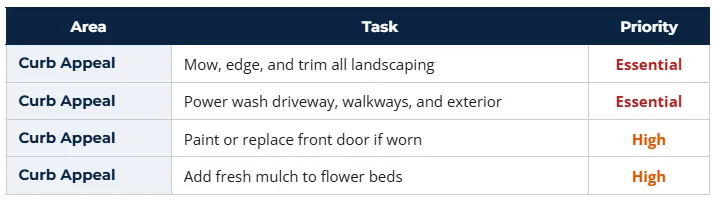
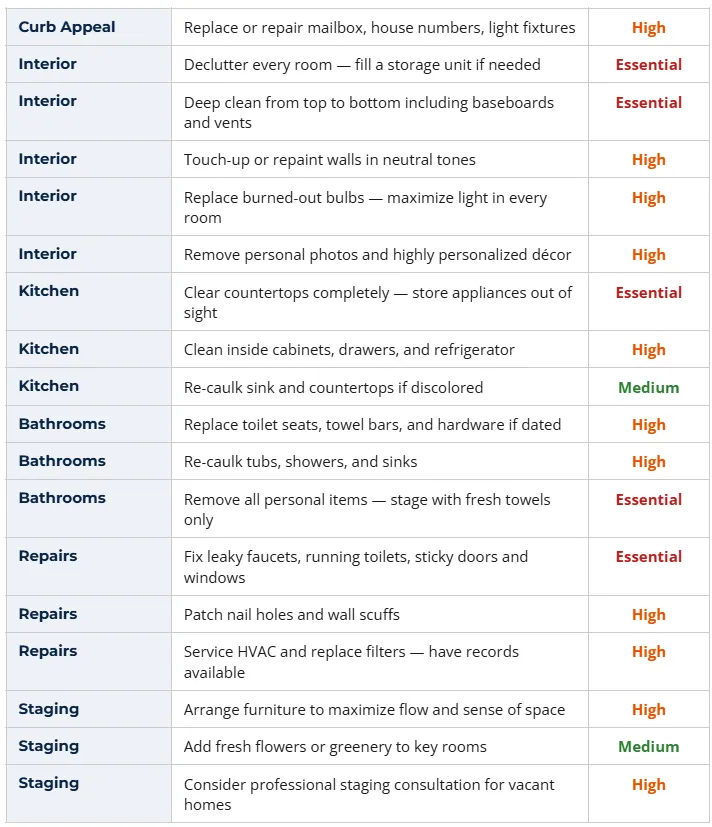
Use this as your working checklist as you prepare for market. Priorities are marked Essential, High, and Medium — start with Essential items and work your way through before your listing goes live.
The Bottom Line
Preparation is not about perfection. It's about giving buyers every reason to say yes and removing every reason to say no.
The sellers who prepare well don't just sell faster — they sell for more. They walk into negotiations from a position of strength because their home is the one buyers want. They don't have to defend deferred maintenance or accept repair credits that eat into their net proceeds.
A little time and effort before you list can be worth thousands of dollars at the closing table. And in most cases, it's not about major renovations — it's about clean, decluttered, well-presented, and priced right. That combination wins almost every time.
Not Sure Where to Start? Let's Walk Through It Together.
I'll walk through your home with you and build a customized preparation plan — no pressure, no obligation.
Book a free consultation at coastalva.chat
About the Author: Marc Ian Griffin, aka Captain Real Estate, is a licensed REALTOR and Wealth Advisor with Coastal VA Estates LLC, powered by Keller Williams Town Center. A retired U.S. Navy veteran, Marc has called the Hampton Roads area home since 1992. He entered real estate in 2006 because he saw what was happening to everyday families who were losing thousands and, in many cases, losing their homes simply because they didn't have the right person guiding them through the potential real estate pitfalls — and he was determined to be that person. After a period away from the industry, he returned in 2025 with that same mission. Marc serves buyers and sellers across Virginia Beach, Norfolk, Chesapeake, Portsmouth, Suffolk, Hampton, and Newport News.

Expertise
Deep market knowledge.

Integrity
Honesty and transparency.

Excellence
Top-notch services.
Expertise
Deep market knowledge.
Integrity
Honesty and transparency.
Excellence
Top-notch services.
Coastal VA Estates LLC
Powered by Keller Williams Town Center
1 Columbus Center #301 Virginia Beach, VA 23462
Email: [email protected]
Phone: 757-774-7557
QUICK LINKS
FOLLOW US


© 2026 Coastal VA Estates LLC. All rights reserved. Marc Ian Griffin is a licensed REALTOR® in the Commonwealth of Virginia, powered by Keller Williams Town Center. Equal Housing Opportunity.