

House Hacking
Live for free while building long-term equity. Learn how to use your primary residence to generate rental income
and eliminate your housing expenses.
How to Live in a Property While Building Wealth
What if I told you there's a way to buy your first investment property, live in it, and have your tenants cover most — sometimes all — of your mortgage? No trick, no gimmick. It's a real strategy, it's been around forever, and it might be the single best way for a regular person to get started in real estate.
It's called house hacking. And it's the reason I told you back in Blog 1 that you don't need to already own a home to start investing. With house hacking, your first investment property IS your home.
This is the blog I've been most looking forward to, because this strategy has changed the game for so many young buyers and military members here in Hampton Roads. If you're early in your journey and short on capital, pay close attention — this one's for you.
So What Is House Hacking, Exactly?
House hacking just means buying a property, living in part of it, and renting out the rest. The rent you collect offsets your housing costs — and if you buy right, it can wipe them out completely. Instead of housing being your biggest monthly expense, it becomes something close to free. Or even something that pays YOU.
Think about what that does. The average person hands over a huge chunk of their paycheck every month just to keep a roof overhead, and they never see a dime of it again. The house hacker takes that same roof and turns it into an asset that builds equity, earns appreciation, and covers its own costs. Same roof. Completely different outcome.
And here's the part that makes it perfect for a beginner: you're learning to be a landlord with training wheels on. You're right there on the property. You figure out tenant screening, leases, maintenance, and the rhythm of managing rentals — all while living in the place and having the rent subsidize your life. By the time you're ready for property number two, you've already got real reps under your belt.
The Different Ways to House Hack
House hacking isn't just one thing. There are a few different flavors, and the right one depends on your comfort level, your goals, and what you're willing to live with. Literally.
1. The Multi-Unit House Hack
This is the classic. You buy a duplex, triplex, or fourplex, live in one unit, and rent out the others. It's my favorite version for most people because you get real separation — your own unit, your own door — while your neighbors' rent knocks down your mortgage. This is the one the VA and FHA loans were practically made for, and we'll run the numbers on exactly this in a minute.
2. The Rent-by-Room House Hack
Here you buy a regular single-family home and rent out the spare bedrooms — to roommates, traveling nurses, students, whoever fits. It takes the least money to get into since single-family homes are everywhere, but you're sharing your kitchen and living space, so it asks more of you personally. Popular with younger buyers who don't mind roommates and want to knock their housing cost down to near nothing.
3. The Basement, ADU, or In-Law Suite Hack
Got a property with a finished basement that has its own entrance? An in-law suite? A garage apartment or backyard ADU? You live in the main house and rent out the separate space. You get more privacy than renting by the room, and there's steady demand around here for that kind of setup — especially near the bases.
4. The Short-Term Rental Hack
Same idea as the others, but instead of a long-term tenant, you rent a room or unit out short-term to travelers. It can bring in more per month, but it's more work — more like running a small hospitality business — and you've got to check local rules, because short-term rental regulations vary city to city across Hampton Roads. Do your homework on this one before you count on the income.
Why This Is the Best On-Ramp in All of Real Estate
I don't say that lightly. Here's why house hacking beats just about every other way of getting started:
You get in with very little money. Because you're living in the property, you qualify for owner-occupant financing — which means far lower down payments than an investor loan. We're talking as little as nothing down with a VA loan.
Your housing cost drops through the floor. Every dollar of rent you collect is a dollar you're not paying to live there. That freed-up money becomes your reserve, your next down payment, your breathing room.
You build equity and get appreciation on the whole property. Not just your unit — the entire building is appreciating and paying down, and it's all yours.
You learn the business from the inside. Being a landlord looks scary from the outside. Doing it while you live on-site, one unit at a time, is the gentlest way to learn there is.
It sets up your next move. After a year, you can move out, rent your old unit too, and go do it all over again. That's how portfolios get built — more on that in Blog 7.
The Financing Edge — Especially for Our Military
This is where house hacking really separates itself, and it's why military members and veterans have such an advantage here in Hampton Roads.
The VA loan lets an eligible service member or veteran buy a property with up to four units — zero down — as long as they live in one of them. Sit with that for a second.
You can buy a fourplex, live in one unit, rent the other three, and put nothing down to do it. There's no other financing on earth that lets a regular person control that much income-producing real estate with that little out of pocket. If you've earned that benefit, this is one of the best possible ways to use it.
Not military? You've still got strong options. FHA lets owner-occupants buy up to a fourplex with as little as 3.5% down. And conventional loans have owner-occupant multi-unit programs too, with down payments well below what a pure investor would have to bring. The common thread is simple: because you're going to live there, the lender treats you far better than they'd treat an investor buying the same building.
Coming Up in Blog 5
We're going to break down VA loans, FHA, DSCR loans, conventional financing, and more in Blog 5 — the whole financing toolbox. For now, just know this: living in the property is what unlocks the best loan terms you'll ever get on an investment. That's the whole magic trick behind house hacking.
Let's Run the Numbers on a Duplex Hack
Enough talk — let's see it. We'll take a Norfolk duplex and run it as a VA loan house hack, zero down. (Round teaching numbers, and rates move, so confirm current numbers with your lender.)
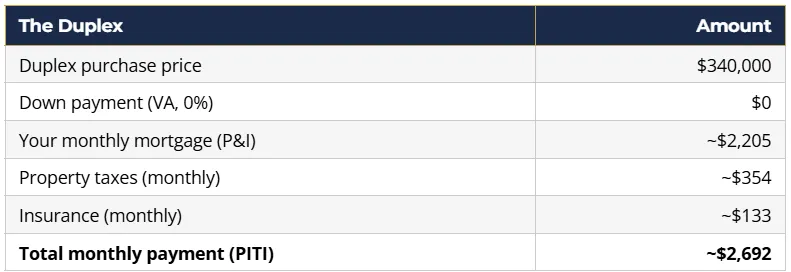
Now here's the magic. You live in one side. You rent the other side out for $1,600 a month. Watch what that does to your cost of living:
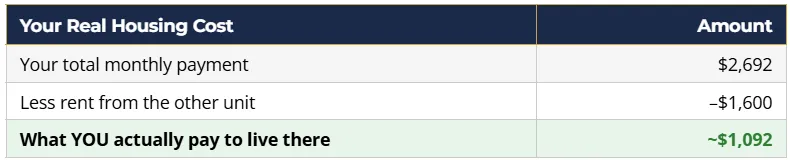
Let that sink in. You're living in a $340,000 property you own, for about $1,092 a month. A comparable two-bedroom rental nearby might run you $1,700 or more — money you'd never see again. So you're not only living for roughly $600 a month less than you'd pay to rent, you're building equity, you're getting appreciation on the whole $340,000, and your tenant is paying down your loan every single month.
And then the long game kicks in.
After a year of living there, you're allowed to move out. Now you rent BOTH sides — $1,600 plus $1,600 is $3,200 coming in against that same $2,692 payment. The property that used to cost you $1,092 a month now puts money in your pocket every month and runs as a full rental. And you? You go find the next one and do it all over again.
Let's Run the Numbers on a Duplex Hack
Now, that example ran on a VA loan, which is the veteran's advantage. But I don't want my non-military folks thinking they're locked out — you're not, not even close. The FHA loan gets you into the very same duplex; the only real differences are that you put 3.5% down instead of zero, and FHA adds a monthly mortgage insurance premium (that's MIP), which nudges your payment up a bit. Let's run that same $340,000 duplex on FHA so you can see it side by side.
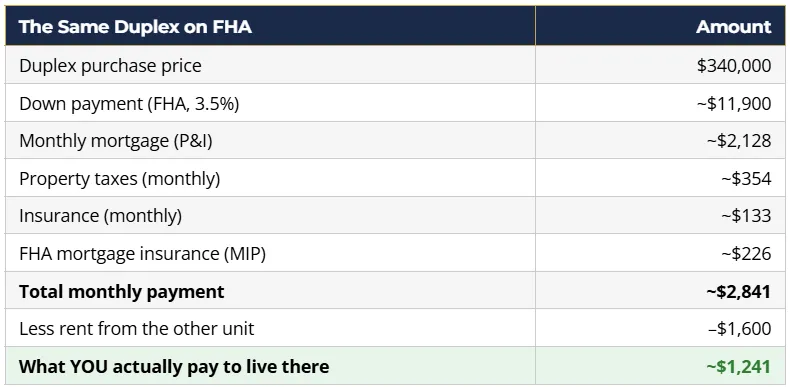
So the FHA buyer needs about $11,900 to get in the door, and pays roughly $1,241 a month to live there instead of the VA buyer's $1,092. That's about $150 more a month and some cash up front — but look at the big picture: you're still living in a $340,000 property you own for a fraction of what renting would cost, still building equity, still getting appreciation on the whole building, still setting up that same move-out-and-rent-both-sides play down the road. The VA loan is the Cadillac, no question. But the FHA loan is a very, very good car, and it'll get you to the exact same destination.
Worth Knowing
One more thing on FHA: because of that mortgage insurance, a lot of folks refinance out of the FHA loan down the road once they've built enough equity, which can drop the MIP and lower the payment. Something to keep in your back pocket. We'll touch on financing moves like this in Blog 5.
Now the Honest Part — the Downsides
I'm not going to sell you a fairy tale. House hacking is powerful, but it asks something of you, and you deserve to hear the real deal before you jump in.
You live where you invest.
Your tenants are your neighbors. When something breaks at 10 p.m., you're right there. You'll see these folks in the driveway, at the mailbox, taking out the trash. For some people that's no big deal. For others it wears on them. Know yourself before you buy.
You've got to hold the line as the landlord.
Here's a tricky one that catches people off guard. When you live right next to your tenants, there's a real pull to be too friendly, too flexible — and honestly, sometimes it's smoother to not broadcast that you're the owner at all. A lot of house hackers keep some professional distance on purpose, handling things in a businesslike way rather than as the buddy next door. It sounds a little strange, but there's wisdom in it. The second a tenant sees you as the soft neighbor instead of the landlord, late rent and bent rules tend to follow. You can be kind and still be firm. You have to be.
You give up some privacy.
This is the trade you're making. You're accepting a little less privacy and a little more responsibility in exchange for drastically cheaper living and a foothold in real estate. For most people early in the journey, that's a trade absolutely worth making. But go in with your eyes open — same as we talked about in Blog 3, you always go in with your eyes open.
You have to actually live there.
Owner-occupant loans like the VA and FHA require you to move in, usually within 60 days, and live there for a set period — typically at least a year. This isn't a suggestion; it's part of the loan agreement. Don't try to game it. Live there, do it right, and then you're free to move on.
Is House Hacking Right for You?
House hacking shines brightest for a few kinds of people. If you're young and early in your career, it's a way to build wealth years ahead of your peers. If you're military or a veteran, that VA loan makes this almost a no-brainer to at least consider. If you're short on capital but long on drive, it gets you in the game when nothing else will. And if you just want your housing to stop being a money pit and start being an asset, this is your answer.
It asks more of you than a hands-off rental across town. But for the right person, at the right stage, there's simply no faster or cheaper way to plant your flag in real estate. I've seen it launch people who thought they'd be renting forever.
If house hacking sounds like it might fit where you are right now, let's talk it through. I can help you figure out whether it makes sense for your situation, and if it does, what to look for.
Let's Talk
If you have questions about real estate investing in Hampton Roads, book a free consultation at coastalva.chat — there's no obligation, just answers.
Book Your Free Consultation → coastalva.chat
About the Author: Marc Ian Griffin, aka Captain Real Estate, is a licensed REALTOR and Wealth Advisor with Coastal VA Estates LLC, powered by Keller Williams Town Center. A retired U.S. Navy veteran, Marc has called the Hampton Roads area home since 1992. He entered real estate in 2006 because he saw what was happening to everyday families who were losing thousands and, in many cases, losing their homes simply because they didn't have the right person guiding them through the potential real estate pitfalls — and he was determined to be that person. After a period away from the industry, he returned in 2025 with that same mission. Marc serves buyers and sellers across Virginia Beach, Norfolk, Chesapeake, Portsmouth, Suffolk, Hampton, and Newport News.

Expertise
Deep market knowledge.

Integrity
Honesty and transparency.

Excellence
Top-notch services.
Expertise
Deep market knowledge.
Integrity
Honesty and transparency.
Excellence
Top-notch services.
Coastal VA Estates LLC
Powered by Keller Williams Town Center
1 Columbus Center #301 Virginia Beach, VA 23462
Email: [email protected]
Phone: 757-774-7557
QUICK LINKS
FOLLOW US


© 2026 Coastal VA Estates LLC. All rights reserved. Marc Ian Griffin is a licensed REALTOR® in the Commonwealth of Virginia, powered by Keller Williams Town Center. Equal Housing Opportunity.