

The Biggest Pricing Mistakes
Home Sellers Make
The fine line between aiming high and sitting on the market. Here's how to nail it.
Priced to Sit vs. Priced to Sell
The Costly Truth About Overpricing Your Home
Most sellers who overprice their home don't think they're overpricing it. They think they're protecting their investment. They think they're leaving room to negotiate. They think they know what their home is worth — and they're not wrong for thinking that. They just don't have the full picture.
Here's what the full picture looks like: pricing a home too high doesn't just slow the sale. It actively works against you in ways that compound over time — reducing your buyer pool, signaling weakness to the market, and ultimately costing you more money than a correct price would have from the beginning.
This blog is about what actually happens when a home is priced to sit — and what a price-to-sell strategy looks like instead.
The First 72 Hours Are Everything
When your home hits the market, there is a window — roughly the first three to seven days — where buyer attention is at its absolute peak. Active buyers who have been searching for weeks or months are notified the moment a new listing appears that matches their criteria. Their agents are watching. The momentum in that launch window is irreplaceable.
A correctly priced home uses that window to generate showings, create competition, and position for multiple offers. An overpriced home wastes it.
Why the Launch Window Matters So Much
Buyers set up automated search alerts based on price range. If your home is priced above what comparable homes in your area are selling for, it either doesn't appear in the right searches at all — or it appears alongside homes that are objectively better for the same money. Either way, the right buyers never see it.
Once that window closes, recovering buyer momentum is an uphill battle. You can reduce the price, but you cannot un-ring the bell of days on market.
What Happens When a Seller Won't Budge
I want to share a story from early in my career that I've never forgotten — because it illustrates exactly how this plays out in real life.
📖 From the Field
I had a listing with a seller who was absolutely convinced she knew what her home was worth. She had a number, and nothing — not the comps, not the market data, not my analysis — was going to move her off it. I presented the Comparative Market Analysis. I showed her what comparable homes in the area had actually sold for. I explained what buyers in that price range were expecting. She listened, and then she held her ground.
The home went on the market at her number. The first week, showings were sparse. Buyers' agents were passing on it in favor of competing listings that were priced in line with the market. The second week, even fewer showings. By week three, the inquiries we were getting had shifted in tone — buyers were sniffing around a home that had been sitting, and they wanted to know how desperate the seller was.
That's the thing about days on market that most sellers don't realize until they're in it: buyers notice. A home that has been sitting for thirty, sixty, ninety days starts to carry a stigma. Buyers start asking what's wrong with it. They assume there's a reason it hasn't sold. And then they do what sharks do when they smell blood in the water — they start making lowball offers.
She eventually sold. But it wasn't with me, it wasn't at her price, and it wasn't without months of frustration that could have been avoided. The painful irony is that a correct price on day one — even a number that felt lower to her — would have likely generated competition and potentially pushed her final sale price higher than what she ultimately accepted after all that time on market.
I've seen this pattern repeat itself more times than I can count. The market doesn't negotiate with your feelings. But a smart pricing strategy will always work in your favor.
The Hidden Costs of Sitting on the Market
Most sellers focus on the list price as the number that matters. But the number that really matters is what you net at closing — and days on market erodes that number in ways sellers don't always see coming.
Carrying costs keep accumulating. Every month your home doesn't sell, you're still paying the mortgage, utilities, insurance, and maintenance. In Hampton Roads, that can easily run $2,000–$4,000 or more per month depending on your home.
Price reductions are public. Every time you drop your price on the MLS, every active buyer and buyer's agent in the market sees it. It signals that you're motivated — and not in the way you want.
You lose negotiating leverage. A seller with a home that has been on the market for 90 days is in a fundamentally weaker position than a seller who just listed. Buyers know it, and they negotiate accordingly.
You may miss your window. If you're selling to buy another home, a prolonged listing can cause you to miss the property you wanted on the other end — or force you into a purchase under pressure.
Emotional fatigue is real. Living in a home that's perpetually show-ready, waiting for offers that aren't coming, and watching the market move around you takes a toll that doesn't show up on a spreadsheet.
The Price Reduction Trap
Many sellers think they can start high and drop the price if it doesn't sell. The problem: by the time you drop to the right price, the buyers who would have been most interested have already moved on to other homes. You're now starting over — but with a listing that has accumulated days on market and a price history that buyers can see. You've effectively paid a premium for the privilege of eventually reaching a price you could have started at.
The Timeline: Overpriced vs. Correctly Priced
Here is what the typical trajectory looks like for an overpriced home compared to one that's priced in line with the market from day one:
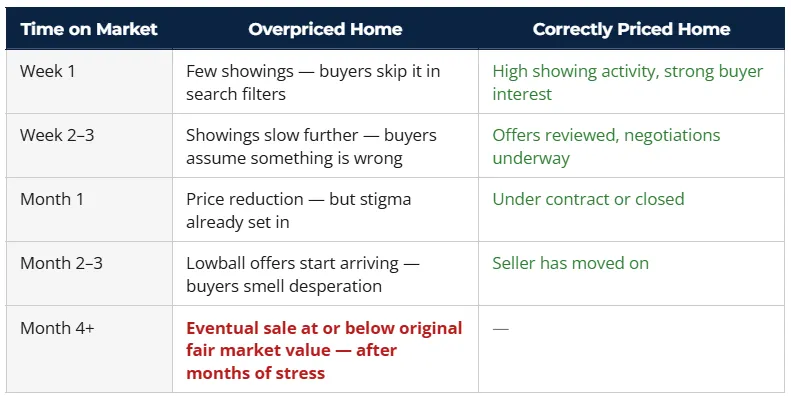
The correctly priced home doesn't just sell faster — it often sells for more. When buyers compete, they bid up. When a home sits, they negotiate down. That spread can represent thousands of dollars in your pocket.
Common Reasons Sellers Overprice — And the Reality Behind Each
"I need to leave room to negotiate."
If buyers aren't making offers, there's nothing to negotiate. Overpricing eliminates the negotiating pool before the conversation even starts. A correctly priced home with multiple interested buyers gives you far more negotiating power than an overpriced home with none.
"My neighbor sold for that amount last year."
Last year is not this year. The market shifts constantly — interest rates, inventory levels, buyer demand, and seasonal patterns all affect what buyers will pay right now. What your neighbor got twelve months ago may be irrelevant to your current situation.
"I've put so much into this home."
Buyers don't pay for what you've invested — they pay for what your home is worth to them in today's market. Some improvements add value; some don't return dollar for dollar. A professional CMA accounts for what buyers in your market are actually responding to.
"The right buyer will come along."
This is perhaps the most costly belief of all. The right buyer is in the market right now — but if your price doesn't match what the market supports, they'll never see your home. You're not waiting for the right buyer. You're waiting for a buyer who doesn't exist at your price.
What a Price-to-Sell Strategy Actually Looks Like
Pricing to sell is not the same as pricing low. It means pricing strategically — at a point that reflects genuine market value, attracts the right buyers, and creates the conditions for competition.
Here's what that process looks like in practice:
Start with a thorough CMA. Not a Zestimate, not a guess — actual sold data from your neighborhood in the last 60–90 days, adjusted for your home's specific condition and features.
Understand the competition. What are buyers comparing your home to right now? Your price needs to position you favorably against active listings, not just justify your number in isolation.
Factor in your timeline. If you need to move in 60 days, your pricing strategy looks different than if you have six months of flexibility. Urgency is a variable, not a weakness — but it needs to be priced in.
Price at or just below market value. Homes priced slightly below their highest supportable value consistently generate more showings, more offers, and stronger final sale prices than homes priced at the ceiling.
Commit to the strategy. A price reduction in week three is not a strategy. Trust the data, launch with confidence, and let the market respond before making adjustments.
The Goal Is Not the Lowest Price — It's the Best Outcome
Pricing to sell doesn't mean giving your home away. It means using price as a tool to generate demand — and demand is what produces the best possible outcome at the closing table. The sellers who net the most money are almost always the ones who priced correctly from day one and let buyer competition do the work.
The Bottom Line
The sellers who sit are not always the ones with the worst homes. They're often the ones with great homes that were handed to the market at the wrong price — and by the time the price was right, the momentum was gone.
You have one launch. One window where buyer attention is at its peak and the market is paying close attention. How you price your home on day one determines whether that window works for you or against you.
Price it to sit, and you'll eventually sell — but you'll pay for every day it takes to get there. Price it to sell, and the market will reward you for it.
Let's Price Your Home to Sell — Not to Sit.
Get a data-driven pricing strategy built on real Hampton Roads sold data. Book a free consultation at coastalva.chat
About the Author: Marc Ian Griffin, aka Captain Real Estate, is a licensed REALTOR and Wealth Advisor with Coastal VA Estates LLC, powered by Keller Williams Town Center. A retired U.S. Navy veteran, Marc has called the Hampton Roads area home since 1992. He entered real estate in 2006 because he saw what was happening to everyday families who were losing thousands and, in many cases, losing their homes simply because they didn't have the right person guiding them through the potential real estate pitfalls — and he was determined to be that person. After a period away from the industry, he returned in 2025 with that same mission. Marc serves buyers and sellers across Virginia Beach, Norfolk, Chesapeake, Portsmouth, Suffolk, Hampton, and Newport News.

Expertise
Deep market knowledge.

Integrity
Honesty and transparency.

Excellence
Top-notch services.
Expertise
Deep market knowledge.
Integrity
Honesty and transparency.
Excellence
Top-notch services.
Coastal VA Estates LLC
Powered by Keller Williams Town Center
1 Columbus Center #301 Virginia Beach, VA 23462
Email: [email protected]
Phone: 757-774-7557
QUICK LINKS
FOLLOW US


© 2026 Coastal VA Estates LLC. All rights reserved. Marc Ian Griffin is a licensed REALTOR® in the Commonwealth of Virginia, powered by Keller Williams Town Center. Equal Housing Opportunity.