

How to Analyze an
Investment Property
A step-by-step breakdown to project true cash flow, uncover hidden costs, and forecast your ROI.
The Numbers Every Investor Should Know Before Buying
Alright — this is the big one. If you only read one blog in this whole series, make it this one. Because analyzing a property the right way is the single most important skill you'll ever build as an investor. It's the thing that keeps you from making a mistake that follows you around for years.
And here's what most trainings on this subject get wrong. They'll hand you a stack of formulas — cap rate, cash-on-cash, all of it — and act like the math is the whole job. It's not. Analyzing a property is really two jobs. One is running the numbers. The other is making sure you're not buying a crappy property in the first place. And I've watched people nail the first one and completely blow the second.
Let me tell you about one of them.
The Guy Who Fell in Love With the Wrong House
Years back — this was early in my career — I had a client who was dead set on a property. And I mean in love with it. You know the type. He'd already decorated the place in his head. He was ready to write the check that afternoon.
Problem was, the house had bones that were rotting out from under it. When I finally got our home inspector in there, it wasn't pretty. One property he was chasing had somewhere around ten thousand dollars in termite damage. Another one had cracks running through it, and when the inspector really dug in, the foundation was cracked — the kind of cracked that doesn't stay put. It was going to keep moving, keep costing, keep causing problems down the road.
Now here's the thing. On a spreadsheet, before anybody looked closely, those deals might've penciled out just fine. The rent worked. The price looked right. If all he'd done was run the numbers, he'd have bought a money pit and felt smart doing it.
That's the lesson I want you to carry through this entire blog. The math matters — we're about to go deep on it. But the math assumes the house is actually the house you think it is. A great cap rate on a property with a failing foundation isn't a great deal. It's a trap with good-looking numbers.
The Whole Point of This Blog
Run the numbers AND kick the tires. Both. Every time. The investors who lose money are almost always the ones who did one and skipped the other. Usually they ran the numbers, fell in love, and talked themselves out of a real inspection.
Two Quick Filters Before You Do Any Real Math
When you're looking at a lot of properties, you need a fast way to weed out the obvious no's before you spend an hour building a full analysis. Here are two back-of-the-napkin screens investors use to do exactly that.
The 1% Rule
Dead simple: the monthly rent should be at least 1% of the purchase price. A $200,000 property should rent for around $2,000 a month to clear this bar. It's not a law of physics — plenty of good deals come in a little under, especially in an appreciation market like ours. But if a property rents for way under 1%, that's your signal to look hard before you go further.
The Gross Rent Multiplier (GRM)
This one tells you how many years of gross rent it'd take to equal the purchase price. You get it by dividing the price by the annual gross rent. Lower is generally better. It's a quick way to compare two properties side by side before you dig into the details.
GRM = Purchase Price ÷ Annual Gross Rent
Example: $185,000 ÷ $24,000 = a GRM of about 7.7
These two filters won't tell you whether a deal is good. They'll just tell you whether it's worth the time to find out. Once a property clears them, that's when you roll up your sleeves and do the real work.
The Numbers That Actually Matter
Now we get into the real analysis. There are three numbers that tell you whether a rental property is worth buying: net operating income, cap rate, and cash-on-cash return. Let me walk you through each one, and then we'll run a real deal from top to bottom so you can see exactly how it all fits together.
Net Operating Income (NOI)
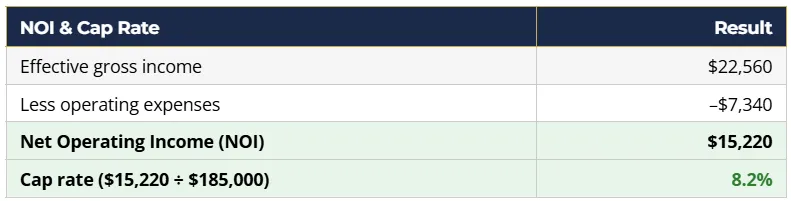
This is your income after operating expenses — but before your mortgage. You take your yearly rent, subtract vacancy, then subtract all the operating costs like taxes, insurance, maintenance, and management. What's left is your NOI. Notice the mortgage isn't in there. That's on purpose — NOI measures how the property itself performs, separate from how you financed it.
Cap Rate
Cap rate is your NOI divided by the purchase price, written as a percentage. It tells you the return the property would throw off if you paid all cash. It's the great equalizer — it lets you compare a Norfolk duplex to a Suffolk single-family on even footing, because it strips financing out of the picture.
Cash-on-Cash Return
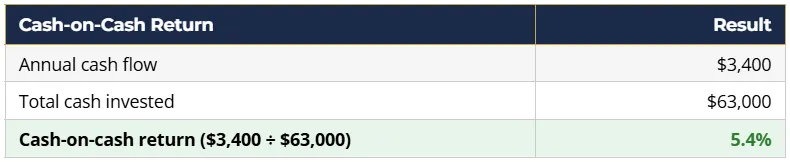
This is the one that hits home for most investors, because it answers the question you actually care about: what am I earning on the money I put in? You take your annual cash flow — that's after the mortgage — and divide it by the total cash you sank into the deal (down payment, closing costs, and any rehab). That percentage is your cash-on-cash return.
Let's Run a Real Deal, Start to Finish
Enough theory. Let's take a property and run it all the way through. We'll use a Norfolk single-family — the kind of place that needs a little work, priced below the fixed-up houses on the same street. Exactly the kind of property a lot of folks overlook and a smart investor grabs.
Here's what we're working with. (These are round numbers for teaching — your real deal will have its own, and interest rates move, so always confirm current rates with your lender).

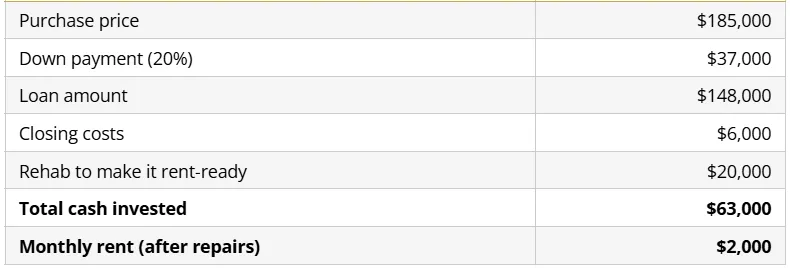
First, the quick filters. Rent of $2,000 on a $185,000 purchase is about 1.08% — it clears the 1% rule, and that's largely because we bought below retail. The GRM is $185,000 ÷ $24,000, or roughly 7.7. Both look healthy. Now let's build the real analysis.
Step 1 — Start With the Income
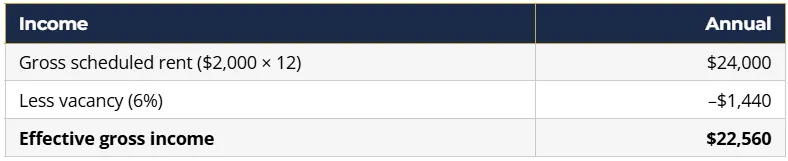
Step 2 — Subtract the Operating Expenses
These are the costs of running the property — everything except the mortgage. We'll assume you're self-managing this one; if you hire a property manager, add roughly 10% of rent (about $2,250/year) and your numbers come down accordingly.
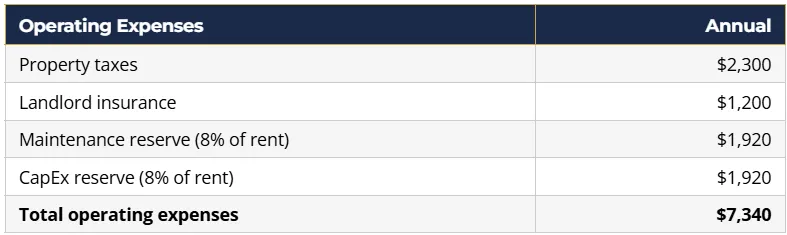
Step 3 — Calculate NOI and Cap Rate
Step 4 — Bring In the Mortgage and Find Your Cash Flow
Now we account for the loan. On $148,000 at 7% over 30 years, principal and interest runs about $985 a month, or roughly $11,820 a year. Subtract that from your NOI and you've got your cash flow.
Step 5 — The Number You Really Came For: Cash-on-Cash
So what did we just learn about this deal?
An 8.2% cap rate, about $283 a month in cash flow, and a 5.4% cash-on-cash return — self-managed. That's a solid, believable Hampton Roads deal. Not a lottery ticket, but a real one. And remember, cash flow is only one of the four ways this property builds wealth. Add in appreciation, your tenant paying down that $148,000 loan year after year, and the tax benefits, and the real return is a good bit higher than that 5.4% suggests.
And notice what made this deal work: we bought below retail on a property that needed some love. That's the whole game. Pay full retail price for a fixed-up house on the same street and this deal likely goes flat or negative. Which brings us right back around to the property itself.
A Fast Sanity Check: The 50% Rule
Here's a shortcut worth knowing. The 50% rule says that over time, your operating expenses — everything except the mortgage — will eat up about half your gross rent. On a place renting for $24,000 a year, you'd ballpark $12,000 in expenses before you ever make a mortgage payment.
Now, in our example we came in under that because we self-managed. Add a property manager and we'd land right around that 50% line. That's the point of the rule — it's a gut check. If somebody's trying to sell you on a deal claiming expenses will only run 20% of rent, the 50% rule tells you to slow down and dig into their math. Real properties have real costs, and they always show up eventually.
The Cost Nobody Warns You About: Carrying Costs
Here's a big one that a shocking number of new investors miss completely — and it can quietly eat a deal alive. It's called carrying costs. Some folks call them holding costs, or talk about the holding capital you need in the bank. Same idea: it's the money you keep shelling out on a property during the stretch when it isn't paying you anything back.
Think about our example property for a second. We're putting $20,000 of work into it to get it rent-ready. That rehab doesn't happen overnight — say it takes three months. Well, guess what? During those three months, the mortgage is still due. The taxes are still adding up. The insurance still has to be paid. And since there's no tenant yet, you're covering the utilities too. That whole time, money is flowing out and nothing is flowing in.
Let's actually put a number on it, because this is the part people skip:


So if that rehab runs three months before you get a paying tenant in the door, that's roughly $4,300 out of your pocket — on top of the down payment, the closing costs, and the rehab budget. Notice that number wasn't anywhere in our earlier analysis. That's on purpose. I wanted you to see how easy it is to run a beautiful cap rate and cash-on-cash return and still forget the money bleeding out while the place sits empty.
This is why you keep holding capital in reserve.
An 8.2% cap rate, about $283 a month in cash flow, and a 5.4% cash-on-cash return — self-managed. That's a solid, believable Hampton Roads deal. Not a lottery ticket, but a real one. And remember, cash flow is only one of the four ways this property builds wealth. Add in appreciation, your tenant paying down that $148,000 loan year after year, and the tax benefits, and the real return is a good bit higher than that 5.4% suggests.
Carrying costs matter on every deal, but they really matter on two kinds. On a flip, the entire game is carrying costs — every extra week you own that property before it sells is money gone, and we'll dig into that in Blog 6. And on a buy-and-hold, the fastest way to turn a decent property into a bad one is to let it sit empty. I've got a story about exactly that coming in Blog 9 — a good man who sat on a property for about a year without ever putting a tenant in it. The carrying costs are a big part of why that one still stings.
The Other Half of Analysis: The Property Itself
Now let's come back to my buddy who fell in love with the money pit — because this is where a lot of investors get hurt, and no spreadsheet will protect you here.
Once a deal clears on paper, your job shifts from the numbers to the bones of the house. This is where you find out whether the property you analyzed actually exists, or whether you've been running math on a fantasy. Here's what you're watching for.
Foundation. Cracks, settling, doors that won't close, floors that slope. A cracked foundation doesn't stay put — it keeps moving and keeps costing. This is the one that ended the deal for my client, and it's the one that ends the most deals, period
Termites and wood-destroying insects. That client was staring at $10,000 in termite damage on one property. In our climate, this is not rare. Always get the wood-destroying-insect report.
The big-ticket systems. Roof, HVAC, water heater, electrical panel, plumbing. Any one of these can wipe out a year of cash flow. Know how old they are and how much life they've got left before you close.
Water. Grading, drainage, moisture in the crawlspace, signs of past flooding. Water is patient, and in Hampton Roads it's everywhere. It'll find the weak spot eventually.
Get a real home inspector. Get the termite report. And if anything looks off structurally, spend the money on a specialist before you close — not after. The few hundred dollars an inspection costs is the cheapest insurance you will ever buy in this business. My client didn't want to hear it at the time. He's awful glad now that somebody made him look.
The Bottom Line
Analyzing an investment property comes down to two questions, and you have to answer both. Do the numbers work? And is the property actually sound? Skip either one and you're gambling, not investing.
Learn to run NOI, cap rate, and cash-on-cash until it's second nature — you'll be able to size up a deal in minutes. But never let a pretty spreadsheet talk you out of a hard look at the house. The best investors I know are part accountant and part inspector. They love the math and they trust their eyes.
And you don't have to do this part alone. Running these numbers with you and steering you clear of the money pits is exactly the kind of thing I'm here for.
If you have questions about real estate investing in Hampton Roads, book a free consultation at coastalva.chat — there's no obligation, just answers.
Let's Talk
If you have questions about real estate investing in Hampton Roads, book a free consultation at coastalva.chat — there's no obligation, just answers.
Book Your Free Consultation → coastalva.chat
About the Author: Marc Ian Griffin, aka Captain Real Estate, is a licensed REALTOR and Wealth Advisor with Coastal VA Estates LLC, powered by Keller Williams Town Center. A retired U.S. Navy veteran, Marc has called the Hampton Roads area home since 1992. He entered real estate in 2006 because he saw what was happening to everyday families who were losing thousands and, in many cases, losing their homes simply because they didn't have the right person guiding them through the potential real estate pitfalls — and he was determined to be that person. After a period away from the industry, he returned in 2025 with that same mission. Marc serves buyers and sellers across Virginia Beach, Norfolk, Chesapeake, Portsmouth, Suffolk, Hampton, and Newport News.

Expertise
Deep market knowledge.

Integrity
Honesty and transparency.

Excellence
Top-notch services.
Expertise
Deep market knowledge.
Integrity
Honesty and transparency.
Excellence
Top-notch services.
Coastal VA Estates LLC
Powered by Keller Williams Town Center
1 Columbus Center #301 Virginia Beach, VA 23462
Email: [email protected]
Phone: 757-774-7557
QUICK LINKS
FOLLOW US


© 2026 Coastal VA Estates LLC. All rights reserved. Marc Ian Griffin is a licensed REALTOR® in the Commonwealth of Virginia, powered by Keller Williams Town Center. Equal Housing Opportunity.