

What Is My Home
Really Worth?
Crack the valuation code and discover exactly what buyers are willing to pay right now.
Zestimate vs. Reality
What Online Tools Get Wrong About Your Hampton Roads Home
It happens more often than you might think. A homeowner decides it's time to sell, pulls up Zillow, sees a number, and walks into their first conversation with a real estate professional convinced they already know what their home is worth.
Here's the truth: that number on your screen is a starting point for curiosity — not a pricing strategy. And confusing the two can cost you tens of thousands of dollars, weeks of market time, and more stress than you bargained for.
In this blog, we're going to break down exactly how online home value estimators work, why they fall short in a market like Hampton Roads, and what actually determines the price a buyer will pay for your home.
How Online Estimators Actually Work
Tools like Zillow's Zestimate, Redfin's Estimate, and similar platforms use automated valuation models — AVMs — to generate a number for your home. These models pull from publicly available data: tax records, historical sales, square footage, lot size, and basic property characteristics.
On the surface, that sounds reasonable. But here's where it starts to break down.
AVMs cannot see inside your home. They don't know about your renovated kitchen, your new HVAC system, your updated bathrooms, or your finished basement.
AVMs use county tax records, which are often years out of date and may not reflect permitted improvements you've made.
AVMs rely on regional averages and national algorithms — they are not built to account for hyper-local market conditions.
AVMs lag behind the market. In a fast-moving market, a Zestimate can be weeks or months behind actual current conditions.
AVMs cannot account for condition, curb appeal, staging, or the emotional impression your home makes on a buyer walking through the door.
Important Disclaimer from Zillow Itself
Zillow openly acknowledges that its Zestimate has a median error rate — meaning roughly half of all Zestimates are off by more than that margin. In markets with limited public data, that error rate climbs significantly. Hampton Roads, with its military relocation cycles, waterfront premiums, and city-by-city variation, is exactly the kind of market where AVMs struggle most.
Why Hampton Roads Is Especially Hard for Algorithms
Hampton Roads is not a uniform market. It is seven distinct cities — Virginia Beach, Norfolk, Chesapeake, Portsmouth, Suffolk, Hampton, and Newport News — each with its own price dynamics, buyer pools, school zones, military proximity factors, and neighborhood-level variation.
A three-bedroom home in Great Neck does not price like a three-bedroom home in Deep Creek. A waterfront property in Norfolk carries premiums that no algorithm can accurately assign without local knowledge. A home near a military installation may sell faster and at different price points depending on BAH rates and PCS cycles — factors that are invisible to a national AVM.
The Hampton Roads Variable an Algorithm
Can Never Capture
Traffic patterns around the tunnels affect where buyers are willing to live — and how much they'll pay to avoid a daily commute through the Hampton Roads Bridge-Tunnel or the Downtown/Midtown Tunnels. That's a hyper-local factor that meaningfully affects value in ways no algorithm accounts for.
This is why working with a local agent who lives and works in this market every day is not just a nice-to-have
it's a competitive advantage that directly affects your bottom line.
What Actually Determines Your Home's Market Value
Market value is not what you paid for the home. It's not what you've invested in improvements. It's not what your neighbor thinks it's worth, and it's not what you need to net in order to buy your next home.
Market value is what a ready, willing, and able buyer will pay for your home — in today's market, in its current condition, against current competition.
The factors that actually drive that number:
What similar homes in your area have actually sold for in the last 90 days
What other homes are currently on the market competing for the same buyers
Move-in ready homes command premiums; deferred maintenance drives price reductions
School zones, proximity to bases, water views, commute access
Interest rates, inventory levels, and seasonal activity all shift what buyers will pay
The longer a home sits, the more negotiating power shifts to the buyer
📖 From the Field
Early in my career, I had a listing with a seller who had done her homework — or so she thought. She had a number in her head, and no amount of market data was going to move her off it. The comps told a different story, but she was convinced her home was worth more.
The home sat. Weeks turned into months. Buyers who toured it started making lowball offers — not because the home wasn't worth something, but because a home sitting on the market that long sends a signal. Buyers start wondering what's wrong with it. They smell an opportunity.
She eventually sold — but not with me, and not at the price she wanted. She would have netted more by pricing correctly from day one, even at a number that felt lower to her in the beginning.
That experience shaped how I talk about pricing with every seller I work with. The market doesn't negotiate with your feelings. But a smart pricing strategy will work in your favor every time.
Online Estimate vs. Comparative Market Analysis: Side by Side
Here is a direct comparison of what you get from an online tool versus a Comparative Market Analysis (CMA) prepared by a local real estate professional:
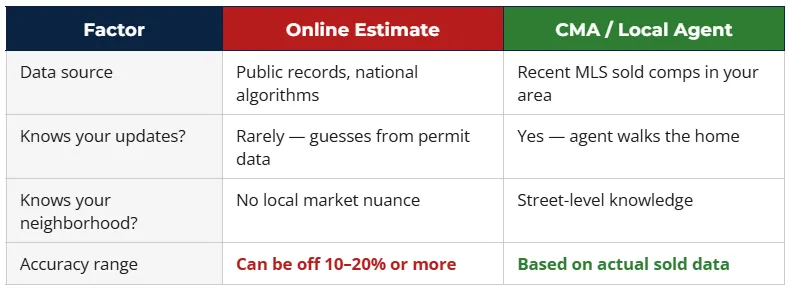

A CMA is not just a number — it's a strategic document. It shows you what buyers in your price range are actually purchasing, what competing homes look like, and where your home fits in the current market landscape. It is the foundation of every pricing decision we make together.
What a CMA Includes — and How to Read One
When I prepare a CMA for a seller, here's what goes into it:
Sold comparables — Homes similar to yours that have closed within the last 90 days, within a defined radius, with similar square footage, bedroom/bathroom count, and features.
Active listings — What your home will be competing against the moment it hits the market.
Expired and withdrawn listings — Homes that failed to sell, and why. This is some of the most valuable data in the analysis.
Price per square foot analysis — Adjusted for condition, updates, and location premiums or discounts.Interest rates, inventory levels, and seasonal activity all shift what buyers will pay
Days on market trends — How long homes are sitting in your price range and neighborhood.
Absorption rate — How quickly available inventory is being absorbed by buyers, which tells us whether we're in a buyer's or seller's market right now.
The Number That Matters Most
Of all the data points in a CMA, the one that matters most is the sold price of comparable homes — not the list price. Sellers list at what they hope to get. Buyers pay what the market will bear. The gap between those two numbers tells you everything about current market conditions in your neighborhood.
How to Use Online Tools the Right Way
This isn't about dismissing online estimators entirely. They have a place in the conversation — just not the place most sellers give them.
Here's how to use them productively:
Use them as a starting point for curiosity, not a final answer.
Track your Zestimate over time to understand directional trends in your neighborhood.
Compare your estimate across multiple platforms — Zillow, Redfin, Realtor.com — and note the variance. A wide spread signals limited data and low confidence.
Use them to open the conversation with your agent, not to close it. Bring the number in and ask your agent to show you where it lands against actual sold data.
The Danger Zone
The sellers who get hurt are the ones who treat the Zestimate as authoritative — who list above market because a website told them they could, then watch their home sit while better-priced competition gets the showings, the offers, and the closings.
We will cover this in full detail in Blog 3: The Biggest Pricing Mistakes Home Sellers Make.
The Bottom Line
Your home is worth what the market will pay for it — not what an algorithm estimates, not what you need to net, and not what your neighbor sold for three years ago.
The best thing you can do before you list is get a professional, data-driven Comparative Market Analysis from a local agent who knows your specific market — not a national algorithm that has never set foot in Hampton Roads.
That's the foundation. Everything else — pricing strategy, preparation, marketing, negotiation — gets built on top of it.
Want to Know What Your Home Is Actually Worth?
Skip the Zestimate. Get a real Comparative Market Analysis based on actual Hampton Roads sold data.
Book a free consultation at coastalva.chat
About the Author: Marc Ian Griffin, aka Captain Real Estate, is a licensed REALTOR and Wealth Advisor with Coastal VA Estates LLC, powered by Keller Williams Town Center. A retired U.S. Navy veteran, Marc has called the Hampton Roads area home since 1992. He entered real estate in 2006 because he saw what was happening to everyday families who were losing thousands and, in many cases, losing their homes simply because they didn't have the right person guiding them through the potential real estate pitfalls — and he was determined to be that person. After a period away from the industry, he returned in 2025 with that same mission. Marc serves buyers and sellers across Virginia Beach, Norfolk, Chesapeake, Portsmouth, Suffolk, Hampton, and Newport News.

Expertise
Deep market knowledge.

Integrity
Honesty and transparency.

Excellence
Top-notch services.
Expertise
Deep market knowledge.
Integrity
Honesty and transparency.
Excellence
Top-notch services.
Coastal VA Estates LLC
Powered by Keller Williams Town Center
1 Columbus Center #301 Virginia Beach, VA 23462
Email: [email protected]
Phone: 757-774-7557
QUICK LINKS
FOLLOW US


© 2026 Coastal VA Estates LLC. All rights reserved. Marc Ian Griffin is a licensed REALTOR® in the Commonwealth of Virginia, powered by Keller Williams Town Center. Equal Housing Opportunity.