

Rental Properties
101
Master the basics of long-term wealth. Your quick- start guide to analyzing rental yields,
mitigating risk, and scaling your portfolio.
Understanding Cash Flow, Expenses, and Long-Term Wealth Building
If there's one thing that separates investors who build real wealth from the ones who end up frustrated and broke, it's this: cash flow is not the same as income. Get that one idea wrong and everything downstream gets wrong with it.
A lot of first-timers see a rent check come in and think, that's what I'm making. Nope. What you're actually making is what's left after every bill tied to that property gets paid. That leftover is your cash flow. Learning to see it, protect it, and grow it — that's what rental investing really comes down to.
In this one we're going to break down the basics — what cash flow really means, what expenses eat into it, how the long-term wealth piece works, and a couple of strategies worth having in your back pocket. Some of this we'll go way deeper on later, but you've got to have the foundation before you go looking at your first deal.
So What Is Cash Flow, Really?
Monthly Rent
minus
All Your Monthly Expenses
equals
Cash Flow
Positive cash flow means money in your pocket every month.
Negative cash flow means you're paying to own the place.
Now, neither one of those automatically makes or kills a deal. Some investors will take neutral or even slightly negative cash flow on a property they're convinced is going to appreciate big. That can be a smart play. But you go in with your eyes open and you know your number before you sign anything. Never guess.
The Whole Picture: What Expenses Really Look Like
This is exactly where a lot of new investors trip. They take the mortgage payment, subtract it from the rent, and call whatever's left their cash flow. That's not cash flow — that's wishful thinking with a calculator. Here's what a rental actually costs you every month:
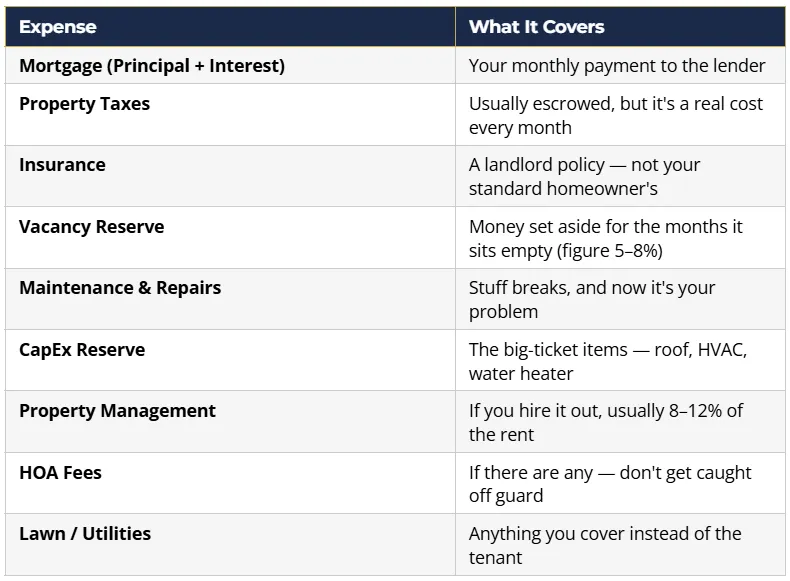
We'll get into exactly how to run all these numbers and analyze a deal properly in Blog 3 — cap rate, cash-on-cash, the whole toolkit. For right now, just burn this into your brain: your mortgage payment is one slice of the pie, not the whole thing.
Worth Knowing
A house that rents for $1,800 with a $1,200 mortgage does NOT throw off $600 a month. Once you factor in taxes, insurance, vacancy, repairs, and reserves, you might be looking at $150 to $300 — maybe less. Run every number before you fall in love with a property.
What This Looks Like in the Real World
Let me tell you about a client of mine — an investor I worked with for a good while. I'm pretty sure we first crossed paths at a TRIG meeting. TRIG's the Tidewater Real Estate Investors Group, where the serious local folks get together, trade leads, and talk shop. By the time he and I connected, he wasn't some beginner. He was already sitting on close to 40 properties.
His whole approach was simple, and he ran it like a machine. He went after the beat-up properties in Suffolk, Carrollton, and Smithfield — the ones priced down around fifteen, twenty grand that made most people turn right back around and walk out. And there was a reason they were that cheap. At that price point, the problem was almost always structural. Floor joists going. The floor literally sinking in on you.
For most buyers, even seasoned ones, that's a hard no. They don't have the crew, they don't have the equipment, and frankly they don't have the stomach for it. For this guy? Old hat. He'd walk a property and half the time his contractor was already there with us, quoting the lift and the joist work before we'd even finished looking around. Everybody else saw a money pit. He saw a problem he'd already figured out how to solve.
He'd buy it, bring his crew in, lift the house, fix what needed fixing, and have a tenant in there inside a month or two. Managed everything himself — no property manager. And he just kept doing it. Deal after deal. While he and I were working together, that portfolio pushed right past 40.
Here's what I want you to take from that. It wasn't luck and it wasn't some secret list of properties nobody else could find. It was that he bought what everybody else was scared of, he had a team that could actually do the work, he knew his costs cold, and he never stopped moving. That right there is the buy-and-hold model run about as well as it gets.
We'll come back to him in Blog 7, when we talk about going from one property to a whole portfolio — because what he built is exactly what that looks like.
We'll get into exactly how to run all these numbers and analyze a deal properly in Blog 3 — cap rate, cash-on-cash, the whole toolkit. For right now, just burn this into your brain: your mortgage payment is one slice of the pie, not the whole thing.
Why the Monthly Check Is Only Half the Story
Cash flow matters — a lot. But it's not the only way a rental makes you money. This is why some investors are fine with thinner monthly margins, especially in a strong appreciation market like ours.
Remember the four ways real estate builds wealth from Blog 1? Cash flow, appreciation, your tenant paying down the mortgage, and the tax breaks — all of it happening at the same time. Stretch that out over ten, fifteen, twenty years and even a property with modest monthly cash flow can build you serious wealth when all four of those are pulling together.
Here's a simple example:
Say you buy a rental for $250,000. Over 20 years, your tenant basically pays your mortgage down for you while the place appreciates. If it's worth $400,000 by the end and you only owe $80,000, you're sitting on $320,000 in equity — a big chunk of it funded by somebody else's rent checks. That's the long game right there.
This is why rental investing rewards patience. The investor who holds is the one who wins.
That said — playing the long game doesn't give you a pass on doing the math up front. A bad deal held for 20 years is still a bad deal. You buy right, you run it well, and you hold on. In that order.
A Strategy Worth Knowing About
One of the smartest moves I'm seeing first-timers make around here — especially military folks — is what's called the owner-occupant multi-unit approach. Here's how it works.
You buy a duplex, triplex, or fourplex. You live in one unit. You rent out the rest. Your tenants' rent knocks down your mortgage — sometimes covers the whole thing — so you're building equity and bringing in rental income while you're literally living in the property.
And if you're military or a veteran, this is where the VA loan really shines. The VA will let an eligible buyer pick up a property with up to four units, zero down, as long as you live in one of them as your primary home. Think about that — you can get into investing with almost nothing out of pocket, using a benefit you already earned.
Not military? You've still got options. FHA lets owner-occupants buy up to a fourplex with as little as 3.5% down, and there are conventional owner-occupant programs that work the same way.
Worth Knowing
One thing to keep in mind:
When you're living right next door to your tenants, you've got to set some boundaries on purpose. You're their neighbor AND their landlord, and those two things don't always mix as smooth as you'd hope. The folks who pull this off keep it professional — written leases, maintenance handled the right way, and they don't get too loose about collecting rent just because they see the person every day. It's very doable with a little discipline, and trust me, the payoff is worth it.
We'll get into house hacking in a big way in Blog 4 — how to set it up, what to look for in a property, how to handle the live-in landlord thing. And Blog 5 is where we break down VA loans, DSCR loans, and the rest of your financing options. Consider this your preview.
Single-Family or Multi-Family for Your First One?
One of the questions I get most from new investors is whether to start with a single-family house or jump into a multi-family. There's no one right answer — but here's how I'd think it through.
Single-Family or Multi-Family for Your First One?
Generally easier to finance with a conventional loan
Bigger pool of renters — and of buyers, if you ever want to sell
Simpler to manage: one tenant, one relationship
Around here, steady demand from military families wanting a longer-term place
Lower total cash flow, but a lot less to juggle
Multi-Family (Duplex, Triplex, Fourplex)
More than one income stream — if one unit's empty, the others still pay
More to manage, but it's one roof, one foundation, one tax bill
Owner-occupant financing up to four units (VA, FHA, conventional)
Higher cash flow potential — and that live-in strategy can crush your housing costs
Harder to find the right one — there's just less of it out there
For a lot of first-timers in Hampton Roads, a single-family rental is the natural starting spot. It's familiar, it's easy to finance, and the demand's always there. But if that owner-occupant multi-unit play fits your life, man, it can be a heck of a first move. Your goals and your wallet are going to make that call.
What Actually Makes a Good Rental?
Not every house that can be rented should be rented. Here's what I'm looking at when I'm sizing up whether a property's worth it:
Location. How close is it to bases, jobs, schools, the roads people actually use? That matters for finding tenants AND keeping them. A place people keep moving out of will bleed your cash flow dry.
Condition. A rough property isn't automatically a bad deal — but whatever it costs to get it rentable has to be in your numbers before you buy. Surprises after closing are the expensive kind.
Rent-to-price. Rough rule of thumb: monthly rent around 1% of the purchase price points to solid cash flow. You won't always hit it here, but it's a handy gut check.
Rental demand. How fast do similar places rent in that neighborhood? A bunch of empty rentals sitting around is a red flag.
Management reality. If you're not managing it yourself, can the deal still cash flow after you pay a manager? We'll get into all of that in Blog 8.
In Blog 3 I'll walk you through running the actual numbers on a specific property — cap rate, gross rent multiplier, cash-on-cash, the expense ratios that tell you straight up whether a deal works. That's where the real decision-making lives.
The Bottom Line
Rental investing isn't complicated, but it does take discipline. Know your expenses before you buy, not after. Remember that cash flow is what's left, not what comes in. And think in years and decades, not months.
The people who build real wealth with rentals aren't chasing the flashiest properties or the biggest swings. They're the ones running clean numbers, buying where the rental demand is strong, and holding on long enough to let the math do its thing.
And Hampton Roads is about as good a place to do that as you'll find.
If you have questions about real estate investing in Hampton Roads, book a free consultation at coastalva.chat — there's no obligation, just answers.
Let's Talk
If you have questions about real estate investing in Hampton Roads, book a free consultation at coastalva.chat — there's no obligation, just answers.
Book Your Free Consultation → coastalva.chat
About the Author: Marc Ian Griffin, aka Captain Real Estate, is a licensed REALTOR and Wealth Advisor with Coastal VA Estates LLC, powered by Keller Williams Town Center. A retired U.S. Navy veteran, Marc has called the Hampton Roads area home since 1992. He entered real estate in 2006 because he saw what was happening to everyday families who were losing thousands and, in many cases, losing their homes simply because they didn't have the right person guiding them through the potential real estate pitfalls — and he was determined to be that person. After a period away from the industry, he returned in 2025 with that same mission. Marc serves buyers and sellers across Virginia Beach, Norfolk, Chesapeake, Portsmouth, Suffolk, Hampton, and Newport News.

Expertise
Deep market knowledge.

Integrity
Honesty and transparency.

Excellence
Top-notch services.
Expertise
Deep market knowledge.
Integrity
Honesty and transparency.
Excellence
Top-notch services.
Coastal VA Estates LLC
Powered by Keller Williams Town Center
1 Columbus Center #301 Virginia Beach, VA 23462
Email: [email protected]
Phone: 757-774-7557
QUICK LINKS
FOLLOW US


© 2026 Coastal VA Estates LLC. All rights reserved. Marc Ian Griffin is a licensed REALTOR® in the Commonwealth of Virginia, powered by Keller Williams Town Center. Equal Housing Opportunity.