

What Happens Between
Contract and Closing?
Navigate the paperwork, appraisals, and underwriting with total confidence.
Under Contract - Now What? The Critical Steps Before Closing Day
Your offer was accepted. That moment is genuinely exciting. You've found the home, negotiated the deal, and now you're under contract. For a lot of buyers - especially first-timers - that excitement is immediately followed by a very real question: okay, now what do we do?
The period between contract ratification and closing day is where a lot of things can go smoothly - and where a lot of things can go sideways if you're not prepared. Deadlines matter. Communication matters. Staying organized and responsive matters. This blog walks you through every major step so you know exactly what's coming and what your role is in each one.
The Timeline at a Glance
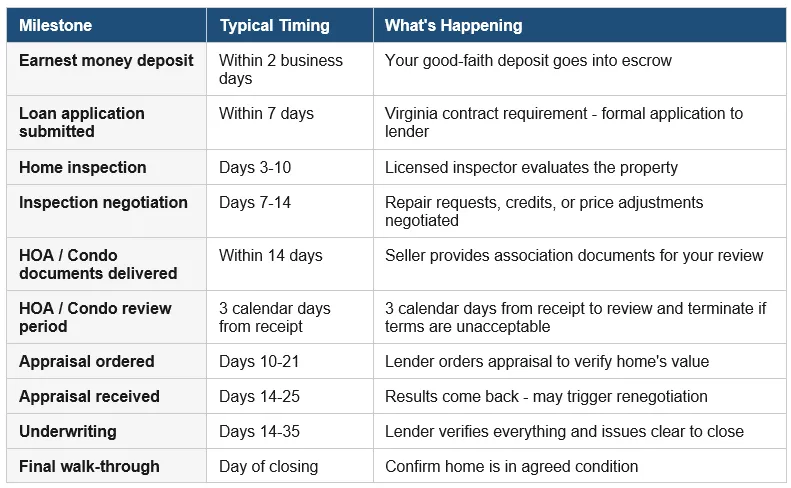

These timelines can vary based on your lender, the complexity of the transaction, and whether any issues arise along the way. Your agent will track every deadline and keep you on schedule.
STEP 1: Submit Your Earnest Money Deposit
Once the contract is ratified, the clock starts. In Virginia, you have 2 business days to deliver your earnest money deposit to the escrow agent. Don't wait. Get this done immediately. Missing this deadline can put the contract at risk.
How to deliver your EMD - three options:
● Digital payment app - most title companies now offer a secure digital payment platform. This has become the most common method, especially for tech-comfortable buyers. It is fast, trackable, and eliminates the risk of a physical check getting lost or delayed.
● Personal check - still accepted by most escrow agents, though some title companies prefer certified funds.
● Cashier’s or certified check - traditional and widely accepted. If you go this route, get it to your agent immediately so it can be delivered to the escrow office without delay.
✦ CAPTAIN’S LOG
The Earnest Money Check
I always treated a client’s earnest money check like it was the most important thing I was carrying that day - because it was. The moment a buyer handed me that check, my first stop was the office to get it into escrow. I never lost an EMD check in all my years doing this, but I also never gave chance the opportunity. Whether you use an app or a check, the goal is the same: get it delivered quickly, get confirmation it was received, and don’t let it sit.
STEP 2: Submit Your Loan Application
Virginia contracts require you to submit a formal mortgage application within 7 days of ratification. If you've already been pre-approved - which you should be - this is mostly paperwork, but it's a contractual requirement that must be met on time.
During underwriting, do not make any large purchases, open new credit accounts, change jobs, or move money around between accounts without talking to your lender first. Any of these can affect your loan approval, sometimes significantly.
STEP 3: Get the Home Inspection Done
Schedule your home inspection as soon as possible after going under contract - ideally within the first week. The inspection period is typically 10-14 days, and you want time to review the report, ask follow-up questions, and negotiate with the seller if needed before the deadline expires.
We covered the inspection in depth in Blog 6. The key points: attend in person, ask questions, and don't skip it regardless of how new or perfect the home looks. One more important point: the home inspector identifies and reports problems but is not licensed to certify or remediate them. That is why there is a second separate inspection you need to know about - covered in Step 3A below.
STEP 3A: Review HOA or Condo Association Documents (If Applicable)
If the property is in a Homeowners Association (HOA) or a condo association, Virginia law requires the seller to provide you with the association documents within 14 days of contract ratification. You then have 3 calendar days from receipt to review them and, if you find the terms unacceptable, terminate the contract and recover your deposit.
These documents cover the association rules, monthly fees, budget, reserves, and any pending special assessments - one-time charges for major community expenses like repaving roads or replacing a roof on a shared building. Read them carefully.
Also be aware that some properties carry dual fees. A condo inside a planned neighborhood may have both a condo association fee and a master HOA fee. A townhome in a community with shared amenities might have a sub-association fee on top of a master community fee. Make sure you understand every recurring cost attached to the property before you close. As your agent, I order HOA and condo documents immediately upon ratification so you receive them as early as possible - because that 3-day review clock starts the moment you have them in hand. We cover HOA and condo fees in more detail in Blog 4 and Blog 10 of this series.
STEP 3B: Schedule the Moisture and Termite Inspection
This is a completely separate inspection from the home inspection and is performed by a different company - a licensed pest control operator, not a home inspector. In Hampton Roads, given our warm, humid coastal climate, moisture intrusion and wood-destroying insects are real and ongoing concerns. Your home inspector may notice signs of moisture or termite damage, but they are not licensed to certify or remediate those issues. That is the job of the moisture and termite inspector.
In Virginia, this inspection is typically ordered by the buyer but paid for by the seller - that is the standard practice, though it can vary. Many lenders, including VA loans, require a signed moisture and termite clearance before they will fund the loan. The licensed inspector will evaluate the property, identify any active infestations or moisture issues, and if problems are found, can also provide the remediation. Their signed report is what the lender needs to see.
Do not assume your general home inspection covered this. It did not. Ask your agent to make sure the moisture and termite inspection is scheduled as a separate service early in the inspection period.
STEP 3C: The PICRA - How Repair Requests Work in Virginia
Once you receive your inspection report and decide you want to request repairs, the formal way to do that in Virginia is through a PICRA - a Post Inspection Correction Request and Agreement. This is the official document used to negotiate repairs between buyer and seller after the home inspection.
The PICRA outlines what repairs or credits you are requesting and gives the seller the opportunity to agree, counter, or decline. Once both parties sign, the PICRA becomes part of the contract. If the seller declines and no agreement can be reached, the buyer may choose to terminate the contract within the inspection contingency period and recover their earnest money deposit.
Knowing this document exists and what it does gives you confidence going into the inspection period. Your agent will prepare the PICRA on your behalf and guide you on what to request and how to frame it strategically.
STEP 4: Navigate the Appraisal
Your lender will order an appraisal to confirm the home is worth what you've agreed to pay. The appraiser is an independent third party - neither you nor the seller controls the outcome.
If the appraisal comes in at or above the purchase price:
Good news - you move forward. The lender is satisfied the collateral supports the loan.
If the appraisal comes in below the purchase price:
This is called an appraisal gap, and it creates a challenge. Your lender will not loan more than the appraised value. If you agreed to pay $350,000 and the home appraises at $300,000, you have a $50,000 gap to resolve. Your options:
• The seller reduces the price to the appraised value - common in slower markets or when the seller is motivated
• The buyer makes up the difference in cash - bringing additional funds to closing to cover the gap
• A combination - seller reduces somewhat, buyer covers the rest
• The deal falls apart - if neither side can bridge the gap, the buyer may terminate and recover their deposit
✦ CAPTAIN’S LOG
When the Appraisal Came In Low
I had buyers who really wanted a specific home. The asking price was $350,000 - using simple round numbers. The appraisal came back at $300,000. That's a significant gap. The buyers had the means to make up the difference and wanted the home badly enough to do it, so they brought additional cash to closing to get the deal done. In their situation the home was worth it to them and they had the ability to make it work. But that's not always the case - and there's no universal right answer. Every appraisal situation is different, and what makes sense depends on how badly you want the home, what you can afford, and what the seller is willing to do. Real estate is never cookie cutter.
STEP 5: Stay on Top of Underwriting
While the inspection and appraisal are happening, your lender's underwriting team is doing a deep dive into your finances. They will verify your income, employment, assets, and credit one more time. They may come back with conditions - additional documents or explanations they need before issuing a clear to close.
Respond to your lender's requests immediately. Every day of delay in underwriting is a day closer to your closing date without a clear to close in hand. Being unresponsive during this period is one of the most common reasons closings get delayed.
STEP 6: The Final Walk-Through
In Virginia, the final walk-through typically happens on closing day - and I always schedule mine a few hours before the closing appointment, not the night before. Here's why that matters.
The walk-through that stopped a closing:
We had a closing scheduled for that afternoon. That morning, we did the walk-through - and found that someone had stolen all the copper from the HVAC unit outside overnight. The unit was completely stripped. This was a serious problem. The home couldn't close in that condition.
The closing was delayed. And here's something important that a lot of buyers don't know: only the lender or the title company can formally extend a closing date. Not the buyer, not the seller, not the agent. If you hear someone say 'we can push the closing because we're going on vacation' or 'I just need a few more days' - that's not how it works. The extension has to go through the proper channels with the lender and title company involved.
In our case, the seller arranged for the HVAC unit to be replaced and had a security cage installed around the new unit so it couldn't happen again. The closing was rescheduled and completed. But none of that would have been caught if we'd done the walk-through the night before and assumed everything was still fine in the morning.
Do your final walk-through as close to closing as possible - ideally the same morning. You're confirming:
• The home is in the same condition as when you made your offer
• Any negotiated repairs have been completed
• All agreed-upon personal property is still in the home
• No new damage has occurred since your last visit
• All systems - HVAC, appliances, plumbing, electrical - are still functioning
If something is wrong at the walk-through, do not close until it's resolved. Your agent will help you determine whether to delay, negotiate a credit, or find another solution. Once you sign at the closing table, the home is yours - along with whatever condition it's in.
⚠ CAPTAIN’S WARNING
Wire Fraud Targets Home Buyers
WIRE FRAUD IS REAL AND IT TARGETS HOME BUYERS. Before wiring any money - your down payment, closing costs, or any other funds - call your title company or attorney directly using a phone number you found independently, not one from an email. Criminals intercept real estate email chains and send fraudulent wiring instructions. Once the money is wired to a fraudulent account, it is almost impossible to recover. Never wire money based solely on email instructions, no matter how legitimate they look.
Your title company will give you wiring instructions in advance. Verify them by phone before you send anything. Every time. No exceptions.
STEP 8: Closing Day
Closing is a signing appointment, typically lasting 45 minutes to an hour. You'll sign the loan documents, the transfer documents, and pay your closing costs. Bring:
• A government-issued photo ID
• Certified funds or confirmation of wire transfer for your closing costs and down payment
• Your checkbook for any small last-minute adjustments
• Any additional documents your lender or title company requested
After everything is signed and the lender funds the loan, the deed is recorded and the home is yours. Keys are typically handed over at closing or shortly after recording is confirmed.
A Note on Closing Extensions
Virginia contracts allow up to a 10-day extension of the settlement date when needed - to resolve an appraisal issue, complete a repair, or give a lender additional processing time. Extensions must be agreed to in writing by both parties and coordinated with the lender and title company.
What cannot extend a closing: a buyer deciding they need more time, a seller going on vacation, or anyone simply not being ready. The contract has a settlement date and if it passes without proper documentation, the party who caused the delay may be in breach. Take your closing date seriously from day one.
The Bottom Line
The period between contract and closing is not a waiting period - it is an active one. Deadlines need to be met, documents need to be submitted, inspections need to happen, and problems that come up need to be addressed quickly and strategically. Stay in close communication with your agent and your lender throughout. Respond promptly. Ask questions when you don't understand something.
The buyers who close smoothly are the ones who stay engaged from ratification to the closing table.
If you'd like help creating a personalized home buying plan for Hampton Roads, book a free consultation at coastalva.chat

Expertise
Deep market knowledge.

Integrity
Honesty and transparency.

Excellence
Top-notch services.
Expertise
Deep market knowledge.
Integrity
Honesty and transparency.
Excellence
Top-notch services.
Coastal VA Estates LLC
Powered by Keller Williams Town Center
1 Columbus Center #301 Virginia Beach, VA 23462
Email: [email protected]
Phone: 757-774-7557
QUICK LINKS
FOLLOW US


© 2026 Coastal VA Estates LLC. All rights reserved. Marc Ian Griffin is a licensed REALTOR® in the Commonwealth of Virginia, powered by Keller Williams Town Center. Equal Housing Opportunity.